AI Answering Service Myths vs. Reality: What Owners Actually Worry About
The three fears that stop small businesses from trying an AI answering service — customers will hate it, it will book nonsense, it's a nightmare to set up — held up against how the technology actually behaves in 2026.
 Vunoon16 min read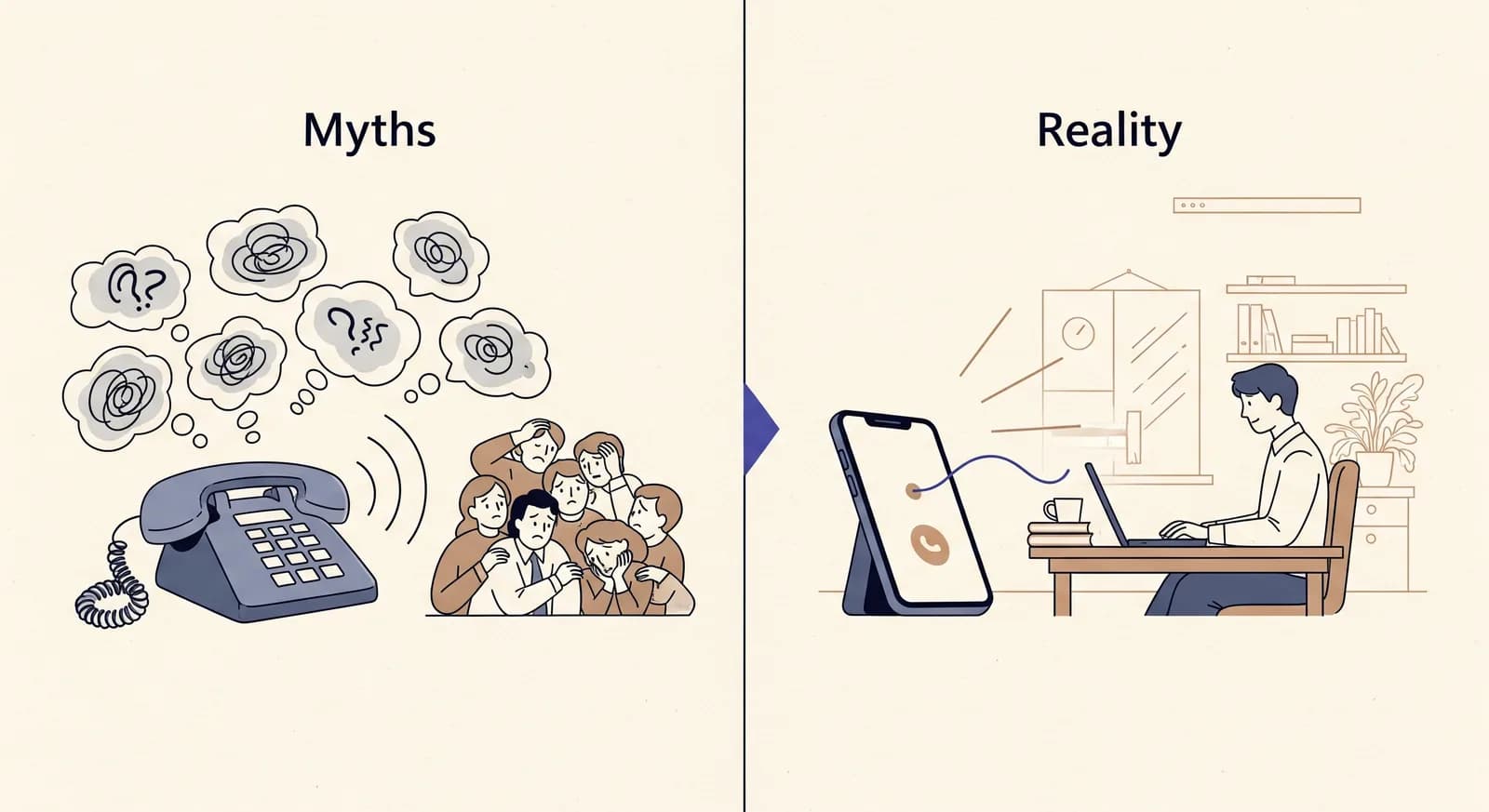
Most owners don't reject an AI answering service because they've tried one and hated it. They reject it because of a story they've built in their head — a robot voice mangling their business name, booking a haircut for 3 a.m., and taking a weekend to configure. Some of that story is fair. A surprising amount of it is three or four years out of date. Let's separate the real ai answering service concerns from the ones you can safely stop losing sleep over.
This isn't a sales pitch dressed as a myth-buster. Where the skepticism is justified, we'll say so plainly — there are things an AI phone assistant genuinely can't and shouldn't do. But the fears that keep the phone ringing out to voicemail deserve a closer look, because for a small business, every missed call has a name and a price attached.
Why these myths stick around
Two things happened. First, most people's mental model of "robot on the phone" was formed by decade-old automated menus — press one for sales, press two to be transferred to a queue and forgotten. That experience was awful, and it's understandable that nobody wants to inflict it on their own callers.
Second, the leap in what these systems can do happened fast and quietly. A tool that in 2021 could barely understand a clearly spoken sentence can now hold a natural back-and-forth, handle interruptions, and understand a caller with a heavy accent and a barking dog in the background. The gap between the myth and the reality widened faster than reputations could update. So let's take the three big fears one at a time.
Myth 1: "My customers will hate talking to a robot"
This is the fear that matters most, because you're not wrong to care about it. Your relationship with your callers is the business. So let's be precise about what people actually dislike — because it isn't "AI" in the abstract.
What people hate is being trapped. Rigid menus that don't have an option for their question. Repeating their phone number three times. Being told "I didn't understand that" over and over. Not being able to reach a human when they clearly need one. Notice that none of these are unique to AI — a bored receptionist reading from a script produces the same frustration.
Now hold that against the alternative most small businesses actually offer after hours or during a rush: the phone rings out. Or it hits a voicemail that says "leave a message" — a message roughly two-thirds of callers won't leave, because they've already opened a tab to call the next business on the list. The honest comparison isn't "AI versus a warm human who always answers." It's "AI versus the call you never took."
“The honest comparison isn't AI versus a warm human who always answers. It's AI versus the call you never took.”
Here's the part that genuinely surprises owners: when an AI assistant answers on the first ring, greets the caller by the business's actual name, understands the question, and either handles it or takes a proper message, most callers simply get what they came for and move on. They wanted an answer, not a friendship. A caller at 8 p.m. trying to find out whether you're open Saturday is delighted to get an instant, correct answer instead of a dial tone.
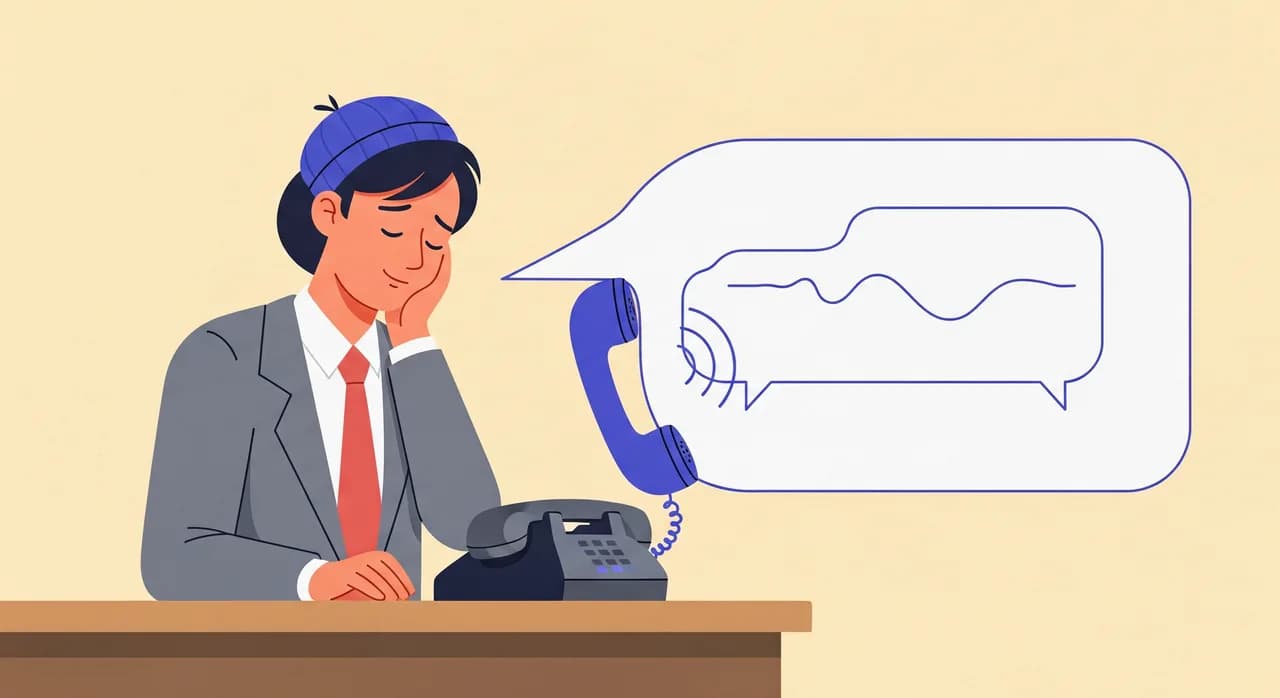
Three design choices decide whether callers have a good experience or a bad one, and they're worth demanding from any tool you consider.
- It's honest about what it is. A good assistant doesn't pretend to be a person named Sarah. If a caller asks "am I talking to a robot?", it should just say yes and keep helping. Deception is what breaks trust — not the technology.
- It hands off gracefully. When a caller wants a human, or asks something outside its knowledge, it should take a clear message or arrange a callback — not loop them in circles. An off-ramp that always works is the whole game.
- It sounds like your business, not a call center. The greeting, the name, the tone, the languages it speaks — all should match the business a caller expected to reach.
The genuine limitation to keep in mind: some of your callers will prefer a human, and a few will hang up the moment they realize they're not talking to one. That's real. But that segment is smaller than the fear suggests, and it shrinks every time the assistant actually solves someone's problem faster than a human could have.
Myth 2: "It'll book nonsense and I'll spend all day cleaning up"
This is the operational fear — the vision of an appointment for a nonexistent service, on a day you're closed, at a time that doesn't exist. If an assistant did that, it would be worse than useless, because now you're paying to create work. So it's a fair thing to interrogate. The good news is that this specific failure is largely a solved problem, and understanding why tells you what to look for.
A modern phone assistant doesn't freely invent answers. It works from a profile you configured: your services, your hours, your prices, your booking rules. It doesn't guess your Saturday hours — it reads them. It doesn't offer a treatment you don't provide, because it only knows the ones you listed. Think of it less as an improviser and more as a very fast, very literal employee who has your fact sheet memorized and never gets bored of following it.
Where fabrication becomes a risk is when a caller asks something the profile doesn't cover — "do you do this unusual thing?" A well-built assistant handles that the way a good junior receptionist should: it says it isn't sure and takes a message for you, rather than confidently making something up. That behavior is a design choice called a guardrail, and it's the single most important thing to test before you trust a tool with your calendar.
There's also a review layer that dissolves most of the anxiety here. A good assistant doesn't operate as a black box you discover the results of a week later. Every call produces a summary and a transcript sent straight to you. If someone books, you see exactly what was said and can confirm or adjust before it matters. The nightmare scenario — waking up to a calendar full of garbage you didn't see coming — depends on the assistant working invisibly. Insist on visibility and the nightmare has nowhere to live.
- 1It reads, it doesn't guessAnswers come from the profile you set up — hours, services, prices, rules. Facts you never entered aren't facts it can state.
- 2Unknowns become messagesWhen a question falls outside what it knows, it takes a message instead of improvising. The failure mode is 'I'll have someone get back to you,' not a fabricated answer.
- 3You see every callA summary and transcript land with you after each conversation, so a booking is never a surprise and mistakes surface immediately.
The honest caveat: no system is flawless, and an occasional message will be garbled or a caller's request will be logged imperfectly — the same way a human on a bad line mishears a name. The point isn't perfection. It's that the errors are visible, small, and recoverable, rather than hidden and compounding. That's a categorically different risk than the one the myth imagines.
Myth 3: "It's too complicated and technical to set up"
This one is quietly the most common reason owners never even start. They picture a project: an integration specialist, a week of configuration, a manual, maybe a call with "IT" — and since a small business often doesn't have an IT, the whole idea gets shelved next to the loyalty-card app they meant to build.
The reality is closer to setting up a new email account than deploying software. You sign up, and a short wizard asks you to describe your business in plain language — what you do, your hours, your main services, the questions people usually call about. You're not writing code or dragging boxes on a flowchart. You're answering the same questions you'd tell a new hire on their first morning.
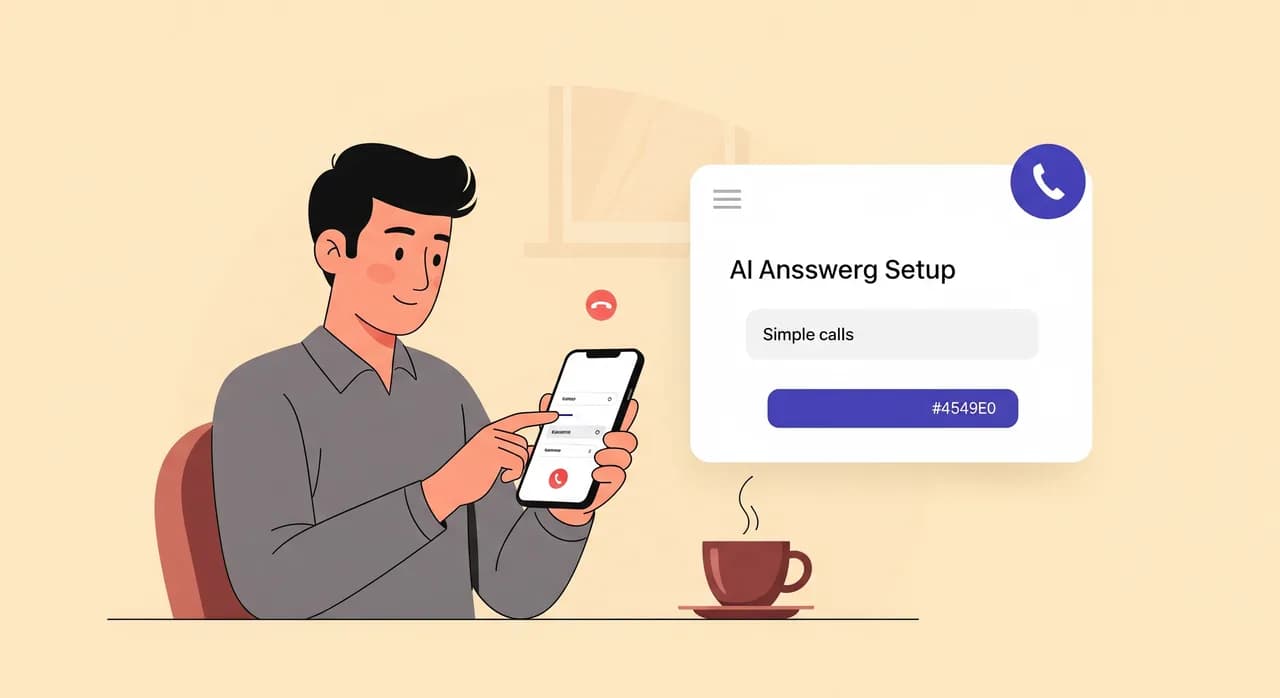
Then comes the step that turns skeptics: you call it yourself and talk to it. Before it ever touches a real customer, you have a conversation with your own assistant, try to trip it up, and hear exactly how it sounds. If the greeting's off or it doesn't know something it should, you edit the profile and try again. It's a rehearsal, not a leap of faith.
The only genuinely "telephony" step is forwarding your number so calls reach the assistant — usually a setting on your existing phone service, or a short instruction your provider can do in minutes. You keep your number. Callers dial exactly what they always have. Nothing about your phone changes except what happens on the calls you'd otherwise have missed.
- 1Describe your businessA short wizard, in plain language: what you do, your hours, your services, common questions. No technical knowledge required.
- 2Test it yourselfCall your own assistant, try to break it, and refine the profile until it sounds right — all before a single customer reaches it.
- 3Forward your numberPoint your existing line at the assistant. You keep your number; callers notice nothing except that someone finally picks up.
The multilingual angle is where setup complexity should be scary and quietly isn't. Configuring a phone line to handle 25+ languages used to be a genuine project. Now it's part of the same profile — a caller speaks German, the assistant answers in German; the next speaks English, it switches. For a business in a tourist town or a mixed neighborhood, that alone can justify the whole thing, and it costs no extra setup effort.
Where the skepticism is actually justified
A myth-buster that busts every myth isn't honest — it's marketing. So here's the other side of the ledger: the concerns you're right to hold, and where an AI answering service is the wrong tool or a partial one.
- Deep, emotional, or high-stakes conversations. A distressed patient, a grieving family, a complex complaint, a delicate negotiation — these need a human, and a good assistant should route them to one rather than attempt them. If most of your calls are emotionally loaded, an assistant is a filter and a message-taker, not a replacement.
- Anything requiring professional judgment. It should never give medical, legal, or financial advice. It can tell a caller your hours and take a booking; it should not opine on their symptoms or their case. If your calls are mostly advice-seeking, the assistant's job is triage — capture the details and get the right human to call back.
- Highly idiosyncratic businesses. If nearly every call is unique and unpredictable, there's less for a profile to anchor to. It'll still catch overflow and after-hours messages well, but it won't resolve as much on its own.
- Rock-bottom expectations from a specific clientele. A small slice of callers will refuse to deal with anything but a human, full stop. A clean handoff keeps them, but if that slice is most of your customers, weigh it honestly.
Notice the pattern: the justified concerns aren't about the technology failing. They're about fit. The question is never "is AI answering good or bad?" — it's "which of my calls is it right for?" For most small businesses, the answer is a large and boring chunk: the where-are-you, are-you-open, can-I-book, what-does-it-cost calls that eat a receptionist's day and, after hours, simply vanish. Handing those to an assistant frees the humans for the calls that actually need a human.
“The question is never 'is AI answering good or bad?' It's 'which of my calls is it right for?'”
The fourth, quieter myth: "I need to solve it perfectly or not at all"
There's a subtler belief hiding under the loud three, and it does more damage than any of them: the idea that unless an assistant handles every call flawlessly, it isn't worth having. That standard sounds responsible. It's actually a trap, because you don't apply it to anything else in your business.
Your voicemail handles zero percent of calls in real time — you tolerate it. A part-timer who's new gets some things wrong — you train them. A receptionist can't answer two lines at once — you accept it. Yet the AI assistant somehow has to be perfect on day one or it's a failure. Held to a fair standard — "does it capture more good calls than my current setup, at a downside I can live with?" — the bar is much lower and much easier to clear. The perfect-or-nothing myth keeps more phones ringing out than the robot-voice myth ever did.
The quiet cost of believing the myths
It's easy to treat "I'll deal with it later" as a free, neutral choice. It isn't. Every myth on this page has a running meter behind it, and the meter doesn't pause while you decide.
Do the arithmetic on your own business, not a made-up average. Suppose you miss ten calls a week — some after hours, some while you're mid-job with a customer, some during the lunch rush. Suppose one in three of those callers would have booked or bought if someone had picked up. That's roughly three lost sales a week. Whatever an average sale is worth to you, multiply. Now annualize it. The number tends to be uncomfortable, because missed calls are invisible — you never see the revenue that didn't arrive, so it never shows up as a problem to solve.

The myths are comfortable precisely because they justify inaction, and inaction feels safe. But the risk isn't symmetric. Trying an assistant on your overflow calls has a small, bounded downside — a few callers who'd have preferred a human, easily handed off. Not trying it has an open-ended downside that compounds silently, week after week, in the voicemails no one leaves and the callers who dialed the next business instead of yours.
| The fear | The reality | The genuine caveat |
|---|---|---|
| Customers will hate a robot | Callers want fast, correct answers and an easy path to a human — most get that and move on happily | A small segment prefers humans; a clean handoff keeps them |
| It'll book nonsense | It answers from the profile you built and takes a message when unsure; you see every transcript | Occasional mishears happen, but they're visible and recoverable |
| It's too complicated to set up | A plain-language wizard, a test call, and forwarding your number — closer to email than to software | The number-forwarding step depends on your phone provider |
How to decide for yourself in an afternoon
You don't have to resolve this argument in the abstract. The whole point of a free trial and a self-serve test call is that you can replace opinion with evidence in less time than a lunch break. Here's a practical way to do it.
- 1Set it up honestlyEnter your real business — real hours, real services, the questions people actually ask. Ten minutes of accurate input is worth more than an hour of tinkering with settings.
- 2Be your own worst callerCall in and behave like your most difficult customer. Mumble. Interrupt. Ask for something impossible. Demand a human. See how it handles the calls you're afraid of, not the easy ones.
- 3Read a transcript with fresh eyesWould you have been satisfied as the caller? Would you trust that message enough to act on it? That gut check tells you more than any feature list.
- 4Point one slice of calls at itStart with after-hours or overflow — the calls already lost. Let it run for a week and read the summaries. Judge it on results, not fears.
After a week of real calls, the myths tend to collapse on contact with evidence — or, occasionally, one of them turns out to be true for your specific business, and now you know that too. Either outcome beats a permanent maybe. The mistake isn't choosing wrong; it's letting a story you never tested keep your phone ringing out.
Will my customers know they're talking to an AI?
What happens if the AI can't answer a question?
Can it accidentally book appointments incorrectly?
How long does it really take to set up?
Is an AI answering service a replacement for my staff?
Stop arguing with the myth. Test the reality.
Set up your assistant in minutes, call it yourself, and try to break it before a single customer ever reaches it. See exactly how it handles your hardest calls.
See how the setup works
Vunoon builds an AI phone assistant that answers your business calls 24/7 — it books appointments, answers common questions and sends you a summary of every conversation.