AI Receptionist for Driving Schools: Enroll While You Teach
Your instructors are in the car all day, so the phone rings into an empty office. Here's how an AI receptionist for driving schools books lessons, answers parents, and catches the summer rush you're currently missing.
 Vunoon15 min read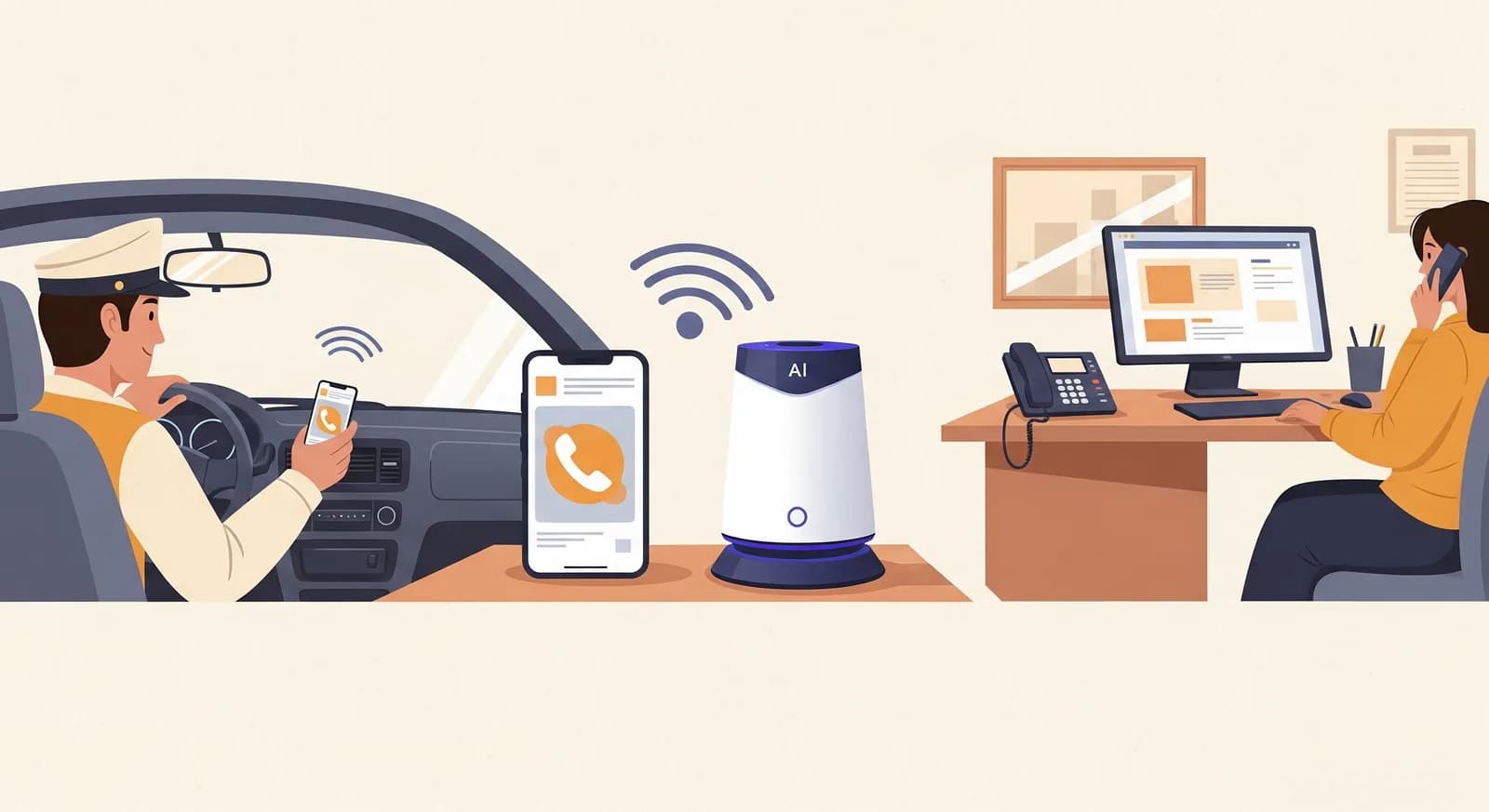
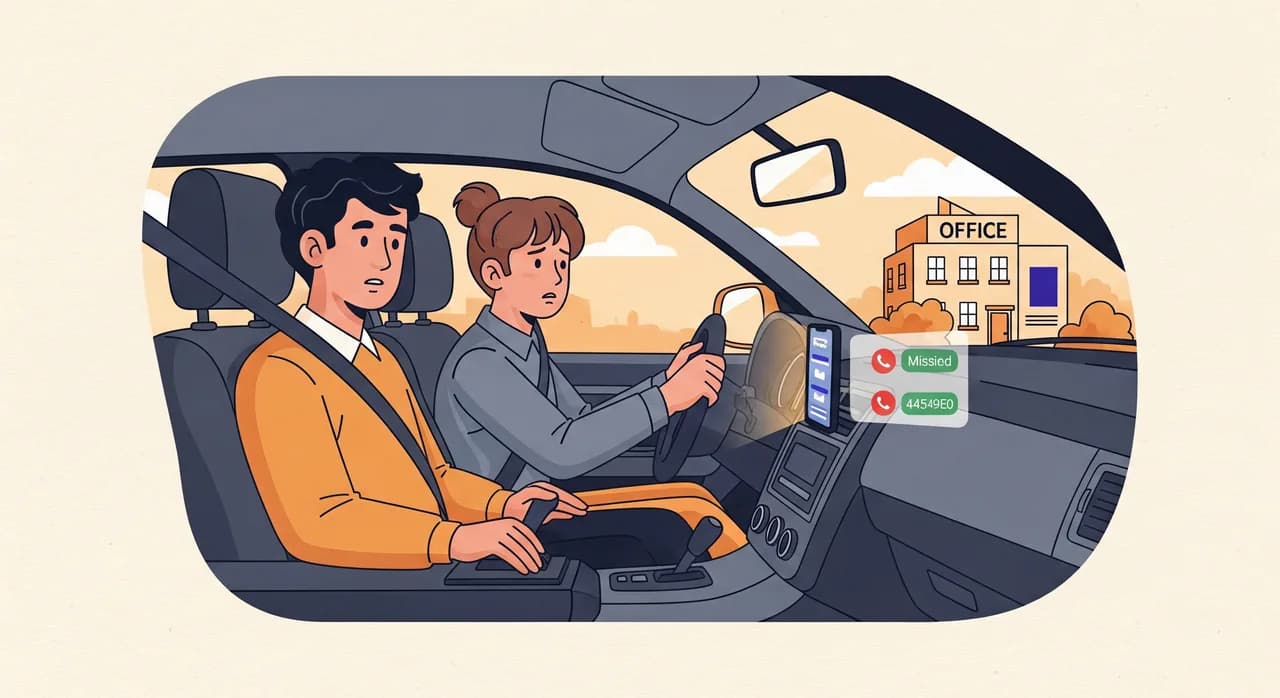
A driving school has a peculiar problem: the people who could answer the phone are the same people who legally cannot — they're in a moving car with a nervous learner, hands at ten and two, phone silenced in the door pocket. The office is empty because the office is on the road. And that's exactly when the calls come.
If you run a driving school, you already know this in your bones. You get to the end of a long day of clutch control and roundabout entries, you finally check your phone, and there are four missed calls and two voicemails that all start with some version of "Hi, I was wondering about lessons for my daughter..." Half of them have already called the school down the road. This piece is about the specific ways an AI receptionist for driving schools plugs that gap — not as a gadget, but as the thing that answers when nobody can.
Why the driving school phone is uniquely broken
Most small businesses miss calls because they're busy with a customer in front of them. A driving school misses calls because its entire workforce is legally required to be unreachable for most of the working day. There's a difference, and it matters. A hairdresser can glance at a ringing phone between snips. An instructor mid-emergency-stop cannot, should not, and in many places is committing an offence if they do.
So the honest picture of a typical single-owner or small driving school looks like this: lessons run from early morning to early evening, back to back, with fifteen minutes of dead time between pupils that gets eaten by driving to the next pickup. The phone is either silenced or ringing to voicemail all day. Admin — the callbacks, the scheduling, the invoicing — gets crammed into the evening, when the caller has already moved on.
- Course and lesson inquiries — "how much, how many lessons, when can you start" — from teens and, more often, from paying parents.
- Scheduling and rescheduling — the pupil who's ill, the parent who forgot about a family thing, the learner who wants to add an extra lesson before their test.
- Theory and practical exam questions — "do you help book the test, what do I need to bring, is the theory separate."
- The pre-summer spike — every April to July, when teenagers turn seventeen and parents suddenly want them driving before the school holidays or before university.
Each of those has a caller on the other end who is comparing you to two or three other schools. In driving instruction the first school to actually pick up and sound competent very often wins, because the service is close to interchangeable in the caller's mind and availability is the tiebreaker. A missed call isn't a delayed sale. It's frequently a lost one.
What an AI receptionist actually does for a driving school
Let's be precise, because the phrase gets thrown around loosely. An AI phone assistant like Vunoon answers your number when you can't. It greets the caller, answers questions from a profile you filled in — your lesson structure, your working area, your general availability, what you charge, how test booking works — and then does the useful thing: it takes the details, captures the booking or the callback request, and sends you a written summary and transcript of the whole conversation.
It is not pretending to be you, and it does not pretend to be human when a caller asks. What it does is refuse to let the phone ring out. A parent calling at 2pm on a Tuesday, while you're teaching, gets a calm, informed answer instead of four rings and voicemail. That's the whole game.
Two callers, two conversations: the parent and the teen
Here's a nuance specific to your trade. Roughly speaking you get two kinds of caller, and they want opposite things. The seventeen-year-old wants to know if you can teach them soon and whether their mates rate you. The parent — who is usually paying — wants structure, price clarity, safety reassurance, and a plan. An AI receptionist handles both because it works from the same profile but responds to the actual question asked.
Imagine a parent phones on a weekday afternoon. "My son's just turned seventeen, he's a bit anxious, how do you usually start someone off?" A well-configured assistant can answer that from what you've written: you begin with a longer first assessment lesson in a quiet area, you build up gradually, lessons are typically weekly, and you'll ring back this evening to fix a start date. The parent hangs up feeling like they've found a professional. The alternative — voicemail — feeds exactly the anxiety they called about.
The teen caller is different: shorter attention, wants speed and social proof, often calls in the evening. Because the assistant answers 24/7, that 8pm "can I start lessons" call gets caught too, with the details logged so you can text back a start time in the morning rather than playing phone tag for three days while they book someone else.
“In driving instruction the service is nearly interchangeable in the caller's mind — availability is the tiebreaker, and the phone is where availability is decided.”
Scheduling and the endless reschedule
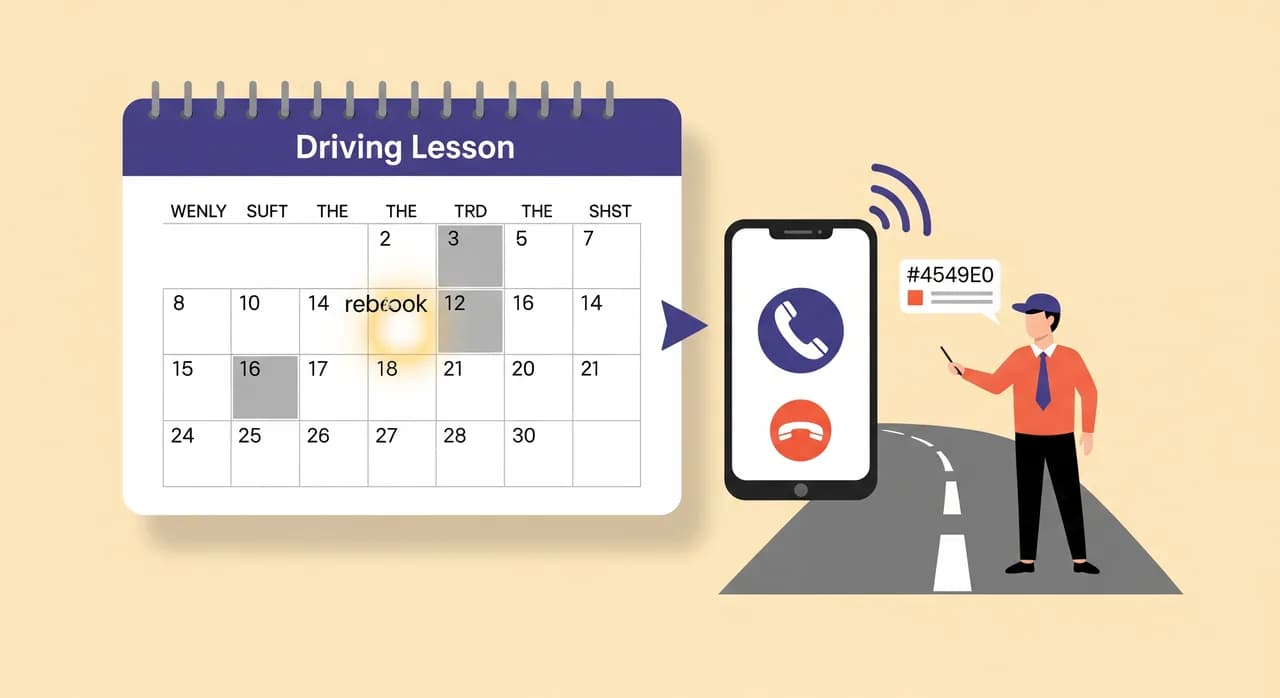
If inquiries are the growth problem, rescheduling is the daily grind. Learners are teenagers with chaotic lives and parents with work. Someone's ill, someone has an exam, someone's car-sharing fell through. Each reschedule is a small negotiation, and every one that lands in voicemail becomes an empty slot in your day — a slot you can't fill on short notice because you didn't hear about it until the evening.
This is where catching the call in real time pays for itself. When a pupil rings at 7am to cancel that afternoon's lesson because they've woken up ill, an assistant that answers at 7am gives you a fighting chance to offer the slot to someone on your waiting list — instead of finding out at 9pm that you drove to an empty pickup. You still make the actual scheduling decisions; the difference is you learn about the change while you can still do something about it.
- 1Caller reaches the assistant instantlyThe pupil or parent gets a real answer mid-lesson-day instead of voicemail, and can say why they're calling — cancel, move, or add a lesson.
- 2Details are captured cleanlyName, which lesson, the reason, what they'd prefer instead. No half-audible voicemail you have to replay twice.
- 3You get a summary between pupilsIn your fifteen-minute gap you glance at a written summary and transcript, not a stack of voicemails to decode.
- 4You act while the slot is still fillableA quick text offers the freed-up slot to a waiting pupil, or confirms the new time — often the same day.
The theory-and-test questions you answer fifty times a week
Every driving school fields the same cluster of questions until they could recite them in their sleep. Do I book the theory or do you? Is theory separate from lessons? How many lessons will I need? What do I bring to a lesson? Do you provide the car for the test? Can I do an intensive course before a certain date?
None of these need you specifically. They need someone who knows your answers. That's an ideal job for an AI receptionist, because the answers are stable and factual, and you only have to write them down once. The assistant then repeats them, patiently, at 11pm on a Sunday, without you touching your phone.
There's an honesty point worth making here. Rules around theory tests, minimum ages, and licence categories vary by country and change over time. A good setup means putting your local, current process into the profile and reviewing it when the rules shift — not trusting the assistant to invent an answer. Configure it with what you know to be true today, and it'll be a rock-solid FAQ line. Leave it vague, and it'll be vague back. Garbage in, garbage out applies to phones too.
- Process questions — "do you help book my practical test?" — answered exactly as you'd answer them.
- Logistics — pickup areas, whether you cover a caller's town, automatic vs manual availability.
- Expectations — a fair, non-promising line on how lessons progress, without guaranteeing a pass, which no honest school does.
- Handoff triggers — anything genuinely case-specific gets taken as a message so you call back informed instead of cold.
Surviving the pre-summer enrollment spike
Driving schools have a season, and it's brutal. Spring into early summer is when a wave of new seventeen-year-olds arrives, when parents want lessons wrapped up before holidays or a move to university, and when the sun makes everyone suddenly keen. Your call volume can double or triple for a few months. Your capacity to answer the phone does not.
This is the cruelest version of the missed-call problem, because in peak season the calls are pure demand. A caller in April who can't reach you doesn't wait — they work down a list of local schools until someone answers, and the ones who answer fill their diaries first. By the time you check voicemail that evening, the best summer bookings are gone. You lose the very calls you most wanted, at the only time of year they arrive in bulk.
An assistant doesn't get overwhelmed by volume the way a person does. Whether it's the third call of the day or the thirtieth, it answers each one the same way, captures the details, and lines them up for you. During a spike, that's the difference between a full summer diary and a stack of "sorry we missed you" that never converts. You can't clone yourself for three months. You can make sure the phone never rings out during them.
What a missed call is actually worth here
It's worth being concrete, because "you're missing calls" is easy to shrug off. A driving pupil isn't a one-off transaction. Someone who signs up for lessons usually books many, often over months, sometimes with a top-up course before their test. The value of a single "can my daughter start lessons" call that converts is not one lesson — it's a whole customer relationship, plus the referrals that come when a nervous parent is happy.
So when a call rings out, you're not losing a lesson slot. You're losing the pupil, the twenty-odd lessons they might have booked, and the two friends they'd have recommended you to. That's the real cost of the empty office. Framed that way, the phone stops being an interruption and starts being the front door of the business — one that's currently locked for eight hours a day.
“A missed inquiry isn't one lost lesson. It's a whole pupil, the course they'd have booked, and the friends they'd have told.”
Where an AI receptionist stops — the honest bit
Any tool that's worth using is worth being honest about. An AI receptionist is a front desk, not an instructor and not a magic wand. Here's what it won't do, so you're not disappointed.
- It won't teach or assess. Test-readiness, technique, whether a pupil should take their test — all you.
- It won't guarantee bookings. It answers and captures; it can't force a comparison-shopping caller to choose you. It just makes sure you're in the running.
- It won't replace judgement on tricky cases. A pupil with special requirements, a disputed cancellation charge, an unusual request — it takes a message and hands those to you.
- It's only as accurate as your profile. Feed it wrong prices or outdated test rules and it'll repeat them confidently. That's on the setup, not the tool.
None of that undercuts the value. It reframes it. The assistant isn't there to be a driving instructor. It's there so that the ninety per cent of phone traffic that's admin — inquiries, scheduling, FAQ — stops stealing your evenings and your bookings, leaving you to do the one thing only you can do: teach people to drive.
How to set it up without losing a teaching day
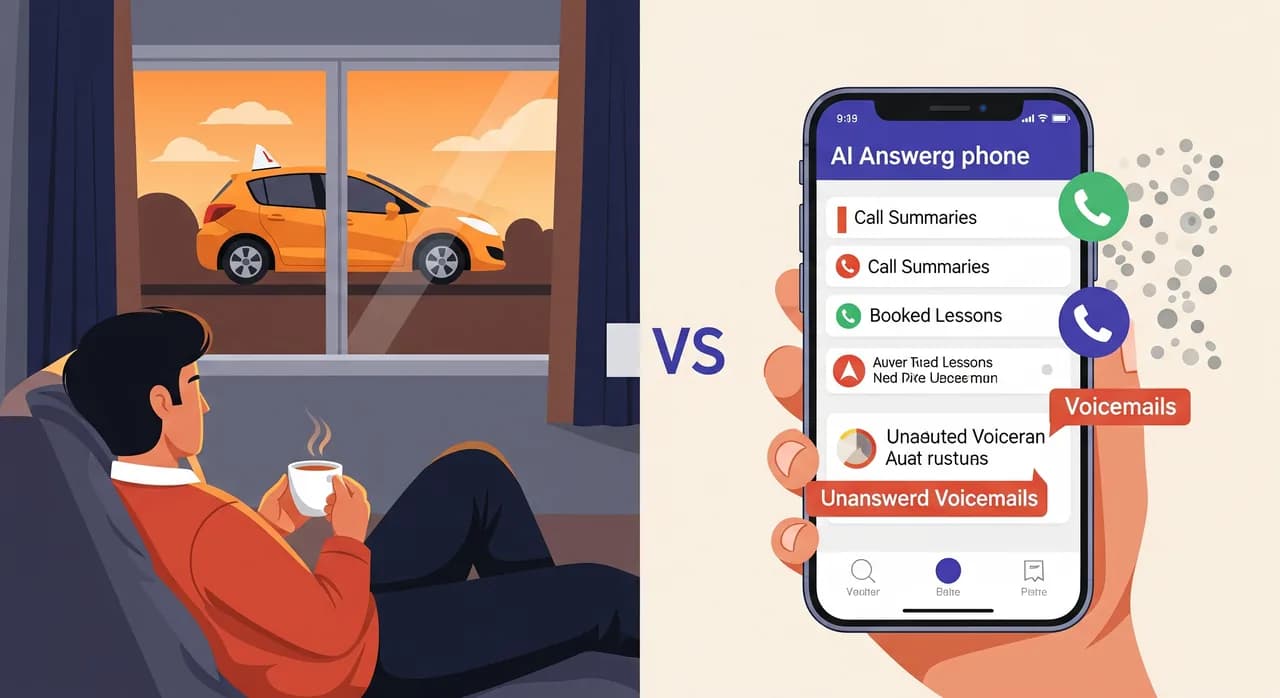
The good news for a time-starved instructor is that this isn't an IT project. Setup with Vunoon is self-serve and takes minutes, not a technician visit. You describe your school in a short wizard, you test it by actually phoning it and talking to it like a parent would, and then you forward your number when you're happy. You can do the whole thing between pupils or on a Sunday evening.
- 1Write down how you really workLesson structure, area covered, manual or automatic, general availability, how test booking works, cancellation rules. Twenty honest minutes.
- 2Build the profile in the wizardDrop those details in. Keep answers factual and current — especially anything about tests and prices.
- 3Phone it and role-playCall as an anxious parent, then as a teen wanting a fast start, then as a pupil cancelling. Fix any answer that sounds off.
- 4Forward your number and watch the summariesPoint your line at the assistant during teaching hours. Read the call summaries for a week and tighten anything that keeps coming up.
It works in 25+ languages, which matters more than you'd think in a mixed community where a parent might be more comfortable asking about their child's lessons in their own language. And there's a free trial, so you can run it through a normal busy week and judge it on your actual call log rather than on a promise.
Which driving schools get the most out of this
Be realistic about fit. If you're a single instructor with a full diary and a partner who answers the phone from home all day, your gap is smaller. But most driving schools are not that. The ones who benefit most are the solo instructors and small teams where everyone who could answer is out teaching — which is nearly everyone in this trade.
- Solo instructors who are the business and physically cannot answer while teaching.
- Small schools of two to five instructors with no dedicated office staff.
- Schools with a strong season that get buried every spring and lose peak inquiries.
- Anyone competing on availability in a town with several schools, where picking up first wins the pupil.
Can an AI receptionist actually book a driving lesson, or just take a message?
Will parents and teenagers realise they're not talking to a person?
Can it answer theory-test and licence questions correctly?
What happens during the spring rush when call volume spikes?
How long does setup take, and do I need any technical help?
Stop letting the phone ring into an empty office
Set up an AI receptionist for your driving school in minutes, test it on a real week for free, and catch the calls you're currently teaching straight past.
See it for driving schools
Vunoon builds an AI phone assistant that answers your business calls 24/7 — it books appointments, answers common questions and sends you a summary of every conversation.