AI Receptionist for Vets: A Playbook for Calls Under Control
A practical guide to putting an AI receptionist to work in a veterinary clinic — from worried-owner triage wording to vaccination bookings, med pickups, and after-hours emergency referrals.
 Vunoon15 min read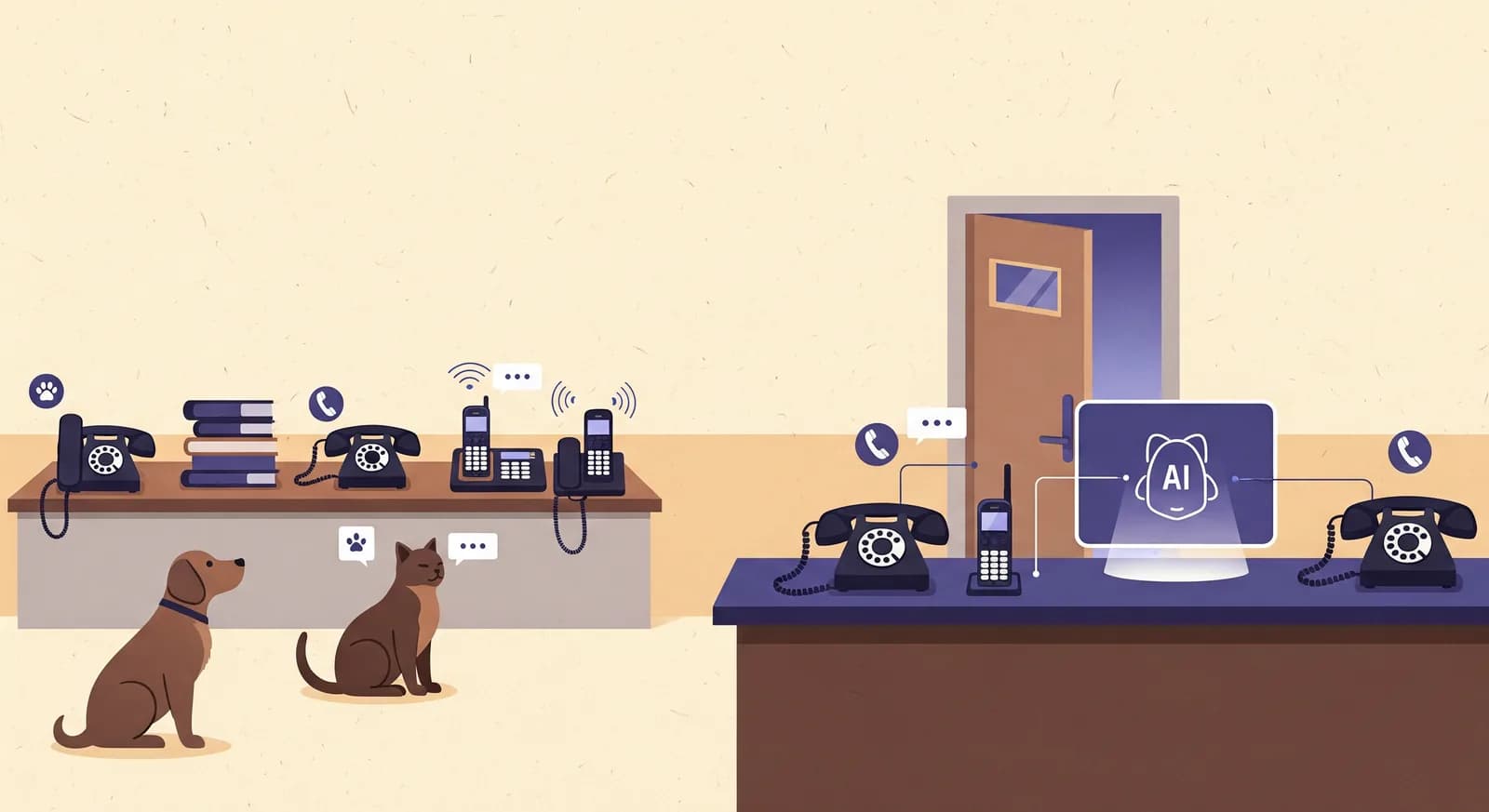
The phone at a veterinary clinic is never just a phone. It's a worried owner who found something on the dog's ear, a breeder trying to book six kittens in for their first shots, and someone whose cat hasn't eaten in two days — all ringing at once, at 8:12 on a Monday, while your one front-desk person is already restraining a Labrador. An AI receptionist for vets doesn't fix your morning, but it can make sure not one of those three calls goes unanswered.
This is a working playbook, not a sales pitch. If you run a small animal practice, a mixed rural clinic, or a two-vet shop that closes at six, the calls you drop are the calls you never knew you lost. We'll walk through the specific conversations that happen in veterinary reception — the ones that are unlike almost any other business — and how to hand the routine ones to an AI phone assistant without ever letting it play doctor.
Why veterinary calls are different from every other business
Most reception advice treats a phone call as a transaction: get the name, book the slot, hang up. Veterinary calls don't work that way. The person on the other end is frightened, often on the way to being distraught, and holding an animal they love. They don't open with "I'd like to book an appointment." They open with "He's shaking and he won't put weight on his back leg and I don't know what to do."
That emotional register changes everything about how the phone should be answered. A booking bot that barrels straight into "What day works for you?" reads as cold and, worse, dangerous — because the caller doesn't yet know whether their pet needs a slot next Tuesday or the emergency clinic right now. The job of the first thirty seconds isn't to book. It's to listen, sort urgency from routine, and route the call to the right place. Get that wrong and you either clog your emergency line with nail trims or, far worse, slot a genuine emergency into a Thursday afternoon.
So the bar for an AI receptionist in a vet clinic is higher than in a hair salon or a plumber's office. It has to be gentle. It has to know its limits. And it has to be crystal clear that it is not a veterinarian and will never guess at a diagnosis over the phone.
The worried-owner call: triage without pretending to be a vet
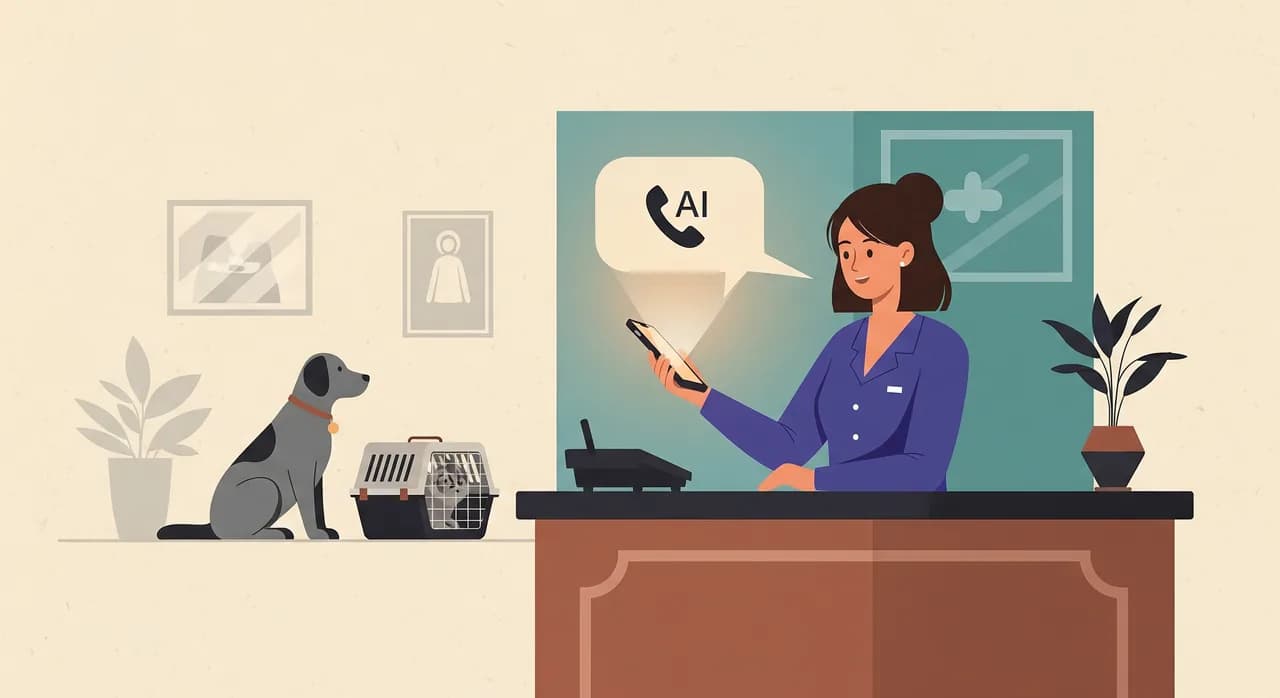
Let's be blunt about the risk first, because it's the one that keeps clinic owners up at night. You cannot let a machine tell an owner whether their pet is fine. If an AI receptionist ever says "that sounds like nothing to worry about," you have a liability problem and, potentially, a dead animal. So the design principle is simple: the AI sorts, it does not assess.
In practice that means the assistant is configured with a short set of urgency signals you choose as a clinic — the phrases and symptoms that should always jump the queue. When a caller mentions one, the assistant stops trying to book anything and does exactly one of two things: connects them to a human immediately, or reads out your emergency instructions verbatim. No interpretation, no reassurance, no "it's probably fine."
For the enormous middle band of calls — the ones that are worrying but not obviously an emergency — the right move is a warm hand-off. The assistant acknowledges the concern, takes the key details (pet's name, species, what's happening, how long, the owner's callback number), and tells the owner a nurse or vet will call back within your stated window. That's honest. It doesn't overpromise, it doesn't diagnose, and it gets a structured message into your inbox instead of a scribbled sticky note that falls behind the monitor.
- 1Open with the animal, not the calendarA vet-appropriate greeting asks what's going on with the pet before it ever mentions appointments. "Thanks for calling — is this something urgent, or would you like to book a visit?" gives the caller room to say the scary thing.
- 2Listen for red flagsIf the caller's description matches your configured emergency signals, the assistant abandons booking and switches to your emergency script or a live hand-off.
- 3Capture, don't assessFor non-obvious cases, it collects pet name, species/breed, symptom, duration, and callback number — then promises a nurse callback in your stated window.
- 4Log everythingYou get a summary and a full transcript, so the vet calling back already knows the story before they dial.
“The AI's job in a triage call is to sort urgency from routine — never to tell a frightened owner that their pet is fine.”
Routine vaccination and check-up bookings: the bread and butter
Here's where an AI receptionist actually earns its keep, because a huge share of vet calls are gloriously boring. Annual boosters. Kitten and puppy vaccination courses. Wellness checks. Nail clips. Anal gland expressions (yes, people call about those, and they're never embarrassed enough to whisper). These calls don't need a human's judgement — they need a calendar and a few clarifying questions.
A vaccination booking has more moving parts than a haircut, and the assistant should be configured to ask for them. Is this a first course or a booster? How old is the animal? Cat, dog, rabbit, ferret? A puppy's first vaccination and an adult dog's annual booster are different appointment types and often different durations. If your clinic blocks 20 minutes for a new-patient vaccination and 10 for a booster, the assistant needs to know which it's slotting so your day doesn't fall apart by lunchtime.
- Appointment type: first vaccination course, annual booster, wellness check, nurse clinic, or nail/gland service.
- Species and age: so the right appointment length and the right vet or nurse gets assigned.
- New or existing patient: existing patients you can match to a record; new ones need a longer first slot.
- Owner details: name, phone, and — if you want — a note on whether the pet is anxious or reactive so the team can prepare.
The honest caveat: the assistant is only as good as the profile you give it. If you don't tell it that rabbits go to the exotics vet on Wednesdays, it can't know. The setup is a short wizard where you describe your services, your hours, and your booking rules in plain language — the same things you'd tell a new receptionist on their first day. Spend twenty minutes getting that right and the assistant handles the routine bookings the way your best front-desk person would; skip it and it'll book a cockatiel in with the dog vet.
Food, meds, and repeat prescriptions: the FAQ machine
A quietly large fraction of veterinary calls never needed a person at all. "Is my dog's prescription food in yet?" "Can I pick up Milo's arthritis tablets?" "How much is a large bag of the renal diet?" "Do you have the flea treatment for a 12-kilo dog?" These are lookups and FAQs, and every one of them that a human answers is a minute stolen from the treatment room.
An AI receptionist handles this tier well because the answers live in your business profile: which diets you stock, your pickup hours, whether a repeat prescription needs a vet's sign-off first, and how long that sign-off takes. When someone calls about refilling a chronic medication, the assistant can explain your process — "Repeat prescriptions need approval from the vet, which usually takes a day; I'll log your request and someone will confirm when it's ready to collect" — and drop the request straight into your queue with the pet's name and the medication.
Where you have to be careful, and where a responsible assistant should be built to stop, is anything that edges into clinical advice. "Can I double his dose because he seems worse?" is not a pickup question — it's a medical one, and the assistant must route it to a vet, not answer it. The line is the same as everywhere else in this playbook: logistics and stock, yes; dosing and diagnosis, never.
After-hours: the emergency referral that has to be word-perfect
Nothing tests a clinic's phone setup like 11 p.m. The lights are off, nobody's in, and someone's guinea pig is in trouble. If your out-of-hours message is a rushed voicemail that half the callers hang up on, you're relying on a panicked owner to correctly hear and write down the emergency clinic's address on the first try. That's a lot to ask of someone whose hands are shaking.
This is one of the strongest cases for an AI receptionist in a veterinary setting, because after-hours is exactly when calls are both most emotional and most likely to be missed. Instead of a machine beep, the caller reaches a calm voice that answers, listens for whether this is a genuine emergency, and reads your referral instructions clearly — the name of the 24-hour hospital, the address, the phone number — as many times as they need to hear it. It can then offer to text the details so the owner isn't scribbling in the dark.
For the non-emergencies that come in after hours — "I just wanted to book Rex's booster, I know you're closed" — the assistant takes the booking request or the message and hands you a tidy list at 8 a.m. instead of a voicemail box you have to sit through. Every one of those is a client who felt heard at the exact moment they expected to be ignored. If you want to go deeper on the out-of-hours case specifically, our guide on after-hours answering breaks down the economics of it.
“After hours, the assistant's only job is to point the way to help — calmly, correctly, and as many times as the owner needs to hear it.”
Getting the tone right for pet owners
Tone is not a soft, optional extra in veterinary reception — it's the whole game. A caller can forgive a fumbled booking. They will not forgive feeling brushed off while they're scared for their animal. The emotional intensity of these calls sits somewhere between a doctor's office and a funeral home, and the voice on the phone has to match that.
The good news is that pacing and warmth are configurable. You can set the assistant to slow down, to acknowledge the worry before moving to logistics ("I'm sorry to hear Luna's not herself — let's get you to someone who can help"), and to avoid the cheerful call-centre chirp that feels grotesque to someone who's crying. It should also be plain about what it is. When a caller asks "Am I talking to a person?", an honest assistant says no — it's the clinic's phone assistant — and offers to take a message or have someone call back. That honesty, counterintuitively, builds more trust than a bot pretending to be Sharon from the front desk.
What an AI receptionist won't — and shouldn't — do
Honest limitations, because pretending there are none is how you end up disappointed. An AI receptionist is not a replacement for your veterinary team's judgement, and it is not a triage nurse. It can't examine an animal, it can't read an X-ray, and it must never offer a clinical opinion. It won't handle the genuinely delicate conversations — end-of-life discussions, breaking bad news, the euthanasia appointment — and it shouldn't try. Those belong to a human, always.
It also won't magically know your clinic. A brand-new assistant with an empty profile is useless; a well-configured one that knows your services, your hours, your emergency referral, and your booking rules is genuinely helpful. The difference is the setup, and the setup is on you. Think of it as the training you'd give a temp — except you only do it once.
And it won't replace the person at your front desk. The realistic promise is narrower and more useful: it catches the calls your team can't get to — the overflow at 8 a.m., the ones during a difficult consult, the ones at midnight — so that the humans can do the parts only humans can do.
| Call type | AI receptionist | Human team |
|---|---|---|
| Booking a booster or wellness check | Handles fully | Only if the caller asks |
| "Is the prescription food in?" | Handles fully | — |
| Repeat prescription request | Logs it, explains process | Vet approves |
| Worried but non-urgent symptom | Takes details, promises callback | Nurse calls back |
| Red-flag emergency | Routes to human or emergency script | Takes over immediately |
| End-of-life / euthanasia | Does not handle | Human, always |
Setting it up for a veterinary clinic in practice
The mechanics are refreshingly undramatic. You sign up, walk through a short wizard describing your clinic — services, hours, booking rules, your emergency referral, the phrases that should trigger it — and then you test it by actually talking to it on the phone. Call it, pretend to be a worried owner, pretend to book a booster, pretend it's midnight and your dog ate chocolate. Listen to how it handles each one and adjust the profile until it sounds like your clinic.
- 1Describe your clinicServices, appointment types and durations, opening hours, which vet handles exotics, whether repeats need sign-off — all in plain language.
- 2Write your emergency scriptYour red-flag phrases and your exact out-of-hours referral: hospital name, address, phone. This is the part to get word-perfect.
- 3Test it like a callerPhone it and role-play the hard cases — a seizure at 2 a.m., a first-puppy vaccination, a repeat-med pickup. Tune the wording.
- 4Forward your numberPoint your line to the assistant — all calls, just after-hours, or only when your desk is busy. Start with after-hours if you're cautious.
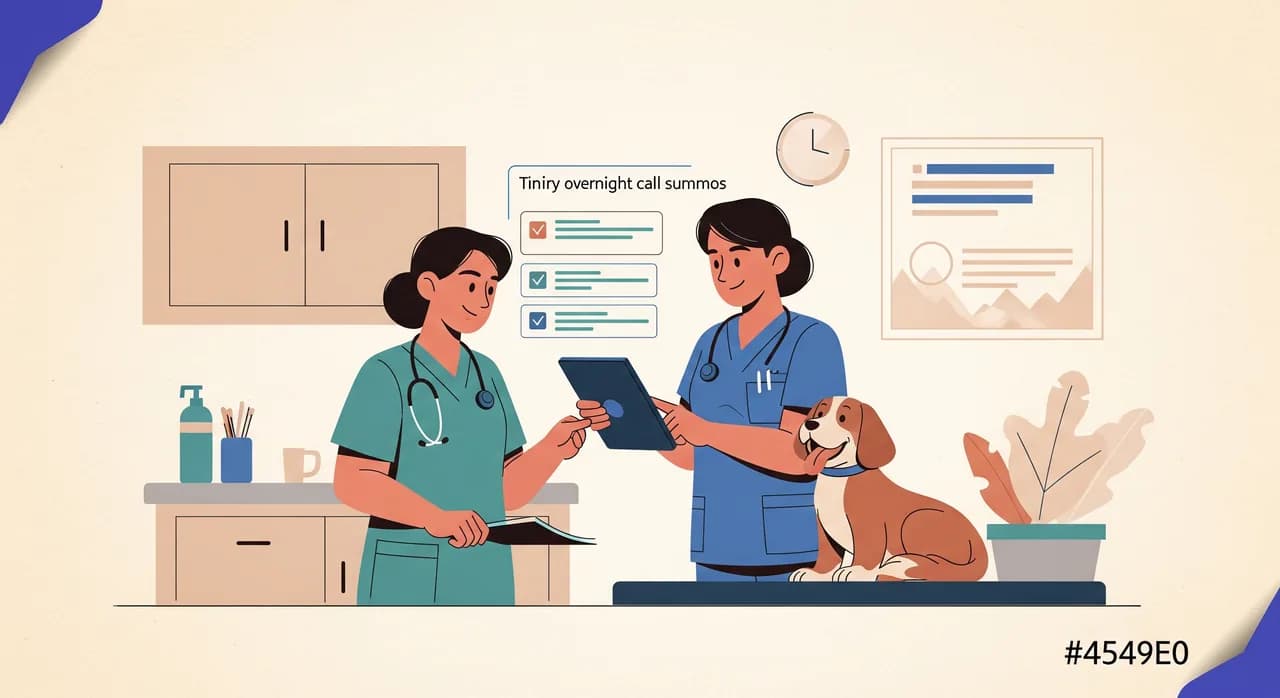
It works in 25+ languages, which matters more in veterinary reception than people assume — the owner who can't quite explain their cat's symptom in a second language is exactly the person a patient, unhurried assistant helps most. And because every call arrives as a summary plus a full transcript, your team starts each callback already knowing the story, instead of asking the frightened owner to tell it twice.
Start conservatively if you're nervous — a lot of clinics turn the assistant on for after-hours and lunchtime only, see how it does with the low-stakes calls, and widen from there once they trust it. There's no rule that says it has to answer everything on day one.
Can an AI receptionist tell if a pet's symptom is an emergency?
Will it book vaccination appointments correctly?
What happens to calls after we close?
Does it pretend to be a real receptionist?
How long does setup take?
Put your clinic's phone under control
See how an AI receptionist handles worried-owner triage, vaccination bookings, and after-hours referrals for a veterinary practice like yours. Set it up, test it by calling in, and start with after-hours if you'd rather ease in.
Explore Vunoon for veterinary clinics
Vunoon builds an AI phone assistant that answers your business calls 24/7 — it books appointments, answers common questions and sends you a summary of every conversation.