AI Receptionist vs. Virtual PBX: Two Different Jobs on One Line
A virtual PBX moves calls around. An AI receptionist actually answers them. If you're shopping for a cloud phone system to stop missing calls, you may be buying the wrong tool — here's how to tell them apart and combine them.
 Vunoon14 min read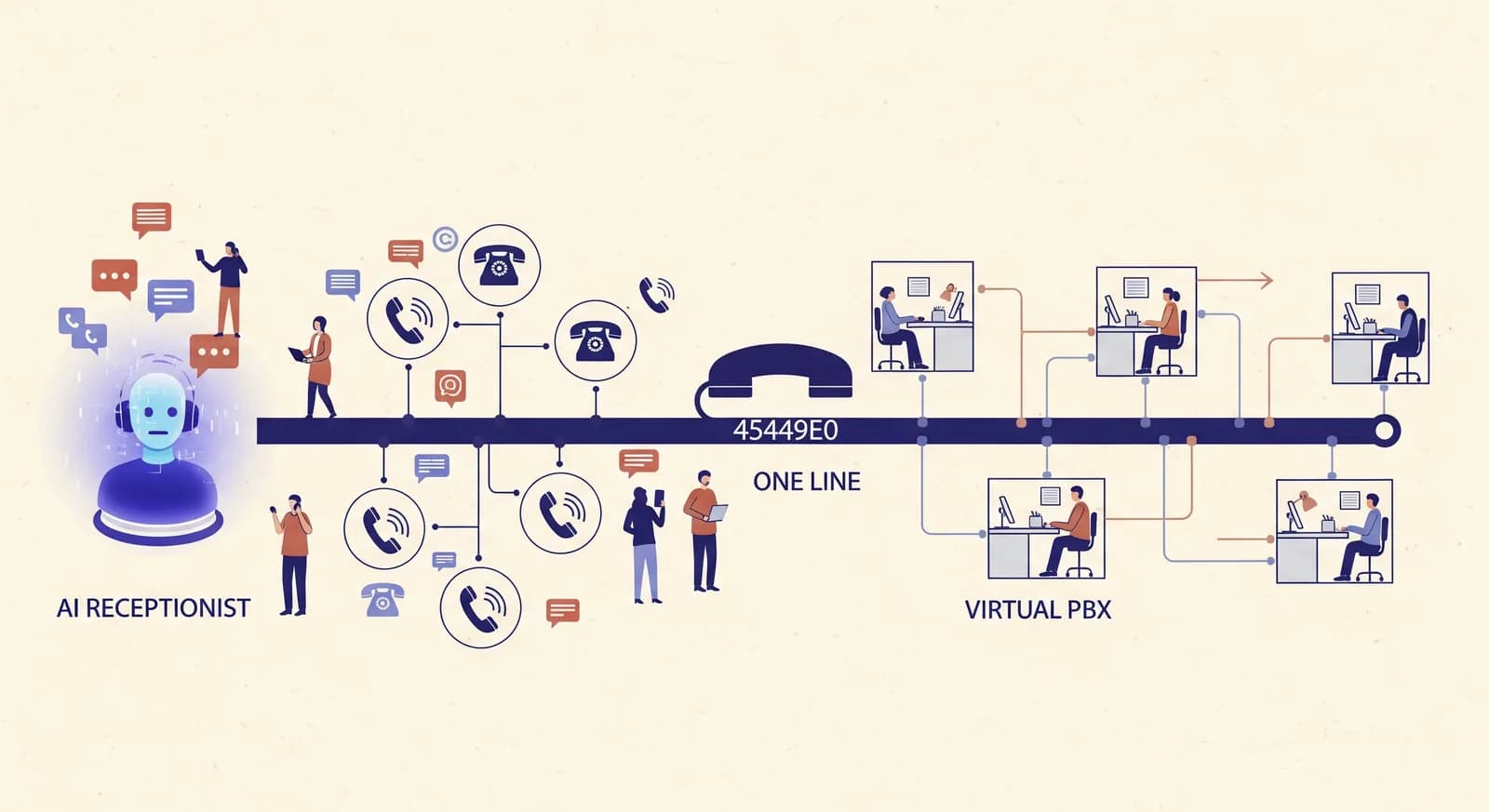
You went looking for a virtual PBX because you keep missing calls. That instinct is half right and half a wrong turn. A PBX is very good at deciding where a call should go — and completely indifferent to whether anyone is there to pick it up. If the real problem is that nobody answers, you may be about to buy a fancier way to ring a phone that no one is standing next to.
This is one of those decisions where the words get in the way. "Virtual PBX", "cloud phone system", "hosted PBX", "centralita virtual" — they all describe roughly the same category of product, and none of them tells you what actually happens when a customer calls at 2pm on a Tuesday while you're elbow-deep in work. An AI receptionist sits in a different category entirely. This piece walks through what each one really does, where people get burned, and why the honest answer for a lot of small businesses is "both, but in the right order."
What a virtual PBX actually is
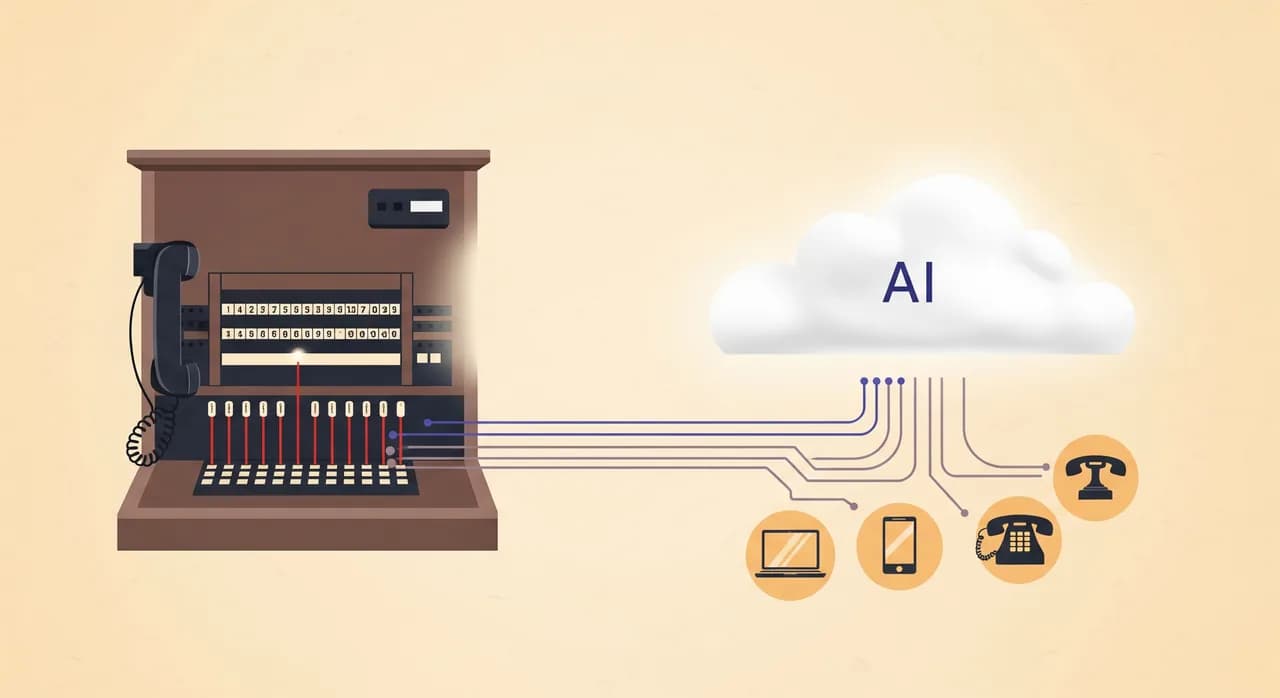
PBX stands for Private Branch Exchange, and the name is older than most of the people buying one. In the office of the 1980s it was a metal box on the wall that let a company share a handful of outside phone lines across dozens of internal extensions. Press 9 for an outside line. Dial 204 to reach accounting. That box is the ancestor of everything sold today as "cloud PBX" or "virtual PBX."
The virtual part just means the box now lives in a data centre instead of a cupboard, and your "phones" might be apps on laptops and mobiles. The job, though, hasn't changed. A PBX is a switchboard. It takes an incoming call and decides where it goes next: ring the front desk, then the workshop, then a mobile; drop it into voicemail after 20 seconds; send after-hours calls to a message box; play a menu that asks the caller to press 1 for sales and 2 for support.
That is genuinely useful. If you have several people and several departments, routing calls sensibly is real work, and a good cloud phone system does it well. The confusion starts when a business with one or two people buys a PBX expecting it to solve a problem the PBX was never designed to touch.
The one thing a PBX doesn't do
A PBX moves the ringing around. It does not answer. This sounds like a small distinction until you follow a call through to its end.
Picture a two-van plumbing outfit. A call comes in. The PBX rings the office line for 15 seconds — nobody there, both plumbers are under sinks. It rolls to the first mobile: ringing, ringing, hands are wet, ignored. It rolls to the second mobile: same. After a tidy little sequence of failures, it does exactly what it was configured to do and drops the caller into voicemail. The routing worked perfectly. The customer still hung up and called the next plumber on the list.
The PBX did its job. Its job was never to have a conversation. It's a traffic cop, not a person. When you read a cloud phone system's feature list — call queues, ring groups, IVR menus, auto-attendants — notice that every single feature is about where the call goes, and not one is about whether the caller gets a useful answer when it gets there.
What an AI receptionist does instead
An AI receptionist starts where the PBX runs out of road: at the moment a call needs to be answered by something that can talk. It picks up, greets the caller by your business name, and holds an actual conversation — understanding what the caller wants, answering from what you've told it about your business, and doing something with the outcome.
Concretely, that means it can say "We're open until six on Saturdays," quote the hours and services you configured, take a booking or a callback request, and then send you a written summary and a transcript of what was said. The caller who reached the plumber's voicemail in the last example instead reaches a voice that says "Both our plumbers are on jobs right now — I can take your details and have someone call you back within the hour, or book you in for tomorrow morning. Which works better?" That call didn't get lost. It got handled.
- Answers — picks up on the first ring, every ring, at any hour.
- Understands — parses "do you do emergency callouts?" not just "press 1."
- Informs — replies from your profile: services, hours, prices you set, location, policies.
- Acts — takes a booking or message, captures a name and number, flags anything urgent.
- Reports — sends you a summary and transcript so nothing lives only in someone's memory.
The mental model that helps: a PBX is plumbing, and an AI receptionist is a person at the other end of the pipe. You can have beautiful plumbing and still have no water if there's nobody at the tap.
“A virtual PBX decides where a call rings. An AI receptionist decides what a caller hears. Those are not the same purchase.”
Side by side: routing vs. answering
It helps to lay the two next to each other, because most "vs." comparisons online quietly assume they're competitors. They aren't. They solve adjacent problems, and the honest comparison is about which problem you actually have.
| What happens on a call | Virtual PBX / cloud phone system | AI receptionist |
|---|---|---|
| Deciding where the call rings | Yes — this is its core strength | No — expects a call to already be handed to it |
| Picking up when nobody's free | No — rolls to voicemail or keeps ringing | Yes — answers every time |
| Answering a spoken question | No | Yes — from your business profile |
| Taking a booking or message | Voicemail only | Yes — structured, with details captured |
| Menus, extensions, ring groups | Yes | Not its purpose |
| Written summary + transcript | No (recordings at best) | Yes, after every call |
| Best when you have… | Several people/departments to route between | Calls going unanswered or after hours |
Read down the two columns and the pattern is obvious: almost nowhere do they overlap. The PBX column is full of where. The receptionist column is full of what. A business drowning in missed calls that buys hard on the PBX column has bought a better map of a building that's still empty.
Which problem do you actually have?
Before you compare products, compare your symptoms. Most small businesses have one of these two problems far more than the other, and naming it correctly saves you from buying the wrong category.
- 1Count your missed calls, not your featuresCheck your phone's call log or your provider's stats for the last month. How many calls rang out, hit voicemail, or came in after hours with no answer? That number is your real problem — and no amount of routing fixes it.
- 2Ask where those calls were goingIf they were bouncing between people who were all genuinely busy or off the clock, routing was never the issue. The calls arrived; there was just no one to take them. That's an answering problem.
- 3Then ask if you have a routing problem tooDo you have separate sales and service lines? Multiple locations? A team that needs calls distributed by skill or availability? If yes, you also have a genuine PBX-shaped problem. If you're one or two people, you probably don't.
- 4Match the tool to the symptomUnanswered calls → AI receptionist. Calls reaching the wrong person or department → virtual PBX. Both symptoms → both tools, layered (more on that below).
Why the search terms send you the wrong way
There's a reason so many owners end up shopping for the wrong thing. When you're losing business to missed calls, the phrases that spring to mind are the ones you've heard for years: "phone system," "cloud phone system," "virtual PBX," "centralita virtual," "business phone service." Those are all PBX-flavoured terms. The vocabulary for the thing you might actually need — something that answers — is newer and less familiar, so it doesn't come to mind first.
So you search for a phone system, you find a market full of well-marketed PBX products, and every one of them promises to "never miss a call." Read that promise carefully. "Never miss a call" from a PBX vendor almost always means "we'll ring every device you own and then take a voicemail" — which is not the same as "a caller always reaches someone who can help." The words are doing a lot of work there.
“"Never miss a call" usually means "never fail to take a voicemail." Those are wildly different promises.”
This isn't a knock on PBX vendors — they're selling routing, and routing is real. It's a knock on the fuzzy language that lets a routing product sound like an answering product. Once you can hear the difference, the marketing stops being confusing.
The real answer: layer them, don't pick
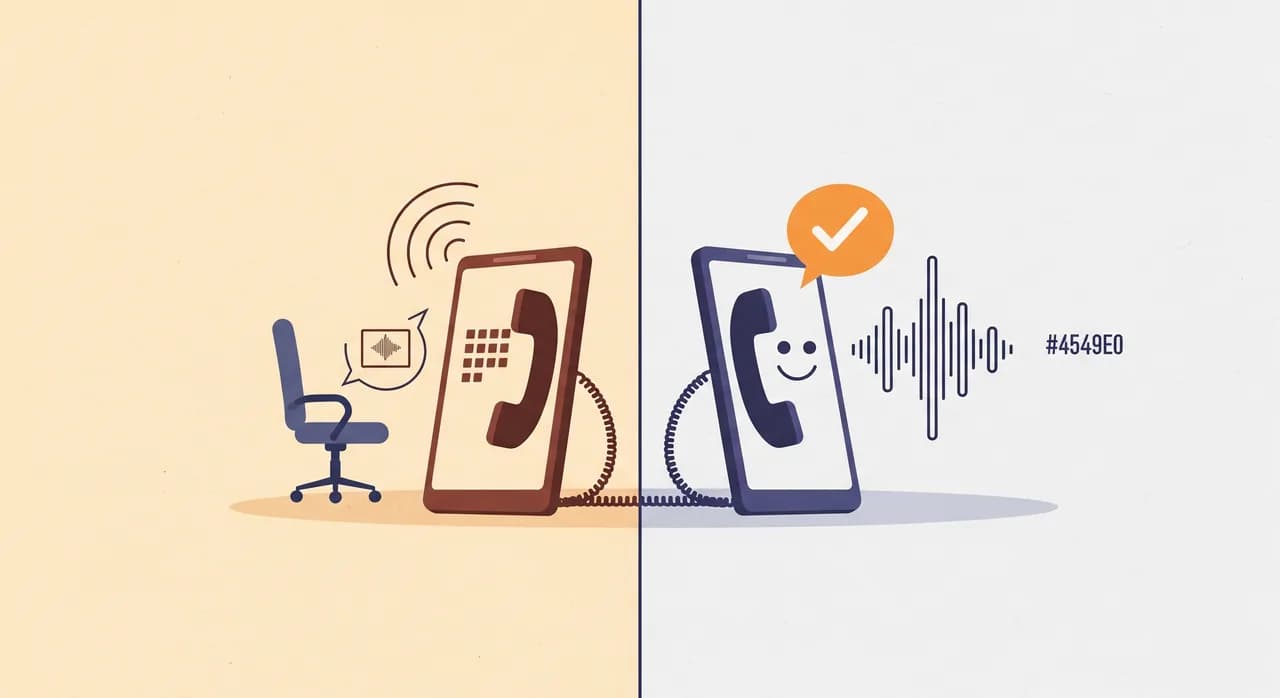
Here's the part most "X vs. Y" articles won't tell you: for many businesses the right move isn't choosing one, it's stacking them in the correct order. The PBX handles the where; the AI receptionist becomes the where of last resort — the thing that picks up when routing runs out of humans.
Practically, that looks like this. Your cloud phone system keeps doing what it's good at: an incoming call rings your desk, then your mobile, then your colleague. But instead of the chain ending in voicemail, you point the final hop at an AI receptionist. Now the sequence ends in a conversation, not a beep. Nobody free? The AI answers, helps the caller, books them or takes a message, and sends you the transcript. The PBX routes; the receptionist rescues.
- During hours: PBX rings your team first. Real people answer real calls, as they should.
- Overflow: when everyone's busy, the PBX rolls the call to the AI receptionist instead of voicemail.
- After hours: the PBX routes straight to the AI receptionist, so evenings and weekends are covered.
- Every case: you get a written summary, so you always know who called and what they needed.
And if you're a solo operator or a two-person shop with no real routing needs? You can often skip the PBX layer entirely and just forward your one number to an AI receptionist. There's no ring group to design, no extensions, no menu tree. The call comes in, it gets answered. Simpler problems deserve simpler stacks.
How Vunoon fits this picture
Vunoon is the answering half of this story — the AI receptionist, not the switchboard. It's built to sit at the end of whatever routing you already have, or to be the whole thing if you don't have any. You describe your business in a short setup wizard: services, opening hours, the prices you want quoted, how you'd like bookings and messages handled. Then you test it by literally talking to it before a single customer ever does.
When you're happy, you forward your number — either directly, or as the last hop from your existing cloud phone system. From then on it answers calls around the clock in any of 25+ languages, works from the profile you gave it, and sends you a summary and transcript of every conversation. It hands off gracefully too: if a caller needs a human, it takes a message or arranges a callback rather than pretending to be one.
The setup is deliberately self-serve and takes minutes rather than an IT project, and there's a free trial so you can hear it handle your own calls before deciding anything. The point isn't to sell you away from your phone system — it's to fill the gap your phone system was never built to fill.
Cost, effort, and the hidden price of voicemail
When people weigh a PBX against an AI receptionist on price, they usually forget to put a number on the thing they already have: voicemail. Voicemail feels free. It isn't. Every voicemail is a customer who wanted to talk now and was told to wait — and a meaningful share of those never call back, because the next business on their list picked up.
Run the arithmetic on your own trade. If you miss ten calls a week and each one, on average, could have become a single booking, that's ten jobs a week walking to a competitor — not because you were bad at the work, but because a machine took a message instead of a booking. Against a loss like that, the cost of either tool is usually a rounding error. The expensive option is the one that looks free: the beep.
Effort is the other quiet cost. A full multi-line PBX rollout can be a project — extensions, menus, ring groups, someone to maintain it. An AI receptionist, by contrast, is closer to filling in a form and forwarding a number. If your business is small, matching the effort to the need matters as much as matching the tool.
Common questions
Is a virtual PBX the same as an AI receptionist?
Do I need both?
Can I keep my current phone system?
Doesn't my PBX's auto-attendant already do this?
What happens if a caller wants a real person?
How long does it take to set up an AI receptionist?
Hear it answer your own calls
Stop guessing whether you need routing or answering. Set up an AI receptionist in minutes, describe your business, and test it live before a single customer ever calls in.
Try Vunoon on your line
Vunoon builds an AI phone assistant that answers your business calls 24/7 — it books appointments, answers common questions and sends you a summary of every conversation.