AI Receptionist vs. Voicemail: Capture the Call, Don't Deflect It
Voicemail asks the caller to do the work. An AI receptionist does the work for them. Here is how the two really compare — and where voicemail still earns its keep.
 Vunoon14 min read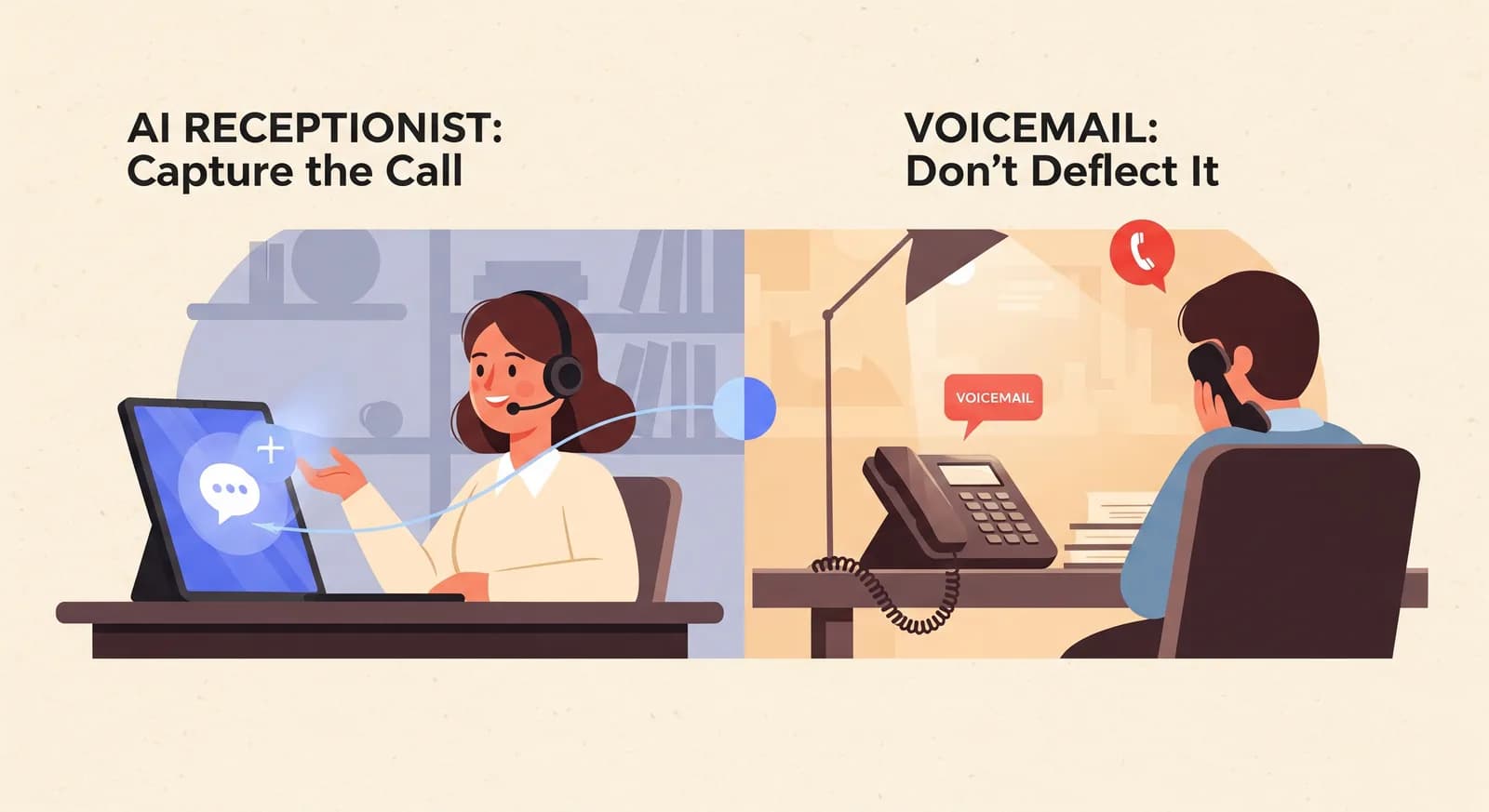
Voicemail is the polite way of telling a caller: I'm not here, so now it's your job to try again. An AI receptionist flips that around — it stays on the line and does the caller's work for them. That single difference, capture versus deflect, is most of the story.
The real question isn't which is cheaper
Most comparisons of an ai voicemail answering service against plain voicemail get stuck on cost. Voicemail is free and already sitting inside your phone plan, so on a spreadsheet it wins before the race starts. But that framing measures the wrong thing. Voicemail isn't cheap — it just moves the cost off your books and onto the caller, and then onto the sale you never closed.
Think about what actually happens after the beep. The caller has to remember what they wanted, compress it into a stranger's answering machine, leave a number slowly enough to be legible, and then wait — with no idea whether you got it, when you'll call back, or whether you're even still in business. Every one of those steps is friction, and friction is where callers leak away.
The honest question is not which costs less but which one keeps the caller. A missed call that turns into a booking is worth far more than the few cents you saved by letting a machine take a message. This article walks through that trade-off carefully — and it also tells you where voicemail is genuinely still the right tool, because it sometimes is.
Deflect vs. capture: two opposite jobs
Voicemail and an AI receptionist look similar from ten feet away — both answer a call you can't take — but they're doing opposite jobs. Voicemail is a deflection tool. Its entire purpose is to end the interaction as gracefully as possible and push responsibility back to the caller. An AI receptionist is a capture tool. Its purpose is to continue the interaction and get to a useful outcome before the caller hangs up.
That distinction shows up in the details. Voicemail can only record. It can't tell someone your Tuesday hours, confirm you handle a particular service, quote the price you already published, or book them into a free slot. It has one verb: store. An assistant has a whole vocabulary — greet, answer, qualify, schedule, take a message, promise a callback — and it uses whichever one the call actually needs.
“Voicemail has one verb: store. An assistant greets, answers, books, and reassures — it uses whichever one the call needs.”
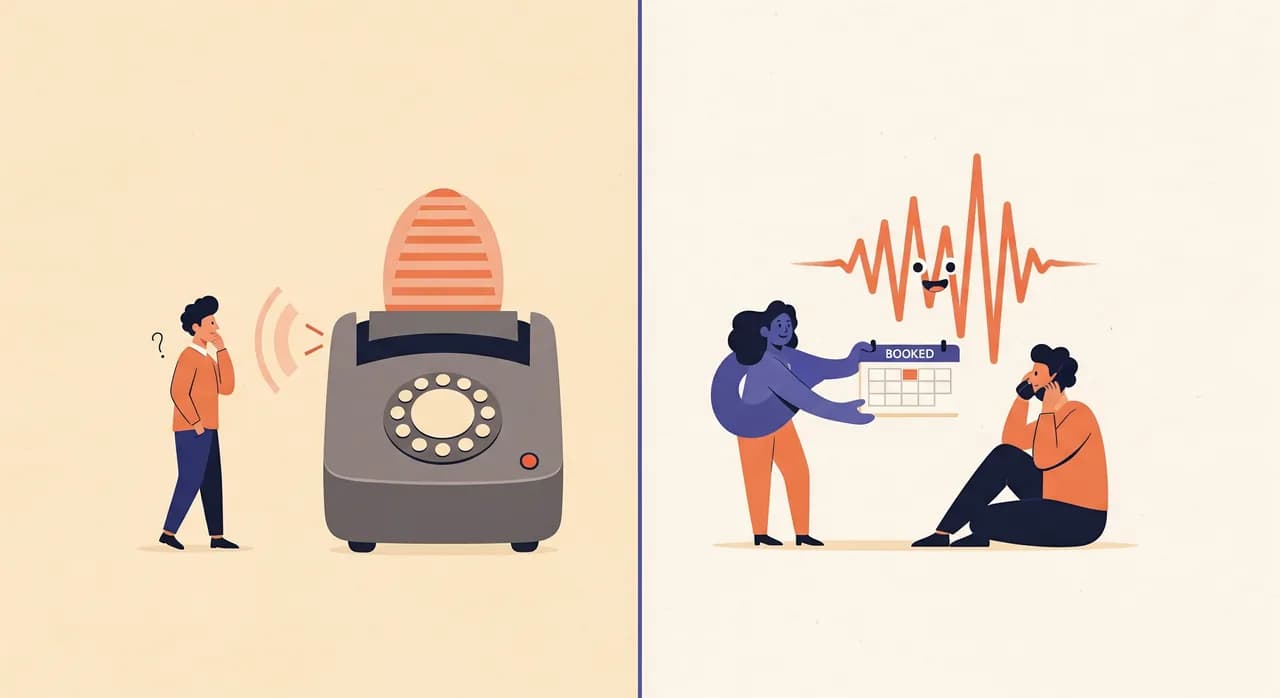
Here's the thing most owners underestimate: a large share of the calls you miss don't need you at all. They need a quick, correct answer. "Are you open Saturday?" "Do you take walk-ins?" "Can I book for four people at seven?" Voicemail can't give any of those. It sends a person who was ready to act off to your competitor's website — or just off. An assistant answers on the spot, and the call ends resolved instead of parked.
What callers actually do when they hit voicemail
Ask yourself what you do when a business you're calling sends you to voicemail. Most people don't leave a message. They hang up and either call the next name on the list or try again later — and "later" often never arrives. A caller who reaches voicemail hasn't been served; they've been asked to volunteer for a second attempt, and plenty of them decline.
The callers who do leave a message aren't home free either. Now you've got a queue of recordings to work through, half of them mumbled, a number you have to replay three times, and no context about how urgent any of it was. You call back, they don't pick up, you leave your own voicemail, and the two of you begin a game of phone tag that can stretch across days. Somewhere in that gap, the appointment they wanted has already gone to someone who answered.
First-time callers behave differently from regulars, too. Someone who already trusts you might leave a message and wait. A brand-new prospect — the exact person you spent marketing money to reach — has no loyalty yet and no reason to chase you. For new business, voicemail is close to a dead end.
The after-hours and overflow problem
Voicemail earns most of its keep during two moments: after you close, and when you're already on another line. Those are exactly the moments that decide a lot of small-business revenue, because people call about services in the evening — after their own workday, when they finally have a minute to sort out an appointment.
Picture a two-chair hair studio. The owner and one stylist are heads-down with clients from morning to close. The phone rings during a color treatment; nobody can stop mid-foil to answer, so it rolls to voicemail. It rings again at 7:40 in the evening, long after the lights are off. In both cases voicemail technically "handled" the call. But a caller who wanted a Saturday slot got a beep and a delay, and by the time anyone listens to the message the next morning, that slot may already be booked by someone who reached a business that actually picked up.
An AI receptionist covers precisely these gaps. It doesn't get tired at 8pm, doesn't need a lunch break, and never has both hands busy. When you're mid-appointment or long gone for the day, it's still on the line — greeting the caller, answering the question, and, where it can, closing the loop by booking them in or taking a proper structured message you can act on the moment you're free.
The quiet math of a missed call
You don't need fabricated industry statistics to see this; the arithmetic is your own. Take a modest business that misses ten callable inquiries a week — evenings, busy stretches, the odd sick day. Suppose just one in five of those would have become a booking. That's two bookings a week walking out the door, roughly a hundred a year, before you count the repeat visits and referrals a happy first-timer brings.
Now weigh that against what an assistant costs. You don't have to recover many of those lost bookings for the trade to make sense — and the ones you recover tend to be new customers, the most valuable kind, the ones voicemail is worst at holding onto. That's the whole economic case in one line: a machine that captures beats a machine that deflects, because captured calls turn into revenue and deflected calls turn into someone else's revenue.
“Captured calls turn into revenue. Deflected calls turn into someone else's revenue.”
What an AI receptionist actually does on the call
It helps to be specific about what "answers the phone" means here, because it's easy to imagine either a rigid press-1 menu or a magical human replacement. It's neither. An assistant like Vunoon works from a short profile you fill in — your services, your hours, the prices you've decided to publish, how you like bookings handled. On a live call it uses that profile to actually help.
- 1It greets the callerA natural spoken greeting in your business's name and language — not a beep, not a menu tree. The caller knows immediately they've reached a real place that's paying attention.
- 2It answers what it knowsHours, services, location, the prices you configured. The everyday questions that make up most calls get resolved without anyone being asked to leave a message.
- 3It books or takes a messageWhere you've set it up to schedule, it can take the booking on the spot. Where a human really is needed, it takes a clear, structured message and arranges a callback.
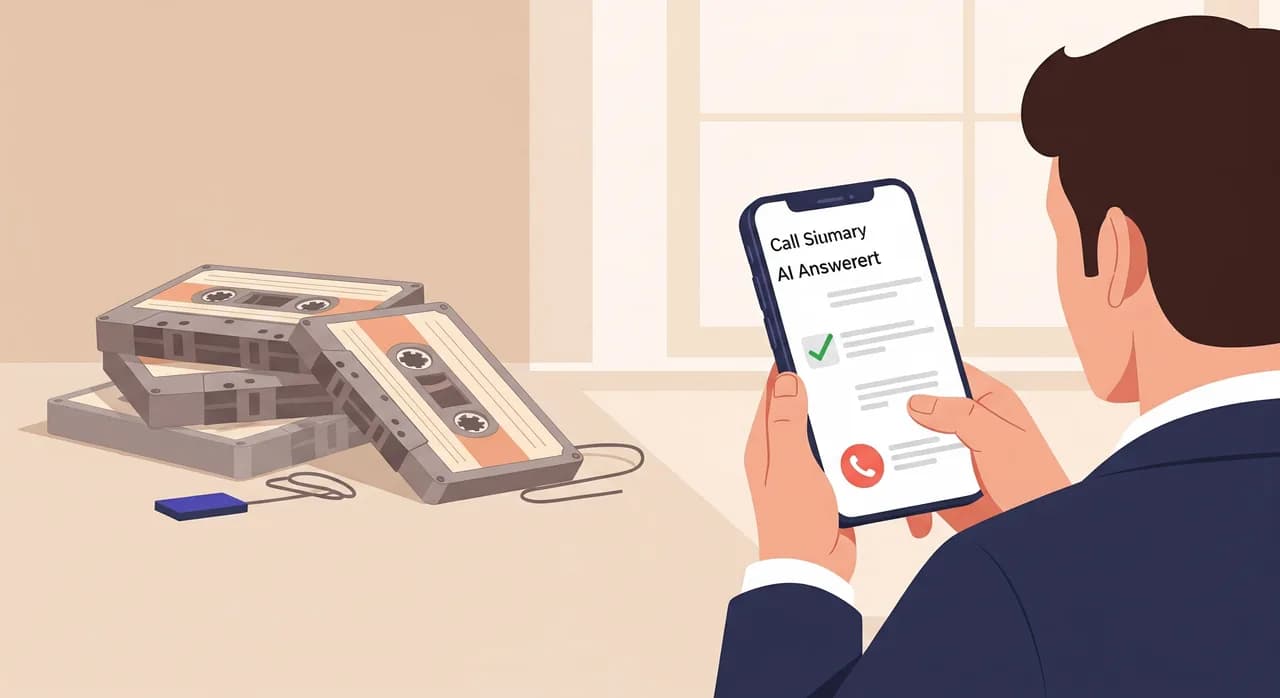
- 4It sends you the recordAfter every call you get a written summary plus the transcript — who called, what they wanted, what was agreed — so nothing lives inside a recording you have to replay later.
Two honest guardrails matter here. It hands off gracefully: when a caller asks for something outside its knowledge, or clearly needs a person, it says so and takes a message rather than guessing. And it doesn't pretend to be human when asked directly — no theatre, no deception. That honesty is part of why callers stay on the line instead of feeling tricked.
Side by side: the same call, two outcomes
Comparisons feel abstract until you run one call through both systems. Here's the same simple inquiry — someone who wants to book and has one question — landing in voicemail versus landing on an assistant.
| Moment in the call | Voicemail | AI receptionist |
|---|---|---|
| Caller reaches you | Beep, then silence to fill | Spoken greeting in your name |
| "Are you open Saturday?" | No answer; caller left guessing | Answered from your hours instantly |
| "Can I book for two?" | Recorded, if they bother | Booked on the spot or a callback arranged |
| After the call | A recording you must replay | Summary and transcript in your inbox |
| Likely result | Caller tries a competitor | Caller is served and stays |
Nothing in that table is exotic. It's the ordinary shape of most inbound calls to a small business — a quick question wrapped around an intent to buy. Voicemail treats the whole thing as something to store and deal with later. An assistant treats it as something to finish now.
Where voicemail is still perfectly fine
Now the honest part, because pretending voicemail is useless would be its own kind of AI-slop marketing. Voicemail is a mature, reliable, free tool, and there are situations where reaching for anything fancier is overkill. If your calls fit these patterns, voicemail may be all you need.
- Very low call volume. If your phone rings a handful of times a month and every caller already knows you, the friction of voicemail costs you almost nothing.
- Callers who will always wait. Existing clients, suppliers, regulars — relationships where a message and a callback are completely normal and nobody's shopping around.
- Genuinely message-only lines. A back-office number, a line that only ever takes deliveries or admin notes, where there's no sale to lose and no question to answer.
- A short, planned absence. Closed for a week's holiday? A clear voicemail with a reopening date and an emergency contact does the job honestly.
- When a wrong answer would be worse than no answer. If a call absolutely must reach a specific qualified person and nothing else will do, a message that flags urgency can be the safest route.
The pattern under all of these: voicemail is fine when the caller is patient, the stakes are low, and there's nothing useful to say that isn't "I'll call you back." The moment a caller is new, impatient, or asking a question you could have answered — which describes most growth-driving calls — deflection starts quietly costing you.
The objections worth taking seriously
"Won't callers hate talking to a machine?" Some might — but they already hate talking to voicemail, which is also a machine, just a deaf one. The difference is that an assistant listens and responds. In practice people are far more forgiving of something that answers their question than of a beep that stores it. And when someone clearly wants a human, a good assistant takes a message and arranges a callback rather than stonewalling.
"What if it gets something wrong?" Fair concern, and the answer is scope. An assistant should only speak from the profile you gave it — your hours, your services, your prices. If it doesn't know, it should say so and hand off, not improvise. That's a design choice, and it's why setting up the profile carefully matters more than any clever feature.
"Isn't setup a project?" This is the objection that keeps people on voicemail longest, and it's mostly outdated. With Vunoon you sign up, describe your business in a short wizard, talk to the assistant to test it, and forward your number — minutes, not weeks. There's a free trial, so you can hear it handle your own calls before you commit to anything. If it doesn't feel right, your voicemail is still sitting there, unchanged.
How to decide for your own line
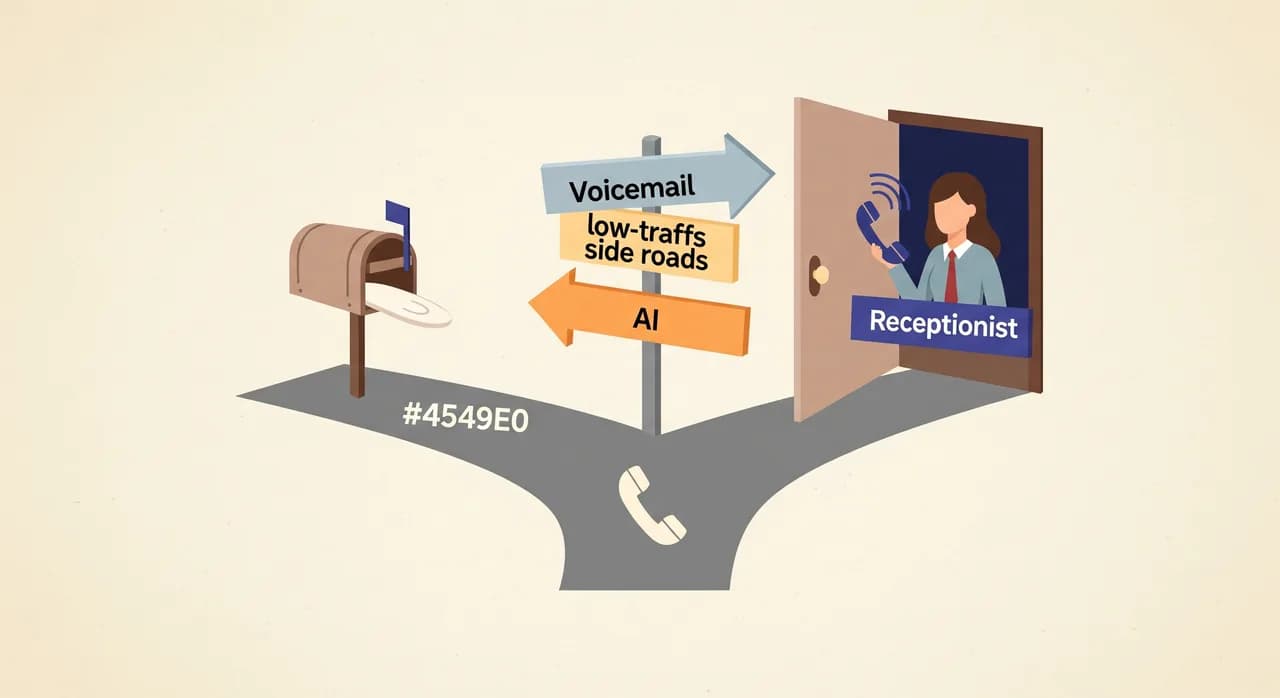
You don't need a framework, just a few honest answers about the calls you actually get. Run your line through these questions and the choice usually makes itself.
- Are most of your callers new to you, or existing relationships? New skews toward an assistant.
- Do people call outside your working hours or while you're mid-task? Gaps skew toward an assistant.
- Could a correct answer to a simple question close the call? If yes, voicemail is leaving money behind.
- Would the caller happily wait a day for a callback? If genuinely yes, voicemail may be fine.
- Is there anything to say beyond "we'll get back to you"? If there is, you want something that can say it.
If you answered "new callers, off-hours, simple questions, impatient people, real answers available" — which is most service businesses — you're describing a line that's leaking value to voicemail every week. The fix isn't to work the phones harder. It's to stop deflecting the calls you meant to capture.
Common questions
Is an AI receptionist just a smarter voicemail?
Can an AI voicemail answering service actually book appointments?
Will my callers know it isn't a person?
Should I get rid of voicemail entirely?
How long does it take to switch from voicemail to an assistant?
Stop sending your best calls to a beep
Hear Vunoon answer your own line before you decide. Set it up in minutes, test it by talking to it, and keep your voicemail exactly where it is if you change your mind.
See how to never miss a call
Vunoon builds an AI phone assistant that answers your business calls 24/7 — it books appointments, answers common questions and sends you a summary of every conversation.