AI Secretary for Phone Calls vs. a Telephone Secretary Service
Outsourced telephone secretaries have covered small-business phones for decades. Here is an honest look at how an AI secretary for phone calls compares on price, knowledge, message quality, and availability.
 Vunoon15 min read
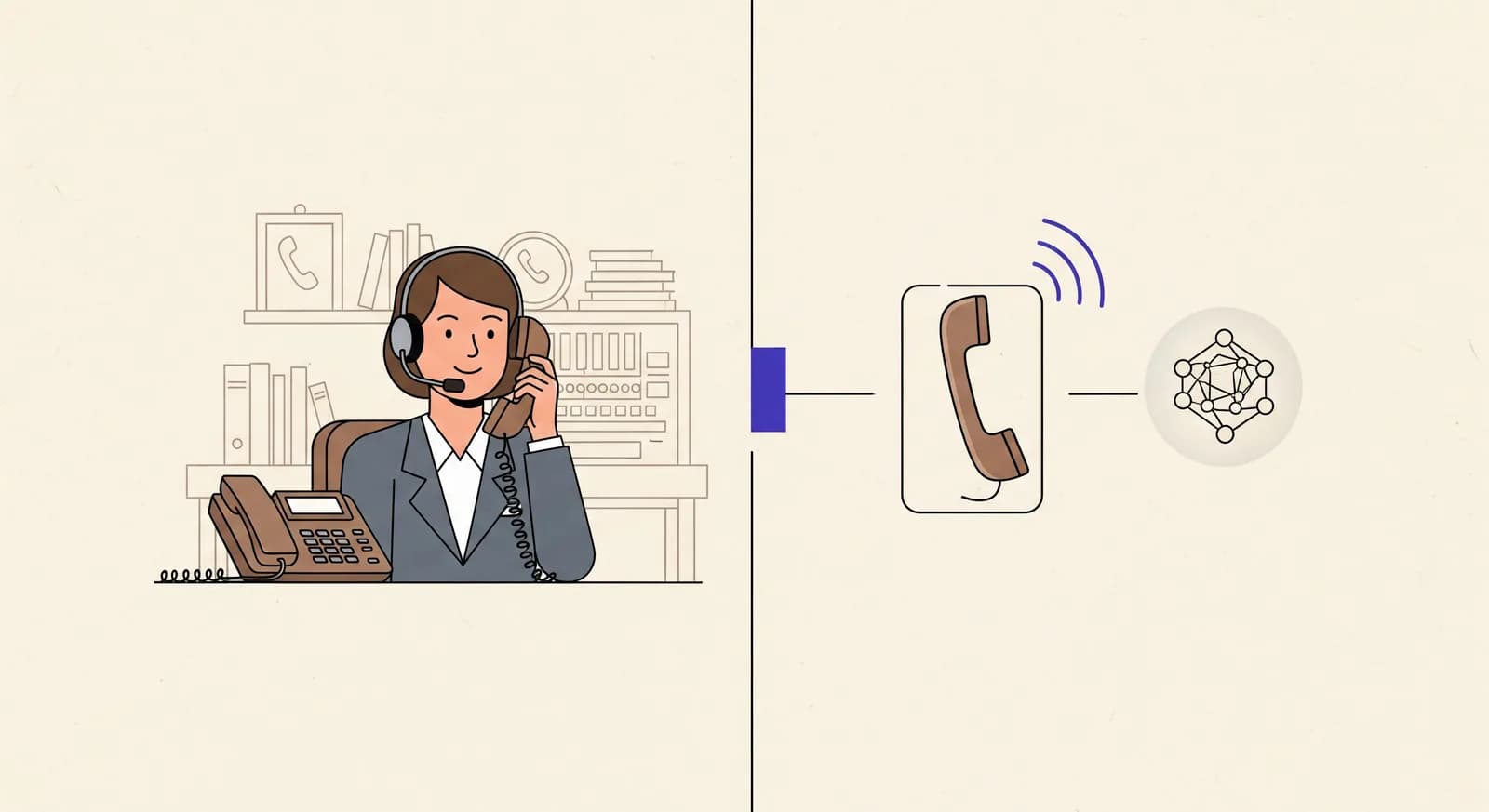
For decades, the small business that couldn't answer every call had exactly one option: pay a telephone secretary service to do it. Now there's a second option that didn't exist a few years ago — an AI secretary for phone calls that picks up on the first ring, in your business's voice, for a flat monthly fee. This is an honest comparison of the two, including the places where the human service still wins.
If you run a two-person clinic, a workshop, a salon, or a law office, the telephone secretary service — the Telefonsekretariat, the télésecrétariat, the outsourced answering service — is a familiar friend. Someone in an office somewhere picks up when you can't, says your company name, takes a message, and emails it to you. It has quietly propped up small businesses for a long time, and in many markets it still dominates the search results when an owner types "who can answer my phone".
The question isn't whether these services work. They do. The question is whether, in 2026, they're still the best-value way to make sure a ringing phone becomes a booked customer instead of a voicemail nobody checks. Let's go through it properly — pricing, knowledge, message quality, availability, and the awkward edge cases — and be upfront about the trade-offs on both sides.
What each one actually is
A telephone secretary service is a company that employs receptionists who answer calls for many businesses at once. When your line rings and you don't pick up, the call routes to their team. An agent sees a short script and a few notes about your business on their screen, answers with your greeting, and does whatever your plan allows — usually taking a message, sometimes booking into a calendar. You're billed per call, per minute, or per bundle of both.
An AI secretary for phone calls is software that answers instead of a person. You set it up once by describing your business — services, hours, prices, the questions you get asked ten times a day — and it handles calls itself. It greets the caller, answers questions from what you told it, takes bookings or messages, and sends you a summary and transcript afterward. There's no queue of other businesses ahead of you, because it's not one team splitting attention across a hundred clients.
That last difference is the quiet one that shapes everything else. The human service is a shared resource. The AI is dedicated to you. Hold that thought — it explains most of what follows.
The price model: per call vs. flat
This is where the two diverge most sharply, and where the maths is worth doing on the back of an envelope before you sign anything.
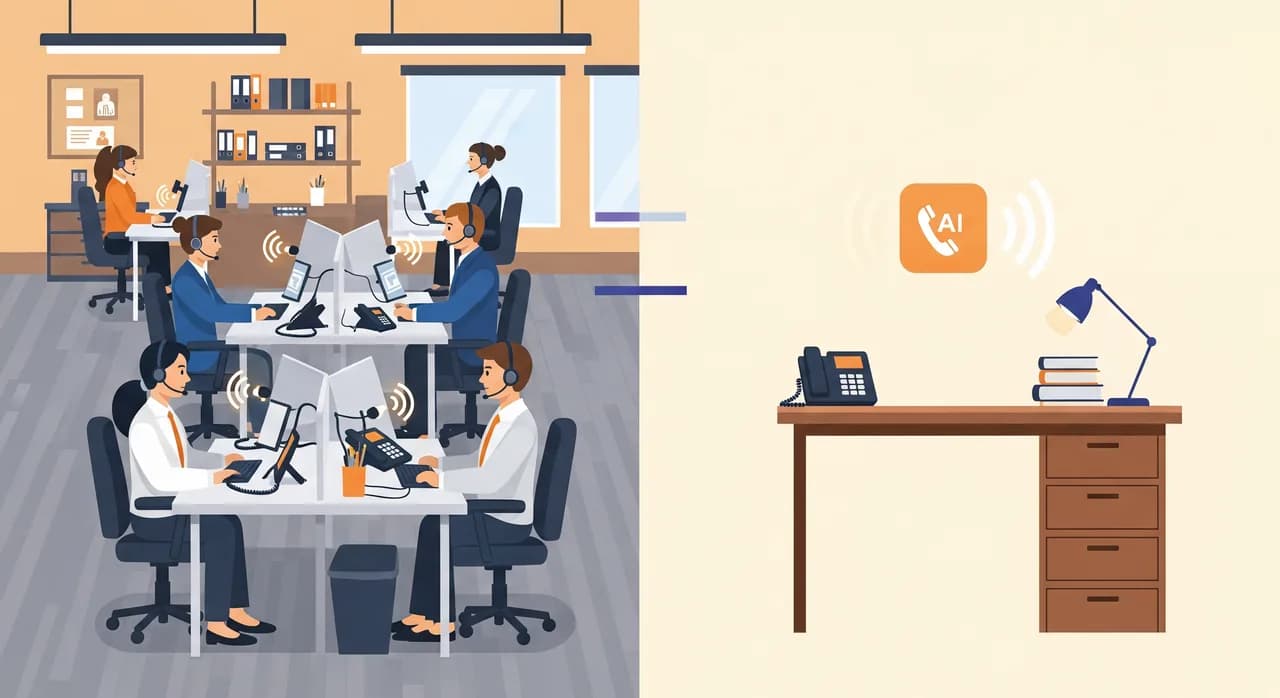
Almost every telephone secretary service is usage-based. You pay for a block of calls or minutes, and when you run over, the meter keeps running. On a slow month that feels fair. On a busy month it punishes you exactly when you least want to be punished — the month you're getting the most enquiries is the month the bill spikes. A single chatty caller who wanders for four minutes about parking and opening hours costs the same as a caller who books three appointments.
An AI secretary is typically flat: one predictable monthly figure regardless of whether it answers twenty calls or two hundred. The cost per call falls as your volume rises, which is the opposite of the usage model. There's no penalty for a busy week, no anxiety about a caller who won't get to the point, no bill that arrives shaped like your best sales month.
None of this means the human service is overpriced for what it is — you're paying for trained people, and people cost money. It means the shape of the cost is different, and the shape matters more than the sticker. For pricing on the AI side, our numbers are on the pricing page rather than buried in a per-minute table.
How much does it actually know about your business?
Here's the uncomfortable truth about most telephone secretary services: the agent answering your call has a screen with a paragraph on it. They're kind, professional, and completely reliant on that paragraph. Ask them something it doesn't cover — "do you do same-day emergency appointments?", "is the crown price with or without the lab fee?", "can I bring my dog into the waiting room?" — and the honest answer is "I'll take a message and someone will call you back."
That's not incompetence. It's structural. The agent is fielding calls for dozens of businesses in a shift and cannot hold deep knowledge of each one. Their job is to be a polite relay, not an expert. So a lot of calls that could have been resolved — and a lot of bookings that could have been closed — turn into a callback that may or may not happen before the caller phones someone else.
“The human agent answers for a hundred businesses and knows a paragraph about each. The AI answers for one and knows the whole profile.”
An AI secretary flips the depth. Because it only serves your business, you can load it with everything: the full service list, the price of a specific treatment, the difference between your two appointment types, the fact that you're closed the first Monday of the month, the exact directions from the car park round the back. When a caller asks, it answers — accurately, in the same wording every time — instead of promising a callback.
That's the real dividing line. A telephone secretary service is excellent at capturing a call. An AI secretary is built to resolve it. Resolution is what turns a phone call into revenue, because the caller who got their answer and booked their slot never had a reason to call your competitor next.
Message quality and what lands in your inbox
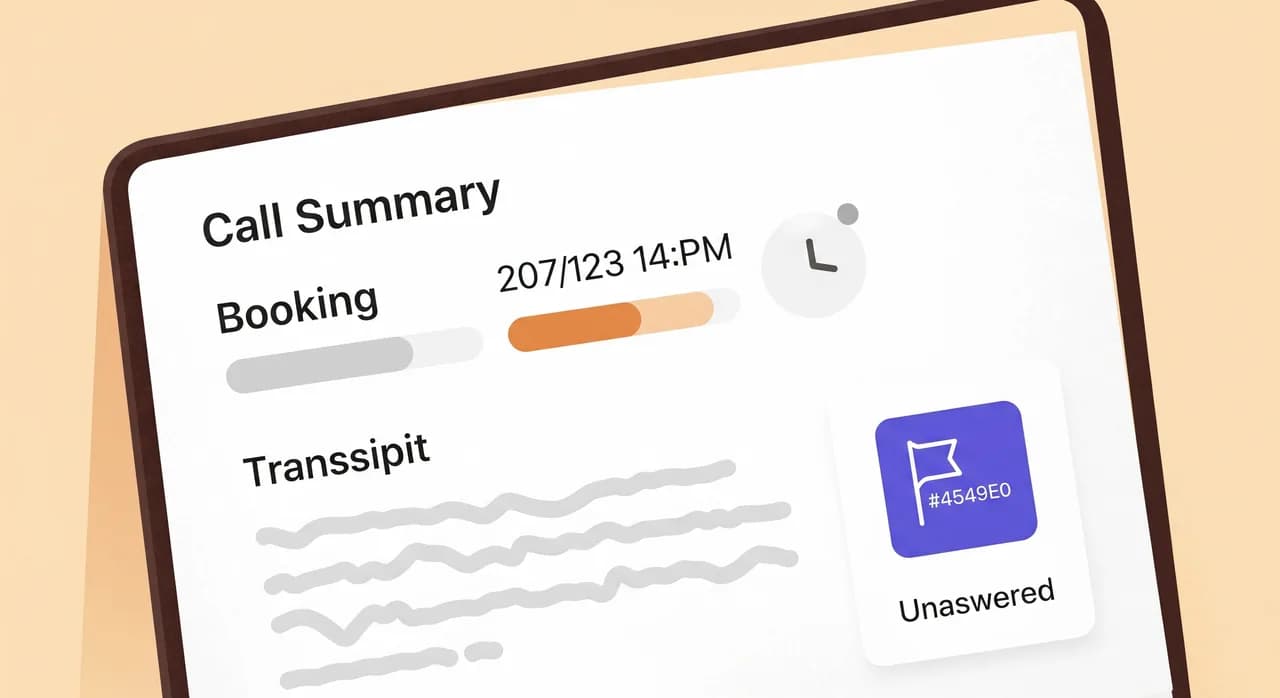
Compare what actually arrives after a missed call. From a typical secretary service you get a short note: caller name, number, "wants to book", called at 14:12. Useful, but thin. You still have to call back to find out what they actually wanted, which appointment, and whether it was urgent.
A good AI secretary sends you the whole thing:
- A plain-language summary of what the caller wanted and what was agreed.
- The full transcript, so nothing is paraphrased away and you can hear the tone even in text.
- The booking details if one was made — date, time, service, name, number — already structured.
- Any question it couldn't answer, flagged clearly so you know what to follow up on.
- A recording, where you've allowed it, for the calls that matter.
The practical effect is that you spend your evening reading, not phoning back. You open your inbox, see five summaries, and know instantly which one needs your attention and which four are already handled. With a message-only service you'd be starting five callbacks from scratch, half of them landing on voicemail.
Availability: the 2am test
Ask any telephone secretary service one blunt question: are you staffed at 2am on a Sunday, and does that cost extra? Many are only open in business hours. Those that offer round-the-clock cover charge a premium for it, and out of hours you're often further back in a shared queue because fewer agents are on.
An AI secretary doesn't sleep, doesn't take holidays, and doesn't cost more at 2am than at 2pm. It picks up on the first ring at every hour, which matters more than it sounds. A surprising share of small-business calls come in evenings and weekends — someone on their sofa finally remembering to book the thing they've been putting off. If your phone rings out or drops to voicemail then, you've lost them to whoever answered.
This is the same argument as our after-hours answering and never-miss-a-call use cases: the value isn't the call you took, it's the customer you kept from calling your competitor. Availability is the cheapest advantage to have and the most expensive to lack.
Where the human service still wins
It would be dishonest to pretend the AI wins everything. A telephone secretary service has genuine strengths, and for some businesses they're decisive.
- Judgement in a mess. A distraught caller with a complicated, emotional problem is handled better by a human who can read the room, improvise, and de-escalate. Software is good at clear intents, not at grief.
- The unscripted curveball. A person can chase down an odd request, cross-reference two things, or just decide something is a bad idea and pause. That kind of on-the-spot judgement is still a human strength.
- Zero setup effort. With a secretary service you hand over a paragraph and you're done. An AI needs you to sit through a short wizard and describe your business properly. Fifteen minutes, but it's fifteen minutes you have to actually spend.
- The comfort of a person. Some clientele — and some owners — simply prefer knowing a human answered. That's a legitimate preference, not a flaw.
So the honest framing isn't "AI beats humans". It's that the two are good at different jobs. If most of your calls are messy, emotional, and unpredictable, lean human. If most of your calls are the same twenty questions and a booking — which, for the majority of small businesses, they are — the AI resolves them faster, cheaper, and around the clock.
And where the AI still loses
Fair is fair. A responsible AI secretary has hard limits, and you should know them before you switch.
It won't pretend to be human when a caller asks directly — that's a design choice, not a bug, and the right one for trust. It won't give medical, legal, or financial advice, and it shouldn't. It won't invent an answer to a question you never told it about; it takes a message instead. And it needs a good profile to be good — feed it nothing and it behaves like an under-briefed temp.
The reassuring part is that its failure mode is a clean handoff: it takes a proper message, flags what it couldn't handle, and passes it to you. That's the same fallback a secretary service gives you — except the AI got there after actually trying to resolve the call, not instead of trying.
A side-by-side you can scan
If you've read this far, here's the whole argument compressed into one place. Weigh it against your own call log, not against a brochure.
| Telephone secretary service | AI secretary for phone calls | |
|---|---|---|
| Pricing shape | Per call or per minute — rises on busy months | Flat monthly — predictable at any volume |
| Business knowledge | A short script; deeper questions become callbacks | Your full profile; answers detailed questions itself |
| Message quality | Name, number, brief note | Summary, full transcript, structured booking, flagged gaps |
| Availability | Business hours, or 24/7 at a premium | 24/7 at no extra cost, first-ring pickup |
| Messy, emotional calls | Human judgement — a real strength | Clean handoff to you rather than improvisation |
| Setup effort | Hand over a paragraph | A short self-serve wizard, then forward your number |
| Languages | Depends on staff on shift | 25+ languages, same assistant |
Who should choose which
Rather than a verdict, a few honest recommendations.
- 1Choose a human secretary service ifyour calls are unpredictable, emotionally loaded, or genuinely need human judgement each time — and your volume is low enough that the per-call bill stays gentle. Some professions and some clienteles simply want a person, and that's a valid reason on its own.
- 2Choose an AI secretary ifmost calls are variations on the same questions plus a booking or a message, you get calls outside office hours, and a per-call bill that balloons on your busiest month makes you wince. This describes most salons, clinics, trades, and small practices.
- 3Consider running bothlet the AI answer everything first — instantly, 24/7, resolving the routine — and route the genuinely complex or sensitive calls to a human. You get resolution on the common cases and judgement on the rare ones, without paying per call for the routine majority.
“You're not choosing who answers the phone. You're choosing whether a ringing phone becomes a booking or a callback nobody makes.”
How to try the AI side honestly
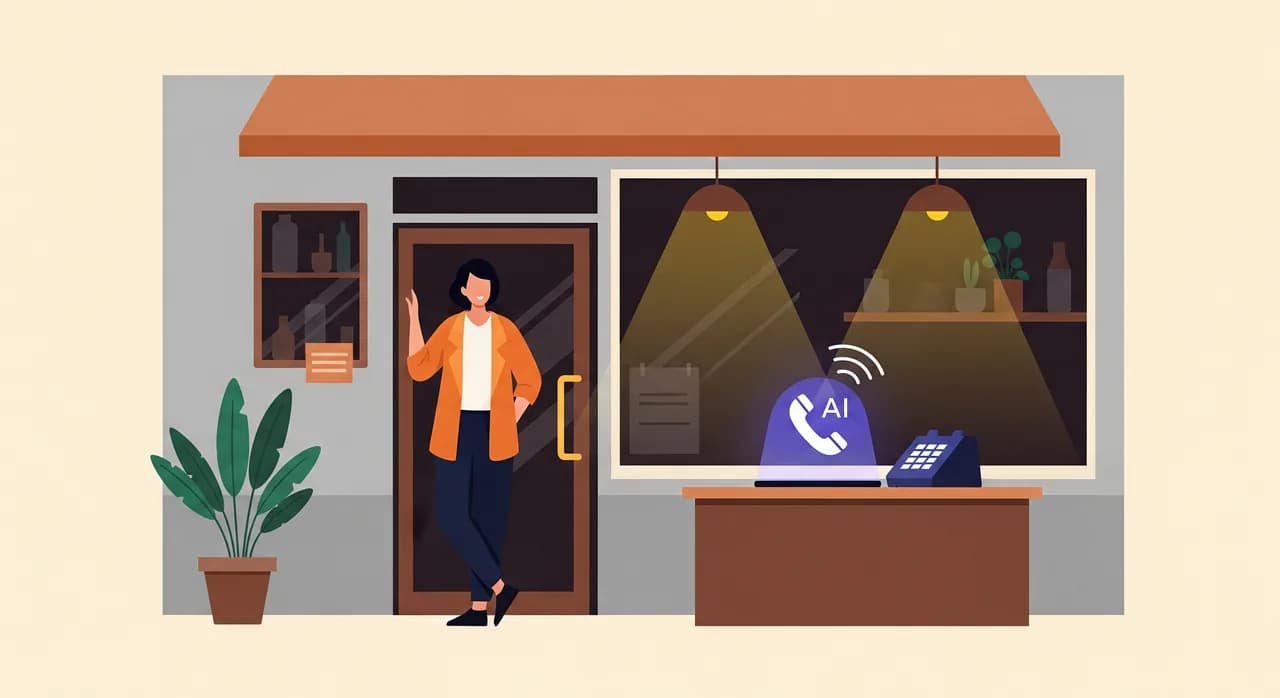
The nice thing about testing an AI secretary is that you don't have to trust a sales pitch — you can just call it yourself before a single customer ever does. Here's a fair test.
- 1Set it up with your real businessRun the short wizard and describe your actual services, hours, and prices — not a stripped-down version. The whole point of the AI's edge is depth, so give it the depth.
- 2Phone it and misbehaveAsk your three hardest routine questions. Interrupt it. Change your mind mid-sentence. Ask to book, then ask about parking. See whether it resolves or fumbles.
- 3Try to break itAsk something you never told it. It should take a clean message and flag the gap — not invent an answer. That's the behaviour you want when a real caller does the same.
- 4Read the summary it sendsCheck the email lands, the transcript is accurate, and any booking came through correctly. If the message that reaches you is good, the calls you never see will be too.
Do the same fairness for the human service if you're weighing one: call it as a mystery customer and ask a real question, then see how long the promised callback actually takes. Both sides deserve a test, not a brochure.
Is an AI secretary for phone calls cheaper than a telephone secretary service?
Will callers be able to tell they're talking to AI?
Can an AI secretary actually book appointments, or just take messages?
What happens with a complicated or emotional call?
Does an AI secretary work outside business hours?
How much work is it to set up compared to a secretary service?
See the two side by side
Weigh an AI secretary for phone calls against a traditional answering service on the details that decide the bill — and try answering your own phone before a customer does.
Compare the options
Vunoon builds an AI phone assistant that answers your business calls 24/7 — it books appointments, answers common questions and sends you a summary of every conversation.