How to Track Missed Business Calls: A One-Week Audit
Most owners guess at how many calls they miss. This is a hands-on, seven-day audit that turns the guess into a real number you can act on.
 Vunoon14 min read
Ask most small-business owners how many calls they miss in a week and you'll get a shrug, a guess, or a defensive "not that many." Ask them how many they booked and they can tell you to the dollar. That gap — precise about wins, vague about losses — is exactly where money quietly leaks out. This is a one-week audit to close it: a repeatable way to track missed business calls, tag what actually happened, and end up holding a real number instead of a feeling.
You don't need software you don't already have. You need your phone bill, a spreadsheet, and about ten focused minutes a day for seven days. At the end you'll know your true miss rate — the share of calls that reach nobody and never get called back — and you'll be able to put a rough dollar figure next to it. That figure is the whole point. Once you can see it, you can decide whether it's worth fixing.
Why your gut number is always too low
There's a simple reason owners underestimate missed calls: you only remember the ones you know about. A missed call that goes to voicemail and gets a message left is visible — it nags at you until you return it. A missed call where the caller hangs up on the third ring, or bails halfway through your voicemail greeting, leaves no trace you'll ever notice. It's not on a sticky note. It's not a red badge. It happened while you were elbow-deep in another job, and as far as your memory is concerned, it never happened at all.
The other reason is that misses cluster. They don't arrive one an hour, politely spaced out. They pile up during the exact windows when you can't answer: the lunch rush, the school run, the two hours a plumber spends under a sink with a wrench in one hand. So the days you feel busy and productive are often the days you're leaking the most. The audit exists to replace this fog with a log.
What you need before day one
Set up takes fifteen minutes and you only do it once. Gather three things and you're ready.
- Access to your carrier's call log. Every mobile carrier and most VoIP or landline providers let you see itemised call history in an online account or app: number, timestamp, direction, and duration. If you use a business VoIP system, this is usually a downloadable CSV, which makes the whole audit twice as fast.
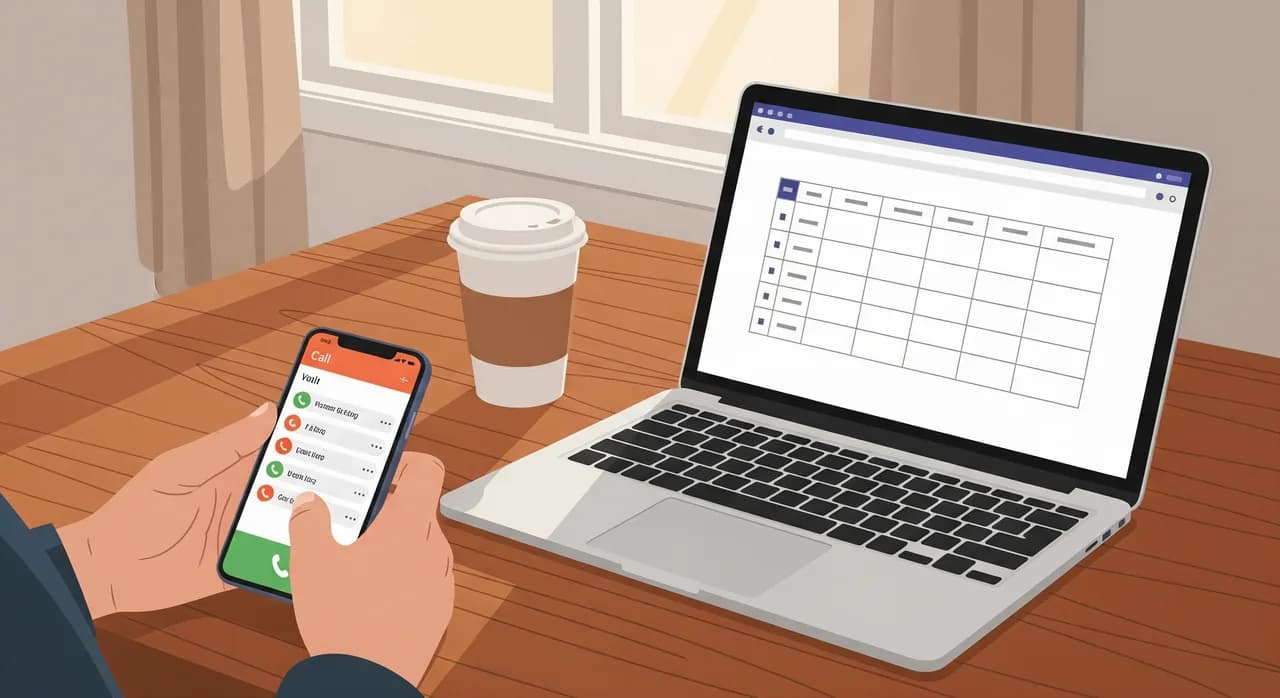
- A spreadsheet. One tab, seven columns. That's the entire tool. Google Sheets, Excel, anything.
- Whoever answers your phone. If it's just you, easy. If a receptionist, a partner, or a family member picks up too, loop them in now — they'll tag calls they handled so those don't get miscounted as misses.
Make your columns: Date · Time · Number · Direction · Duration · Outcome · Note. Direction is inbound or outbound. Duration matters more than you'd think — a fourteen-second inbound call is almost never a real conversation; it's a ring-out or a hang-up mid-greeting. We'll use duration as a lie detector later.
The seven-day plan, day by day
Run this over one ordinary week — ideally a full trading week including whichever days are your busiest. Don't pick a quiet holiday week to make the number look kind. You want the truth, not comfort.
- 1Day 1 — Set up and start tagging liveBuild the spreadsheet. From today, at the end of each day, open your carrier log and paste in every inbound call. For each one, mark the outcome from your own memory and any voicemails: answered, voicemail with message, voicemail no message, or ring-out/hang-up. Ten minutes, tops.
- 2Days 2–5 — Log daily, don't batchRepeat the end-of-day pass every single evening. The reason to do it daily rather than reconstruct the whole week on Sunday is simple: by Sunday you won't remember whether Tuesday's 11:04 call was a real customer or a wrong number. Fresh memory is accurate memory.
- 3Day 6 — Cross-check with the people who answerSit down with anyone else who picks up the phone and reconcile. They'll have handled calls that never touched voicemail, so those get marked answered even though your log looked like a miss. This step alone stops you from wildly overcounting.
- 4Day 7 — Chase the ghostsTake every inbound call still tagged as a ring-out, hang-up, or voicemail-no-message. Check each number against your bookings, your CRM, your inbox. Did that person reach you another way? Did anyone call them back? If yes, reclassify. Whatever's left after this is a genuine missed opportunity.
How to tag each call so the count is honest
The audit lives or dies on consistent tagging. Use a small, fixed set of outcome labels and don't invent new ones halfway through. Here's the vocabulary that works.
| Tag | What it means | Counts as a miss? |
|---|---|---|
| Answered | A real conversation happened, live | No |
| Answered late | Rang a while but you picked up and handled it | No |
| Voicemail — returned | They left a message and you called back same day | No |
| Voicemail — no callback | Message left, nobody called back | Yes |
| Voicemail — no message | Rolled to voicemail, caller hung up | Yes |
| Ring-out | Rang until it stopped, no voicemail reached | Yes |
| Not a customer | Spam, wrong number, supplier, personal call | Excluded |
The "Not a customer" tag is the one people forget, and it matters enormously. If you count the robocall about your "vehicle's extended warranty" as a missed booking, your final number is garbage. Be ruthless here: suppliers you already work with, your own outbound calls, obvious spam, and personal calls all get excluded. What remains is calls from people who might have become customers.
Computing your true miss rate
Now the arithmetic, which is deliberately simple. First, throw out everything tagged "Not a customer" — those never counted. Call what's left your real inbound calls. Then count how many of those carry a miss tag: voicemail-no-callback, voicemail-no-message, or ring-out.
Your miss rate is simply: missed calls ÷ real inbound calls. If you had 80 real inbound calls in the week and 22 of them dead-ended, that's 22 ÷ 80 = 27.5%. Better than one in four callers reached nobody. That's not a doomsday statistic pulled from a study — it's your own week, on your own phone, and you can point to every row.
“The goal isn't a scary percentage. It's a number you can't argue with because you counted it yourself.”
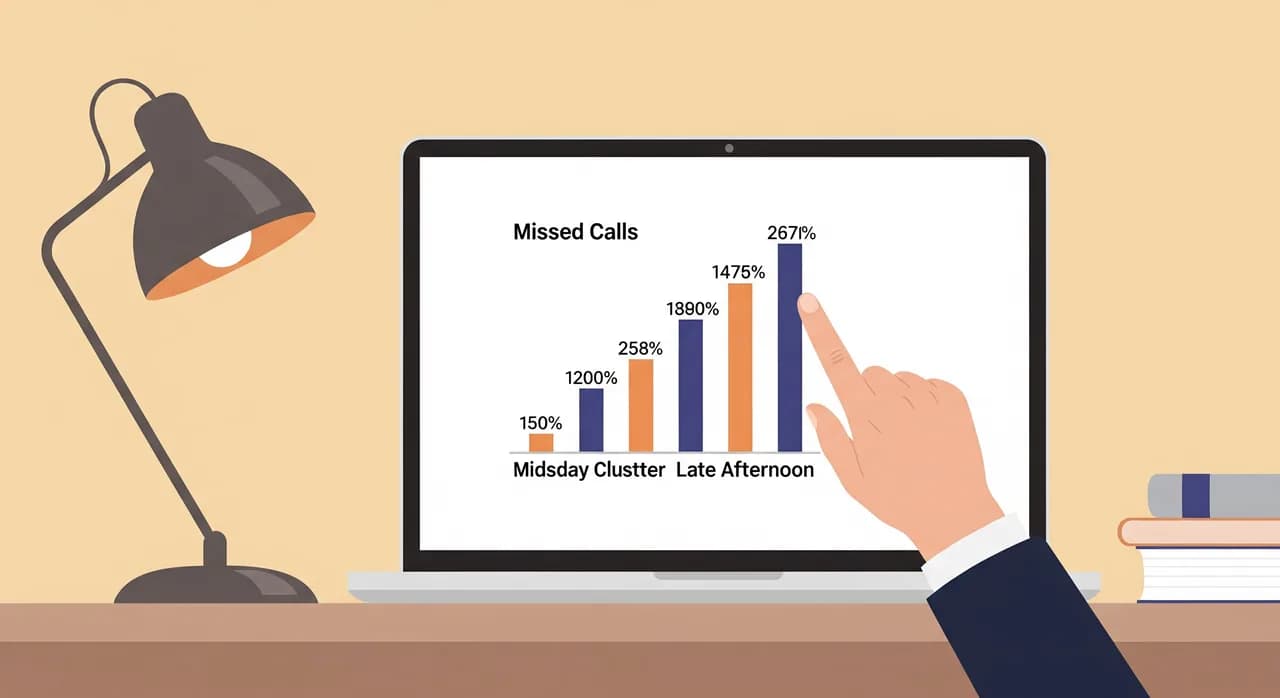
Two more cuts make the number more useful. Split misses by time of day — you'll almost always find a cluster, and it's usually painfully obvious in hindsight (lunch, or the last hour before close, or right when you're on site). Then split by weekday versus weekend or after-hours. Many small businesses discover that a huge share of misses land when the shop is simply shut — which is a different, and often easier, problem to solve than being too busy during open hours.
Putting a rough price on the leak
A percentage is interesting. A dollar figure changes behaviour. You can estimate the cost of your misses with three numbers you already know, no fabricated benchmarks required.
- Your missed calls per week — straight from the audit.
- The share of real inbound callers who become customers when you do answer. Don't overthink this. If roughly one in three people who reach you end up booking, that's 33%. Use a conservative estimate.
- The average value of one job or sale. Use your typical ticket, not your best-ever invoice.
Multiply them: missed calls × conversion rate × average job value. Say 22 missed calls a week, a 33% conversion rate, and a $180 average job. That's 22 × 0.33 × $180 ≈ $1,300 a week of opportunity walking out the door — call it $60,000-plus a year of potential revenue you never got a shot at. Round it down hard if it feels too big to believe. Even halved, it's the kind of number that makes you stop scrolling.
Reading your results honestly
Once the numbers are in, resist the urge to either panic or explain them away. A few patterns show up again and again, and each one points to a different fix.
Most misses are after hours
If the bulk of your dead-ends land in the evening, at weekends, or before you open, the problem isn't that you're slow — it's that nobody's there. A callback the next morning sometimes works, but for anyone comparing three businesses at 8pm, you've already lost. This is the cleanest case for always-on answering of some kind, because there's no version of you that can pick up at 10pm on a Sunday.
Most misses are during open hours
This one stings, because it means calls are coming in while you're technically "available" — but hands-deep in work, driving, or on another line. The fix here is about overflow and coverage: something that catches the call when your hands are full, takes the details, and lets you follow up without the caller having reached a void.
Voicemails pile up and never get returned
If your log is full of "voicemail — no callback," the honest diagnosis is that voicemail is a graveyard, not a safety net. People increasingly won't leave one anyway, and the ones who do often get to a competitor before you find the message. A voicemail-heavy audit is a sign that your real answer rate is even lower than it looks, because the safety net has holes.
“Voicemail feels like a backup. For most callers in a hurry, it's just a slower way of hanging up.”
What to do with the number you've built
The audit is diagnosis, not treatment. But it hands you a clear shortlist of options, and now you can weigh each one against a real cost instead of a hunch.
- Change your own habits. Sometimes the fix is boring and free: a firm rule to return every voicemail within an hour, or forwarding your line to a partner during your busiest window. Cheap, but it depends on discipline and it can't cover after-hours.
- A human answering service. A team picks up in your name. It covers hours you can't, but it costs per call or per minute, and quality varies. Your audit tells you whether the volume justifies it.
- An AI phone assistant. Software that answers every call, day or night, in your business's voice — greets callers, answers questions from a profile you set up, takes bookings and messages, and sends you a summary and transcript of each call. It handles the after-hours and overflow patterns at once, and it doesn't get tired at 11pm on a Saturday.
Vunoon is in that last category, and it's worth being straight about what it is and isn't. It answers the phone 24/7 and can hold a natural conversation about your services, hours, and prices — the ones you configure. It won't pretend to be a person if a caller asks, and it hands off gracefully: take a message, or have you call back. It won't magically close every sale or replace judgement calls that genuinely need you. What it does do is make sure the call is answered — which, if your audit looks anything like most, is where the whole leak begins.
Re-run the audit after you change something
Whatever fix you try, the audit is how you prove it worked. Run the exact same seven-day process a few weeks after you make a change and compare the two miss rates. This is the part almost nobody does, and it's the part that turns a guess into a decision you can defend.
If you set up an AI assistant, the re-audit is even easier, because the assistant logs every call and sends you transcripts — so your "misses" column should collapse to the handful of calls that genuinely needed a human and got escalated. If it doesn't improve, you'll see that too, and you can walk away with your baseline intact. Either way you're deciding with evidence.
How do I track missed business calls without special software?
How many days should the audit run?
What counts as a missed call versus a returned one?
How do I turn my miss rate into a dollar figure?
Isn't voicemail a good enough safety net?
Found a leak worth fixing?
If your audit shows calls dead-ending after hours or when your hands are full, Vunoon answers every one — 24/7, in your business's voice — and sends you a summary of each. Try it against your own number and see the misses disappear.
Start your free trial
Vunoon builds an AI phone assistant that answers your business calls 24/7 — it books appointments, answers common questions and sends you a summary of every conversation.