Building a DIY AI Voice Agent for Business vs. Using a Ready Receptionist
A build-vs-buy guide for owners who like to tinker. What a homemade AI voice agent actually involves, where the hidden work lives, and when a managed service saves you months.
 Vunoon16 min read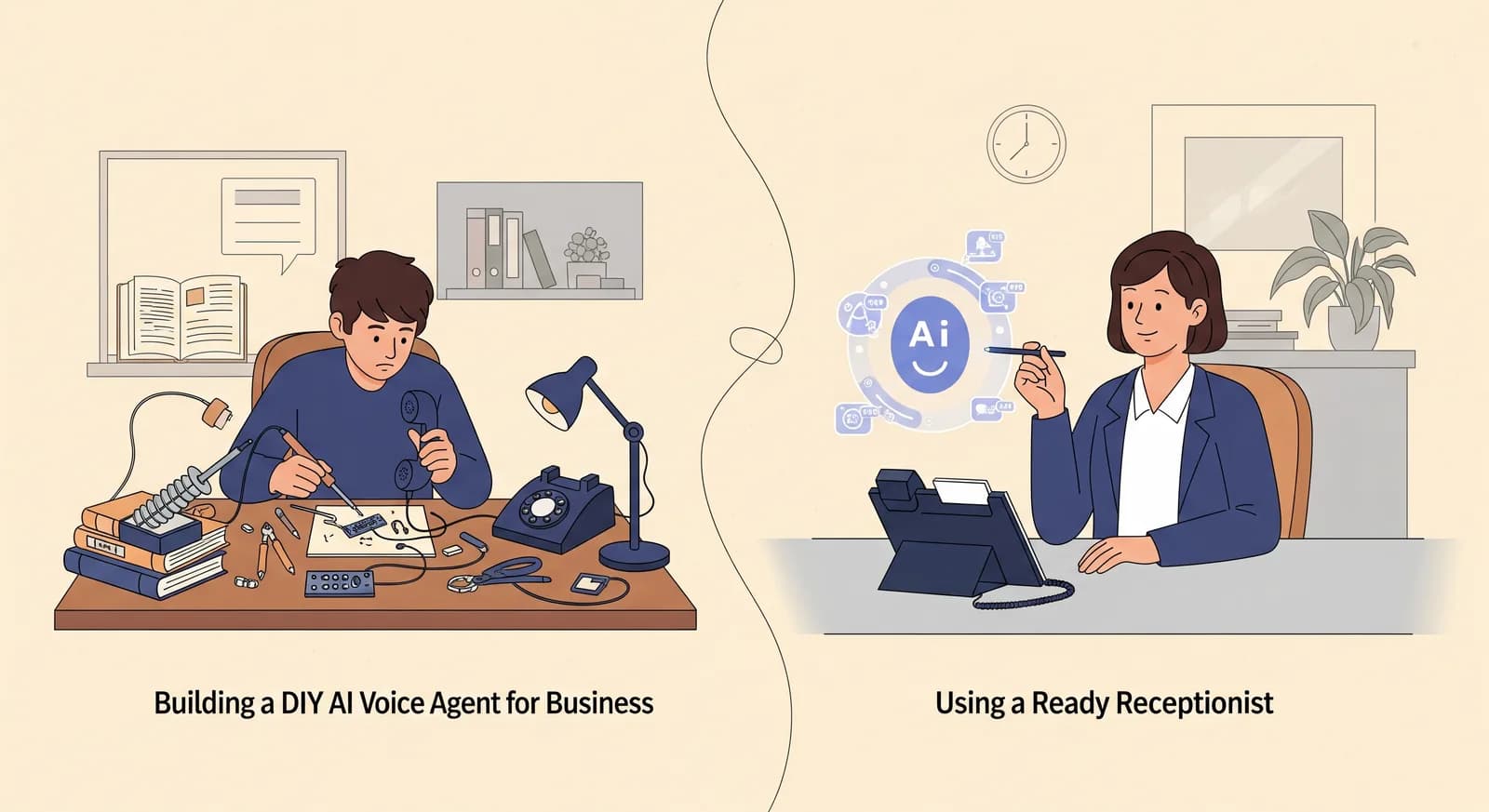
You can build an AI voice agent for your business over a weekend. Whether it survives contact with real customers on a Monday morning is a different question — and that gap between the demo and the dependable is the whole story of build vs. buy.
If you're the kind of owner who's comfortable in a terminal, the idea is tempting. The pieces are all available. Speech-to-text is a cheap API call. Large language models will happily role-play as your receptionist. Text-to-speech now sounds startlingly human. Connect the three, wire in a phone number, and you have a robot answering your line for a fraction of a salary. That's the pitch, and it's not wrong — it's just incomplete.
This article is the honest version. Not "you could never do this" — you could, and for some people it's genuinely the right call. Rather: here is exactly what a do-it-yourself AI voice agent involves, where the effort actually hides, what breaks in production, and how to judge whether your weekend is better spent building or booking. We'll be specific, because vague advice is how people end up six weekends deep in a project they meant to finish in one.
Why building your own AI voice agent is so tempting
The appeal is real, so let's honour it before we complicate it. When you build the thing yourself, you own every decision. The greeting is exactly the greeting you want. The agent knows your quirks — that Tuesdays are walk-in only, that the guy who calls about the blue van is a supplier not a customer, that you never quote prices over the phone. You can wire it into whatever calendar or CRM you already run. And the running cost, on paper, is just the sum of a few API bills, which for a low-volume line can look almost free.
There's also the learning. If you want to actually understand how these systems work — how a model decides to book versus take a message, how latency creeps in, why the agent occasionally talks over the caller — building one teaches you more in a weekend than a month of reading. For a technically curious owner, that education has value even if you later throw the project away.
So this isn't a hit piece on DIY. It's a map of the terrain, drawn by people who've walked it. The question isn't whether you're capable. It's whether the finished, reliable version is worth what it truly costs — and that cost is almost never the part you see in the demo.
The DIY stack, piece by piece
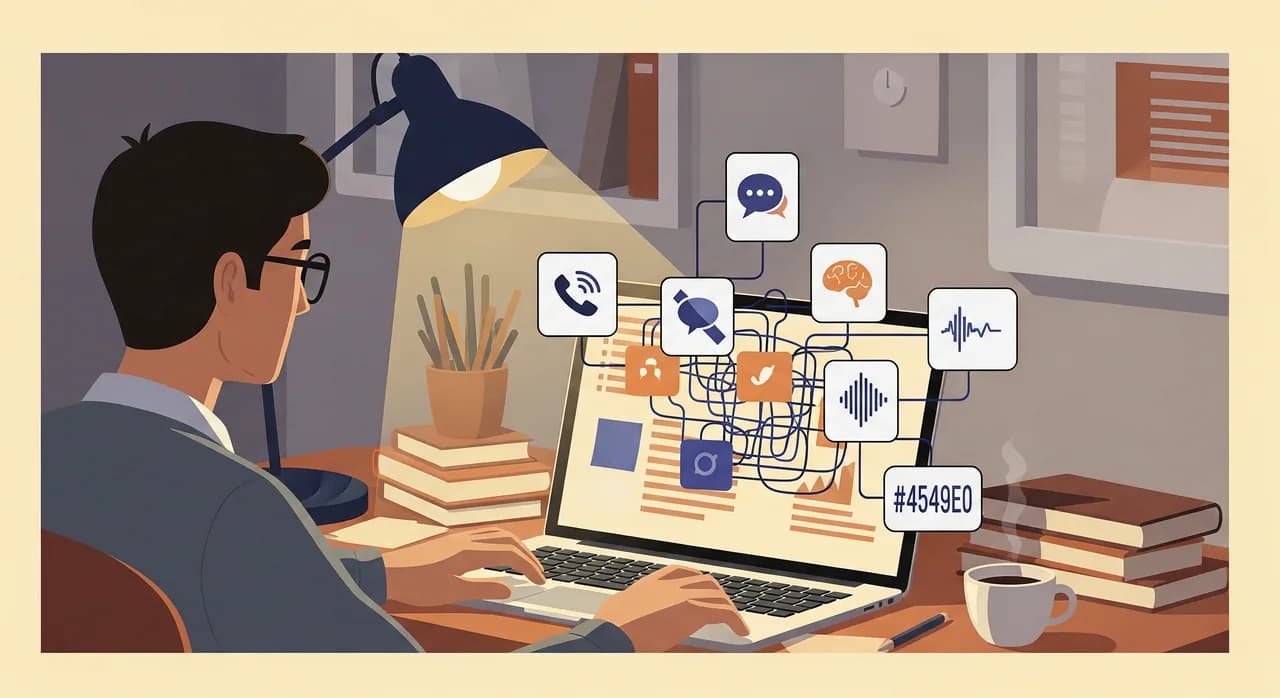
An AI voice agent is a pipeline. A caller speaks, something turns that into text, something decides what to say back, something turns that reply into speech, and all of it rides on top of a phone system. Each stage is a component you have to choose, integrate, pay for, and maintain. Here's the anatomy.
Telephony: getting the call into your code
This is the part most weekend builders underestimate. You need a phone number that can hand a live audio stream to your software and stream your response back — in real time, in both directions, with sub-second latency. That means a telephony provider, a media stream (usually a websocket carrying raw audio), and the plumbing to keep it stable while a human is talking. You'll deal with audio codecs, sample rates, and the fact that phone audio is compressed and noisy in ways your desk microphone is not. Get any of this slightly wrong and the caller hears a robot that clips words, lags a beat behind, or drops the line mid-sentence.
Speech-to-text: hearing the caller
Transcription over the phone is harder than transcription of a clean recording. Callers mumble, stand in wind, drive with the radio on, share a name that isn't in any dictionary. You'll want streaming transcription so the agent can respond before the caller finishes a sentence, plus logic to detect when someone has actually stopped speaking rather than just paused to think. Guess wrong on the pause and your agent either interrupts people or leaves awkward three-second silences. Neither reads as friendly.
The reasoning layer: deciding what to say
This is where the language model lives, and where most of your actual craft goes. You're not just prompting a chatbot; you're building a phone agent that has to stay on-script, pull the right fact from your business profile, refuse to invent prices, know when to book and when to take a message, and never claim to be a human when asked. That's a system prompt, a set of tools it can call (check calendar, save a booking, send a text), and a lot of guardrails. It's also the stage where costs and latency stack up, because every turn of the conversation is another round trip to the model.
Text-to-speech: the voice itself
The voice is the first thing a caller judges. Modern text-to-speech sounds excellent — until it hits a phone number, an address, a decimal, or a foreign name, at which point it can produce something confidently wrong. You'll tune pronunciation, pick a voice that fits your brand, and again fight latency: the faster you want the agent to reply, the more you have to stream speech out while it's still being generated, which is its own small engineering problem.
The glue: everything between the boxes
None of these components talk to each other out of the box. You write the orchestration — the loop that listens, transcribes, thinks, speaks, handles interruptions, manages state across a conversation, logs what happened, and hands the caller off cleanly when the agent is out of its depth. This glue is where a demo becomes a product, and it's the code you'll be maintaining for as long as the agent lives.
The demo-to-production gap
Here's the trap that catches good engineers. You'll get a working demo fast, and it will feel like you're done. You call your own number, ask about opening hours, book a slot, and it works beautifully. You'll be genuinely impressed with yourself, and you should be — that's real progress. The problem is that a demo is a call you already know how to make. Production is every call you didn't script.
Imagine a small hair salon puts a homemade agent live on a Friday. Over the next week the real calls arrive: a caller with a thick accent the transcriber keeps mangling; someone who asks for "the usual" as if the robot knows them; a caller who interrupts to change the appointment halfway through; a wrong number; a supplier; a caller on a train losing signal every few seconds; someone who asks a question the owner never thought to answer, like whether the salon does bridal groups. Each of these is a bug, and each bug is a real customer having a real bad experience while you debug in production.
“A demo is a call you already know how to make. Production is every call you didn't script.”
The insidious part is that voice failures are invisible to you unless you go looking. A caller who has a bad experience with your agent doesn't file a bug report. They hang up, they don't call back, and you never learn it happened. With a text app you can read the broken conversation. With a phone line, the failure walks out the door in silence. Building the agent is the visible half of the work; building the observability to know when it's failing is the half nobody blogs about.
Maintenance: the cost that never ends
Suppose you push through and get a genuinely solid agent live. Congratulations — you now own it. This is the part of DIY that the weekend-project framing hides entirely, because it doesn't happen on the weekend you build. It happens on every weekend after.
- Model churn. The AI providers deprecate and change models on their own schedule. A prompt that behaved perfectly can drift when the underlying model updates, and you find out from a customer, not a changelog.
- API changes. Your telephony, transcription, and voice providers all evolve their interfaces. Something you glued together in March stops working in September for reasons that have nothing to do with your code.
- Your own business changes. New prices, new hours, a new service, a staff change, a holiday closure. Every one of these means editing the agent — and if you hardcoded facts into prompts, that's a code change, not a settings change.
- Cost drift. As call volume grows, or as you add a second language, or as conversations get longer, the API bills climb in ways that aren't linear or obvious until the invoice lands.
- Uptime. When your server hiccups at 8pm, the line is your line. There's no support queue but you, and callers don't care that it's the weekend.
None of this is a reason not to build. It's a reason to be honest that "I built an AI voice agent" and "I run an AI voice agent my business depends on" are two very different sentences. The first is a project. The second is an ongoing responsibility that competes for the same attention you'd rather spend running your business.
What a managed service actually is
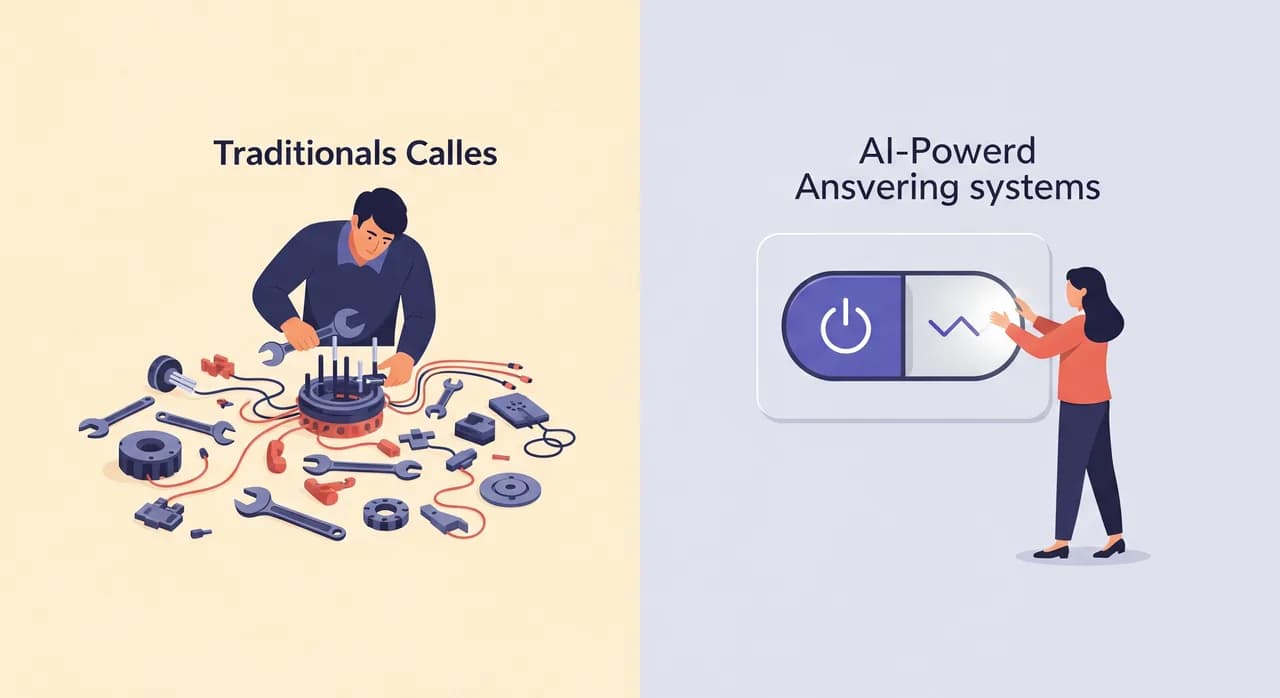
A ready AI receptionist like Vunoon is the same pipeline — telephony, transcription, reasoning, voice, orchestration — but the pipeline is already built, tested against thousands of real calls, and maintained by someone whose only job is keeping it working. What you get is not the components; it's the finished product plus the operational responsibility taken off your plate.
Concretely, the setup you'd spend weekends on becomes a short wizard. You sign up, describe your business — services, hours, the prices you want quoted, how you like calls handled — and you test it by talking to it right there before it ever touches a real caller. When it sounds right, you forward your number. It answers 24/7, in any of 25+ languages, takes bookings and messages, and sends you a summary plus a transcript of every call so you're never guessing what happened on the line.
It also handles the parts that are easy to forget you'd have to build. It hands off gracefully — takes a message or arranges a callback when it's out of its depth, rather than bluffing. It doesn't pretend to be human when a caller asks. It updates when the underlying models change, so you're not chasing a drifting prompt. And the pronunciation of phone numbers, addresses and awkward names has already been fought over by someone else.
An honest side-by-side
No table can settle build vs. buy for you, but laying the axes next to each other helps you see where your own priorities land. Here's the trade, without the marketing gloss on either side.
| What matters | Build it yourself | Ready service |
|---|---|---|
| Time to a working line | Days for a demo, weeks to months for production | Minutes to set up, then forward your number |
| Control over behaviour | Total — every word is yours | High within the profile you configure, not source-level |
| Handling of edge cases | You build and debug every one | Already handled across many real calls |
| Maintenance | Yours forever: models, APIs, uptime | Handled for you |
| Cost shape | Variable API bills plus your time | A predictable subscription |
| Who's on call at 8pm | You | The provider |
| What you learn | A great deal about voice AI | How to run your business, not the plumbing |
Notice the last row, because it's the one that decides most cases. Building an AI voice agent teaches you about AI voice agents. Running a business is a full-time thing already. The question underneath build-vs-buy is really: is voice AI infrastructure a thing I want to be in the business of, on top of the business I'm already in?
When building your own is genuinely the right call
There are real situations where DIY wins, and pretending otherwise would be exactly the kind of dishonesty this article is trying to avoid. Build it yourself when:
- The learning is the point. You want to understand voice AI deeply, and the agent is a means to that end. Ship it, learn, keep or scrap it — the education is the return.
- Your needs are genuinely strange. You need behaviour that no product exposes — a bizarre routing rule, a bespoke integration into legacy software, a workflow that isn't a phone assistant so much as a custom voice application.
- You have engineering time to spare, indefinitely. Not a free weekend — a standing budget of hours, every month, for the life of the agent. If you have that and it's cheaper than the alternative for your volume, DIY can pencil out.
- Failure is low-stakes. The line isn't critical. If the agent flubs a call, nobody loses a customer or a booking, so you can iterate in the open without real cost.
When to just use a ready service
For most small businesses, the honest recommendation is to buy — and the reason is time, not capability. Consider a two-chair dental practice. Every missed call might be a new patient or a rescheduled cleaning. The owner is a dentist, not a systems engineer, and their scarce resource is attention. Spending it on codec quirks and prompt drift is a poor trade against spending it on patients. For them, ten missed calls a week that each could have been a booking is a real, countable loss, and the fastest path to plugging it is not a repository — it's a working line by this afternoon.
The buy case is strongest when your phone genuinely matters to revenue, when your time is better spent on your craft than on infrastructure, when you want it working reliably rather than working impressively, and when you'd rather someone else be awake at 8pm on a Sunday when a model provider ships a change. That describes the majority of owners who ask us the build-vs-buy question — including many who are perfectly capable of building it and simply concluded they'd rather not own it.
“The question isn't whether you can build it. It's whether running voice AI infrastructure is a business you want to be in, on top of the one you already run.”
How to decide in an afternoon
You don't need a spreadsheet with twelve tabs. You need honest answers to a few questions, and the willingness to trust them.
- 1Name your real budget of timeNot the build weekend — the monthly hours you'll commit to maintenance forever. If that number is honestly zero, you have your answer, and it isn't DIY.
- 2Rate how much the line mattersIf a fumbled call costs you a customer or a booking, you want reliability over control, which pushes hard toward buy.
- 3Ask what you actually want out of thisA working phone assistant, or the knowledge of how one works? Both are valid — but they lead to different decisions, so answer honestly.
- 4Try the fast path firstSet up a ready service and talk to it in a few minutes. Now you have a concrete baseline, and you can ask whether anything you'd build yourself would beat it enough to justify the weekends.
That last step is the honest tie-breaker. It's easy to romanticise the DIY version while it's still hypothetical. Put a real, working agent in front of yourself first, then decide whether your custom version would be enough better to earn its ongoing cost. Often the answer, once you can actually hear the alternative, is no — and that's a perfectly good outcome that just saved you a month.

How hard is it to build my own AI voice agent for business?
What does a DIY voice agent stack actually include?
Is building my own cheaper than a managed service?
Can a ready AI receptionist be customised enough for my business?
What breaks most often on a homemade voice agent?
Hear the ready version before you build one
Set up Vunoon in a few minutes, describe your business, and talk to your AI receptionist yourself. Then decide whether a weekend project could do better.
Try it on your own business
Vunoon builds an AI phone assistant that answers your business calls 24/7 — it books appointments, answers common questions and sends you a summary of every conversation.