Answering Business Calls Professionally: What New Customers Hear in the First 15 Seconds
The first phone contact decides whether a prospect books or moves on. Here's what ringing out, a rushed pickup, and a calm answer each tell a stranger about your business.
 Vunoon16 min read
A stranger picks your business off a search result, taps the number, and listens. Whatever happens in the next fifteen seconds — the ring, the pickup, the first sentence out of someone's mouth — is the entire brand as far as that person is concerned. They have never seen your workshop, your certificates, or your five-star reviews. They have a phone against their ear and a decision to make.
That is the strange, lopsided math of a first phone call. You have spent years building the thing the caller is trying to buy. They are judging all of it on a sound. Answering business calls professionally isn't about a scripted greeting or a smooth voice — it's about controlling the small handful of signals a nervous stranger uses to decide whether you're safe to trust with their money.
This piece walks through what actually happens in a new customer's head during those first seconds, using three versions of the same call: the phone that rings out, the phone answered in a hurry, and the phone answered calmly and with structure. Same business, same service, three completely different outcomes — decided before anyone has said a price.
Why the first call carries so much weight
A returning customer forgives a lot. They know you, they've been in the chair, they'll wait on hold because they already trust the outcome. A first-time caller has none of that patience banked. They are, quite reasonably, looking for reasons to not proceed — because every stranger they call is a small risk of wasted time, money, or embarrassment.
So they read signals. Not consciously, not with a checklist, but fast and instinctively. How quickly did someone answer? Did the person sound like they were expecting the call, or interrupted by it? Did they know the answer to a basic question, or fumble? Each of these is a proxy for the real question the caller can't test over the phone: can I rely on these people?
The cruelty of it is that the caller has almost certainly lined up alternatives. Search gave them three or four numbers. Yours was one of them. If the first call feels wrong, they don't complain or give feedback — they simply dial the next one, and you never find out you lost them. There is no rejection email. The revenue just quietly goes elsewhere.
“A first-time caller isn't judging your work. They can't. They're judging the one sample of your business they can actually test: the sound of being answered.”

Call one: the phone that rings out
Start with the worst version, because it's also the most common. The caller dials. It rings. Four times, six, eight. Maybe it drops to a voicemail that says the mailbox is full, or one that promises a call back that both parties silently know won't come today. The caller hangs up somewhere around ring five.
Here's what that ring-out communicates, even though you never said a word: we might not be here when you need us. To a returning customer, an unanswered call is an inconvenience. To a first-timer, it's a preview. If they can't reach you before they've paid you anything — while you presumably want their business most — what happens when something goes wrong after?
Owners tend to underrate this because the missed call is invisible from their side. You were with a client, up a ladder, elbow-deep in an engine, or simply eating lunch. Entirely reasonable. But reasonableness isn't audible. The caller doesn't hear "the owner is heroically busy serving another customer." They hear silence, and they fill that silence with the least flattering explanation available.
Do the arithmetic on a quiet week. Say ten first-time callers reach a dead line while you're busy, and even a third of them would have booked. That's three new customers gone — not lost to a competitor's better work, but to their better phone. Multiply by the lifetime value of a customer in your trade and the number stops looking like a rounding error.
Call two: the rushed pickup
Now the better-looking failure. You do answer — but you answer badly, because you answered while doing three other things. "Hello?" No business name. Background noise. A tone that says make this quick. The caller, already a little unsure, now has to work out whether they've even reached the right place.
This version feels responsible from the inside. You picked up! You didn't miss it! But a rushed pickup can do more damage than a missed call, because it replaces uncertainty with a bad impression. A ring-out is neutral — maybe they were out. A harried, half-distracted answer is a data point, and the data says they're stretched thin and I'm an interruption.
Watch what happens to the conversation. The caller shrinks their own request to match your energy. Instead of "I'd like to book a full appointment and I've got a couple of questions," they downgrade to "do you have anything this week?" — and when you say you're not sure, you'd have to check, can they call back — the fragile momentum collapses. They wanted to be sold to. You made them feel like they were bothering you.
- No business name. The caller spends the first three seconds confirming they didn't misdial instead of describing what they want.
- Audible distraction. Clattering, a second conversation, an obvious hold on — each one tells the caller they're second in line before they've even started.
- No structure. Without a couple of quick questions to guide them, a nervous first-timer flounders, and a floundering caller talks themselves out of booking.
- A vague ending. "Call back later" and "I'll have to check" are where warm leads go to cool down.
None of this means you're rude or bad at your job. It means the phone caught you at the worst possible moment and you answered as a busy human, not as a business. The problem is that the caller can't tell the difference, and doesn't try.
Call three: the calm, structured answer
Same business, same Tuesday, same background chaos — but this time the caller hears something entirely different. Within two rings: the business name, a warm greeting, and a simple, confident opening question. "Thanks for calling Larch Lane Physio — how can I help?" The caller's shoulders drop half an inch. They reached the right place, someone's expecting them, and they can just say what they came to say.
Notice the caller didn't need a sales pitch. They needed the small reassurances that let them relax enough to book: a name, so they know they've arrived; a calm tone, so they don't feel rushed; and a bit of structure, so a hesitant stranger doesn't have to run the conversation themselves. Answering business calls professionally is mostly the removal of friction, not the addition of polish.
Then the questions do quiet work. "Have you been to us before?" "What are you hoping we can help with?" "Would a weekday or weekend suit you better?" Each one narrows the conversation and signals competence — this place has done this a thousand times, they know what to ask, I'm in good hands. By the time a slot is offered, the caller has already decided to say yes. The booking is a formality.
- 1Name and greet inside two ringsLead with the business name and a warm, unhurried greeting. The caller's first job — confirming they reached the right place — is done before they've spent any nerve on it.
- 2Ask one guiding questionAn open but directed question ("how can I help?" or "what are you looking to book?") hands the caller a clear on-ramp instead of an awkward silence to fill.
- 3Confirm you can help, specificallyRepeat back what they need in your own words. "So you're after a first consultation for a knee issue — we do those." Being understood is the moment a stranger starts to trust you.
- 4Offer a next step, not a maybePropose an actual slot, a callback at a stated time, or a message that will definitely be seen. Never end a first call on "try us again later."
- 5Close by repeating the detail that mattersRead back the time, the name, the thing they came for. It reassures the caller and quietly proves you were listening the whole way through.
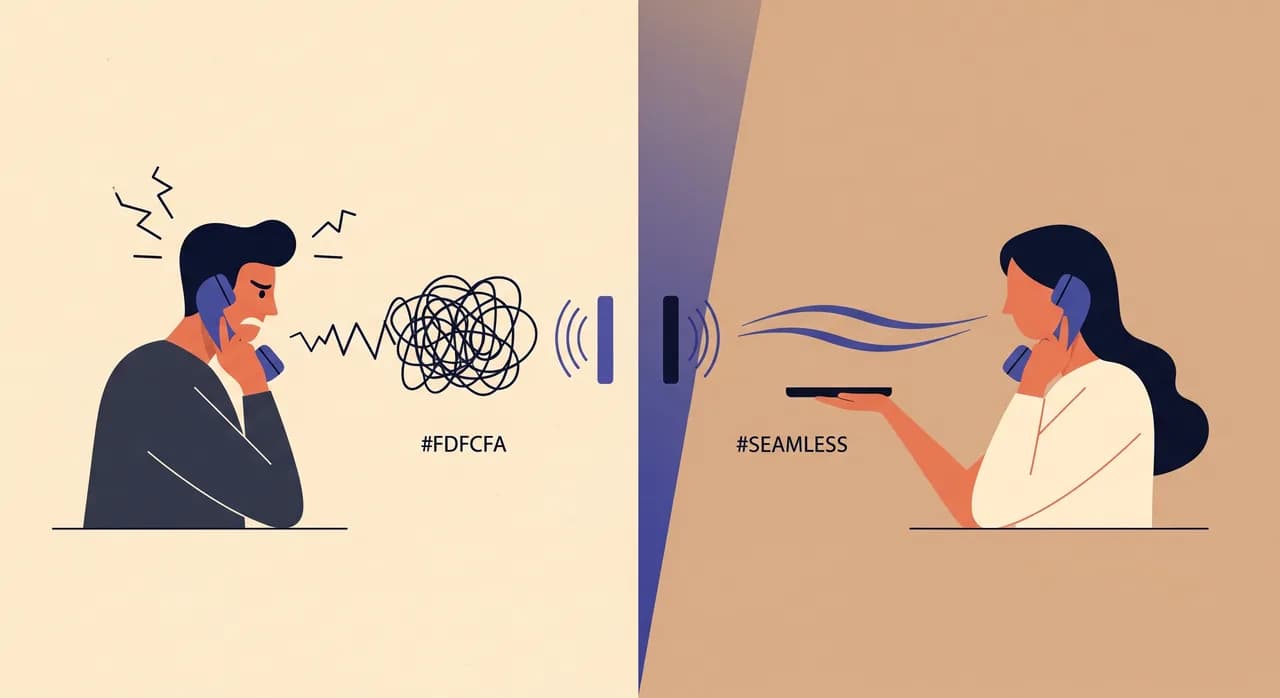
What each version actually signals
It helps to see the three calls next to each other, because the difference isn't the work you do — it's identical in all three. The difference is entirely in what the caller infers before they know anything real about you.
| What the caller hears | What they infer | Likely outcome |
|---|---|---|
| Ringing out to voicemail | They might not be there when I need them | Hangs up, dials the next number, no trace |
| A rushed, nameless pickup | I'm an interruption; they're stretched thin | Shrinks the request, cools off, rarely books |
| A calm, named, structured answer | They're expecting me and they know their job | Relaxes, talks freely, books on the first call |
The uncomfortable takeaway: the quality of your actual service is irrelevant to this decision, because the caller can't observe it yet. You can be the best in your town and still lose to a mediocre competitor who simply sounds available and organised. The first call isn't a sample of your work. It's a sample of your reliability — and reliability is what a stranger is really shopping for.
“You can be the best in town and still lose to someone worse who simply sounded available. The first call tests reliability, not craft.”
The signals you can actually control
Most first-call advice is unrealistic because it assumes you're sitting by the phone with nothing else to do. You're not. So the useful question isn't "how do I answer perfectly?" — it's "which signals matter most, and how do I protect them when I'm busy?" A short, honest list:
- Speed of answer. Two or three rings reads as attentive. Beyond five, the caller starts writing you off. This is the single signal that matters most and the one busy owners control least.
- A named greeting. Saying the business name removes the caller's first anxiety at no cost. "Hello?" makes them do the work; the name does it for them.
- An unhurried tone. Callers mirror your energy. Sound calm and they'll relax and say more. Sound rushed and they'll clip their own request to escape faster.
- Basic competence on the obvious questions. Hours, whether you offer the thing they need, roughly how it works. Fumbling the easy questions makes a stranger fear the hard ones.
- A concrete next step. A time, a callback, a message that lands. Ambiguity at the end undoes everything good that came before it.
Look at that list and notice how much of it is consistency, not talent. None of it requires charisma. It requires the phone to be answered the same competent way whether it's 9am on a slow Monday or the middle of your busiest afternoon. And consistency, for a small team, is exactly the hard part — because the busiest afternoon is precisely when your best callers arrive and your worst pickups happen.
Why "busy" is the enemy of first impressions
There's a bitter irony in first-call impressions: the times you make the worst ones are the times you're doing the best work. A packed schedule means you're serving customers, which is good — and it means the phone rings while your hands are full, which produces exactly the missed calls and rushed pickups that cost you the next customer.
So success quietly caps itself. The busier you get, the worse your first impressions become, the fewer new callers convert — right when you'd most benefit from a steady inflow to smooth out the quiet weeks. Owners often can't see this because both halves feel like normal life. The good day and the lost lead are the same day.
Historically that meant hiring a receptionist, which many small businesses can't justify for a phone that rings a dozen times a day. It meant an answering service that reads a card and takes a message — better than voicemail, but still a stranger the caller can tell is a stranger. Or it meant accepting the leak as a cost of doing business. None of those are great, which is why the phone stayed a weak point for so long.
Where an AI phone assistant fits
This is the gap a tool like Vunoon is built for. It answers your business phone around the clock — greets the caller by your business name, answers the routine questions from a profile you set up (your services, hours, and how you work), takes a booking or a message, and sends you a summary and transcript of every call. Not a voicemail the caller ignores. An actual, calm, structured conversation on the first ring.
The point isn't to sound impressively futuristic. It's to reliably deliver the boring signals that decide first calls: answered fast, named greeting, unhurried tone, competent on the easy questions, and a concrete next step every time — including at 8pm on a Sunday, when a competitor's phone is dark. It doesn't pretend to be a person when asked, and when a call needs your judgement it takes a message or arranges a callback rather than winging it.
Setup is deliberately quick because the whole value is in always being on. You sign up, describe your business in a short wizard, talk to the assistant yourself to check it sounds right, and forward your number. It works across dozens of languages, which quietly widens the pool of first-time callers who get a confident answer instead of a hesitant one.

How to test your own first impression this week
You don't have to guess where you stand. The fastest audit in business is also free: get someone who's never dealt with you to call your number, cold, at a normal busy time, and pretend to be a new customer with a simple question. Then ask them one thing afterwards — would you have booked?
- 1Have a stranger call at your busiest hourNot first thing on a quiet morning when you're relaxed. Call during the crush, because that's when real first-timers reach you and when your impression is weakest.
- 2Ask them to hang up at ring fiveIf it didn't get answered in time, you've found your biggest leak. Note it. That's the exact moment your future customers are dialling someone else.
- 3Grade the first sentenceDid they hear the business name? A calm tone? Or a distracted "hello?" with noise behind it? The first sentence is most of the impression.
- 4Check for a real next stepDid the call end with a booking, a stated callback time, or a message that'll actually be seen — or with a vague "try again later" that a real caller would never act on?
- 5Ask the honest question"If you didn't know us, would that call have won your business?" Believe the answer even when it stings. Your callers are grading you the same way, they just don't tell you.
If the honest answer is anything short of a confident yes, you've found the cheapest growth available to you. Not more advertising to bring more people to a leaky phone — a phone that reliably converts the callers your reputation already earns you. Plugging the leak is almost always better value than pouring more water in the top.
How quickly should a business answer the phone?
What should I say when I answer a business call?
Is a missed call really worse than a bad one?
Can an AI phone assistant really make a good first impression?
How do I know if my first call impression is losing customers?
Make every first call sound like you were expecting it
See how Vunoon greets new callers by name, answers your routine questions, and turns first calls into bookings — day or night, in your language.
See how Vunoon answers your calls
Vunoon builds an AI phone assistant that answers your business calls 24/7 — it books appointments, answers common questions and sends you a summary of every conversation.