How Much Time Your Front Desk Really Spends on the Phone
Most owners underestimate receptionist time spent on calls by half. Here's a simple self-measurement method to find the real number — and why it usually surprises people.
 Vunoon14 min read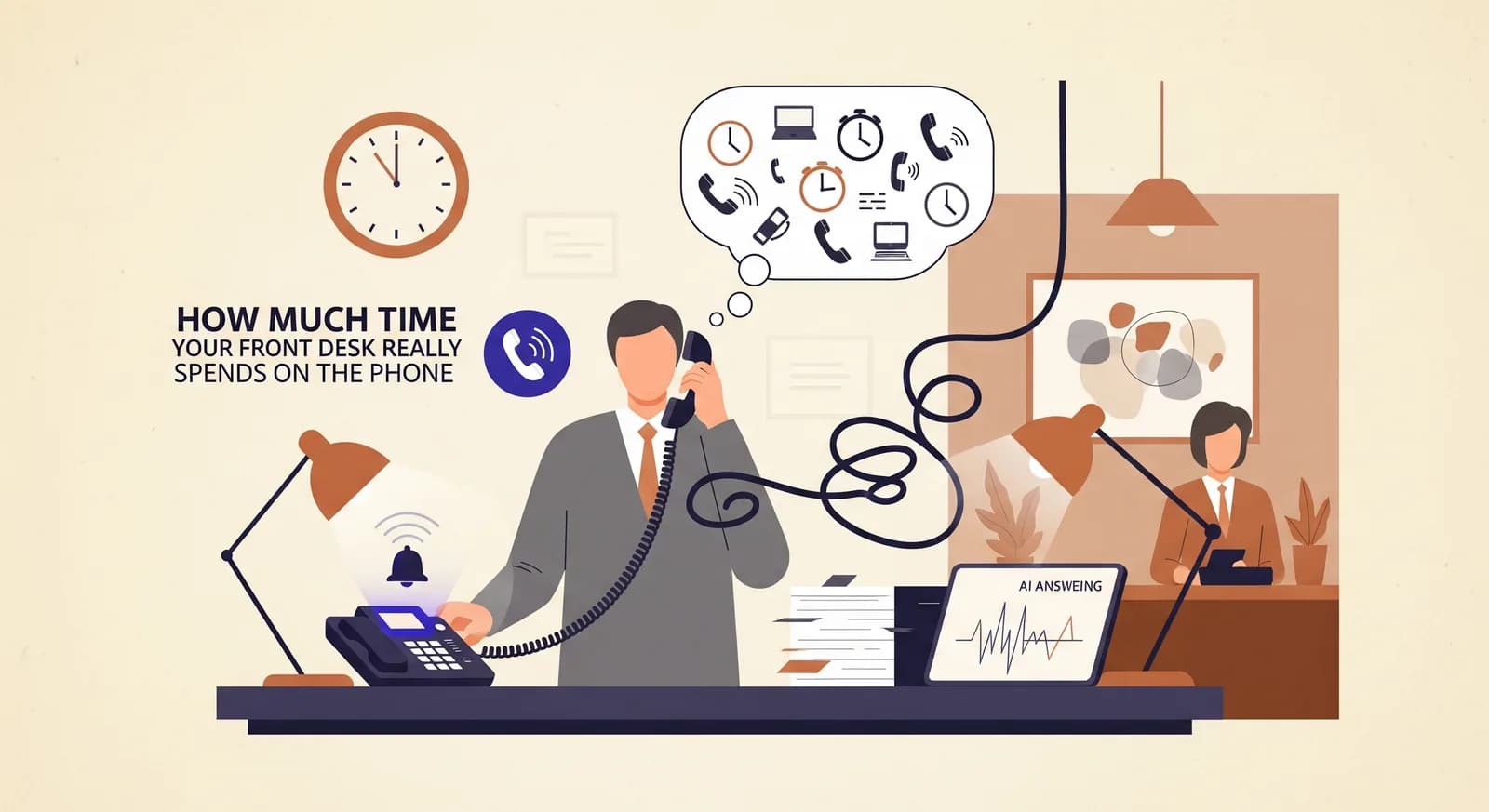
Ask most owners how much of the day their front desk spends on the phone and you'll get a shrug and a guess: "An hour? Maybe two?" Then they actually count. The number is almost always bigger — often twice as big — and the reason has less to do with the calls themselves than with everything the calls interrupt.
This article is about one thing: getting an honest estimate of the receptionist time spent on calls at your business. Not a vendor's scary infographic — your number, from your desk, measured well enough to trust. Once you have it, staffing and tooling decisions stop being arguments and start being arithmetic.
We'll build the estimate in three parts: how many calls actually land per day, how long each one really takes end to end, and the part nobody counts — the cost of being yanked out of another task to answer. That last one is where the guesses fall apart.
Why the gut estimate is always wrong
When you picture "time on the phone," you picture the talking. Caller asks about hours, you answer, you hang up — ninety seconds, done. Multiply by however many calls you vaguely remember, and you land on an hour or two. That's the mental model, and it's wrong in three specific ways.
First, you undercount the calls. The ones you remember are the memorable ones — the angry customer, the big booking. The forgettable eight-second "are you open Sunday?" calls vanish from memory the moment you hang up, but they still happened, and they still cost you.
Second, you time only the conversation. A call isn't the talking; it's the whole arc — the ring you have to notice, the thing you put down, the greeting, the conversation, the note you jot afterward, and the moment where you look back at your screen and think now, where was I? The talking is maybe half of it.
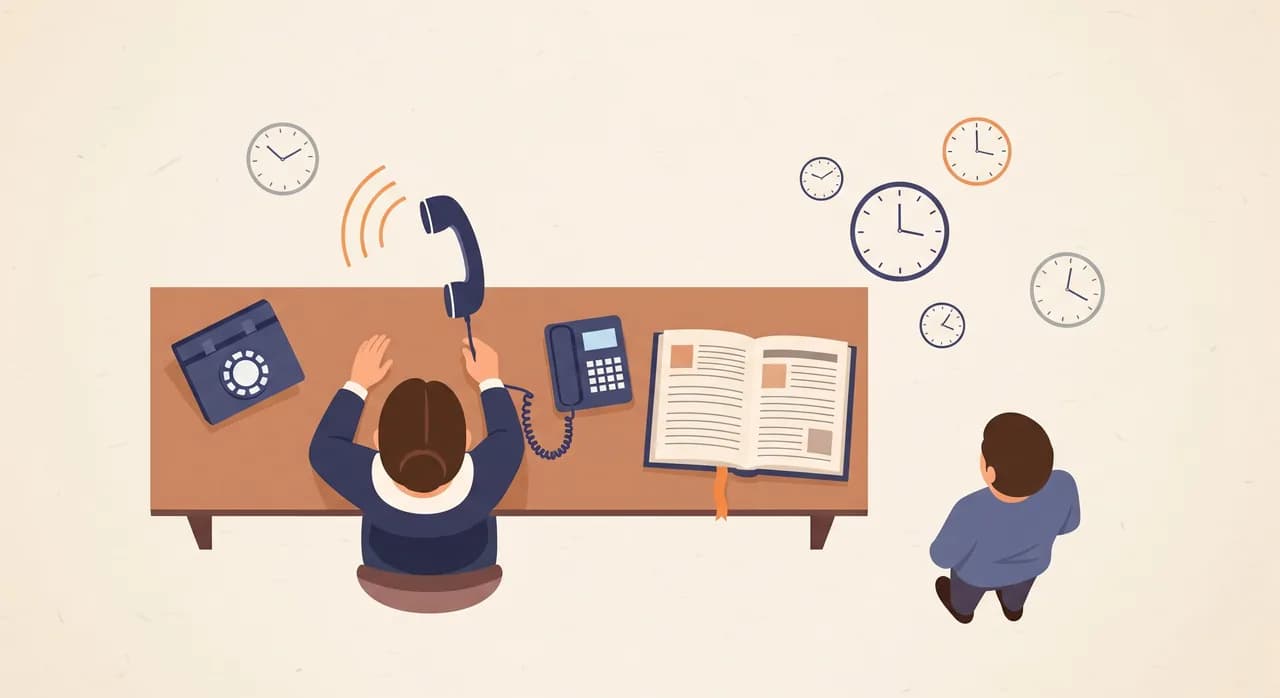
Third — and this is the big one — you count the call but not the damage to whatever else was happening. A phone call doesn't arrive politely into an empty schedule. It lands in the middle of a haircut, a checkout, a difficult email, a customer standing at the counter. The recovery from that interruption is real time, and it belongs on the phone's tab even though no one ever puts it there.
The formula, in plain terms
Here's the whole model in one line, and then we'll fill in each piece with a real measurement rather than a guess.
“Daily phone time = calls per day × (handling time + interruption recovery). The last term is the one owners forget, and it's often the largest.”
- Calls per day — everything that rings, including the ones you don't pick up.
- Handling time — the full arc of a picked-up call, not just the talking.
- Interruption recovery — the minutes lost getting back into the task the call interrupted.
None of these need a stopwatch and a spreadsheet for a week. You can get a defensible estimate in two or three days of light tallying. The point isn't lab precision; it's replacing a wild guess with a measured range.
Part one: count the calls (all of them)
Start with volume, because it's the easiest to measure honestly and the easiest to get wrong from memory. You have two ways to get this number, and I'd use both.
The tally-mark method
Tape a piece of paper next to the phone. Every time it rings, make a mark. Add a second column for "couldn't get to it" — rang out, went to voicemail, or you saw the missed call afterward. Do this for two normal days. Not the quiet Monday and not the chaos before a holiday — two days that feel average.
The couldn't-get-to-it column is the one that stings. Most owners find it's bigger than they thought, and every mark in it is a caller who wanted something and didn't get it. Hold onto that number; it changes the conversation later.
The carrier-log cross-check
Your phone provider already logs every inbound call. Pull a week from your carrier's online portal or your business phone app and count the inbound entries. Divide by the number of days you were open. This catches the calls your tally missed — the ones that rang while everyone was slammed and nobody even registered them.
For a small practice or shop, a realistic figure often lands somewhere between 15 and 40 inbound calls on a normal day. Wherever yours falls, write it down as a range, not a single number — say "25 to 30" — and carry the range forward. Fake precision helps no one.
Part two: time the full call, not the chat
Now the length of a call. The instinct is to time from "hello" to "goodbye," but that misses both ends. A call has a runway and a landing, and they cost time even on a call that ends in fifteen seconds of talking.
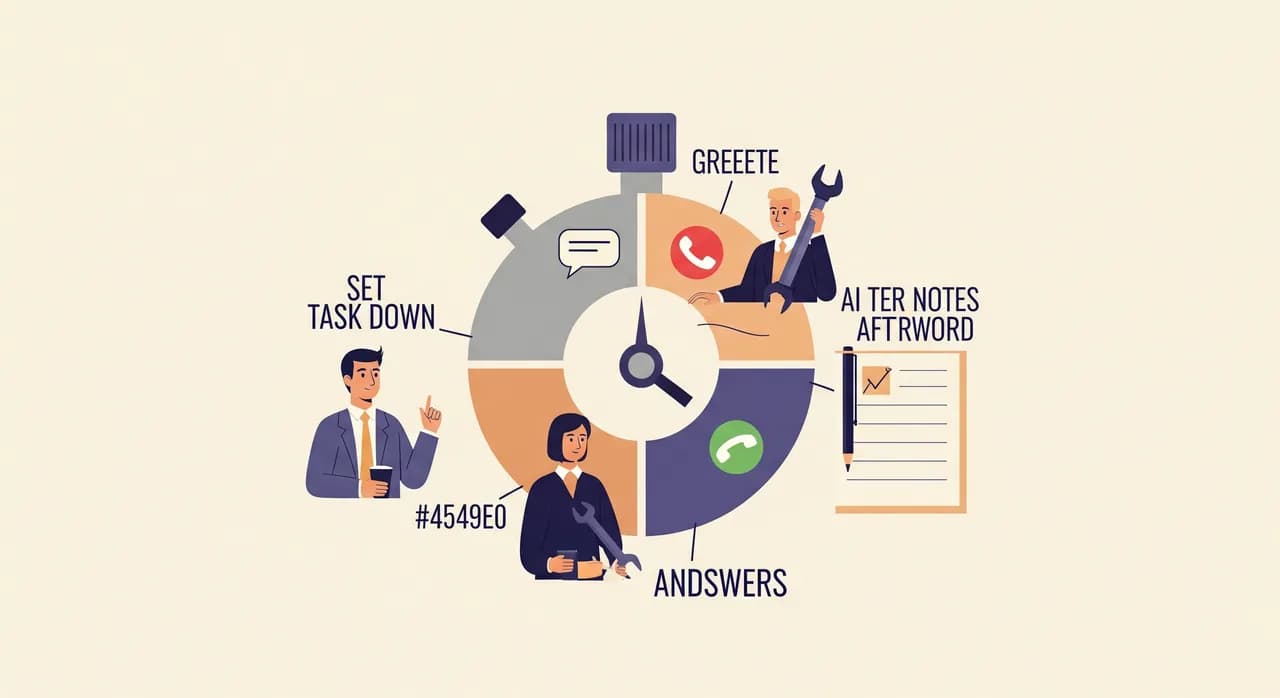
- 1The stopYou hear the ring, register it, and set down whatever you were doing. Two to five seconds, and it's mandatory on every single call.
- 2The greeting and the reach"Good afternoon, thanks for calling…" plus finding the pen, pulling up the calendar, or turning to the screen. Often longer than the greeting itself.
- 3The conversationThe actual back-and-forth. This is the part people time — and it's usually the shortest chunk for routine calls.
- 4The wrap-upWriting the message, adding the booking, flagging the callback. A quick call can create three minutes of admin behind it.
Time ten real calls this way, spanning the boring ones and the involved ones, and average them. Most front desks find their true handling time — the whole arc — runs three to five minutes per picked-up call, even though the talking felt like ninety seconds. That gap between felt time and real time is exactly why the gut estimate is low.
Part three: the interruption tax nobody counts
This is the section that changes owners' minds, so slow down here. A phone call is not just its own duration. It's a hole punched in the middle of another task — and getting back into that task has a cost of its own.
You know the feeling. You were three sentences into a careful email, the phone rang, you handled it in two minutes, you hung up — and then you sat there for another minute rereading what you'd written, trying to remember where the thought was going. That minute is real. It happened because the phone rang. It belongs to the phone.
“The phone doesn't cost you the length of the call. It costs you the call plus the wreckage of whatever the call interrupted.”
For deep work — bookkeeping, a delicate customer conversation, anything that requires holding several things in your head — the recovery can rival the call. For simpler tasks it's shorter. A fair, conservative rule of thumb is to add one to two minutes of recovery per interrupting call, and more if your front desk's other job involves concentration or a live customer in front of them.
Putting it together: a worked example
Imagine a two-chair dental practice with one person at the front desk who also greets patients, handles checkout, and processes the day's paperwork. Nothing exotic — a very ordinary small business. Let's run the numbers with the estimates above, staying deliberately conservative.
| Component | Estimate | Daily total |
|---|---|---|
| Calls per day (from carrier log) | 28 calls | 28 |
| Handling time per call (full arc) | 4 minutes | 112 minutes |
| Interruption recovery per call | 1.5 minutes | 42 minutes |
| Total phone-related time | — | ≈ 154 minutes |
That's about two and a half hours a day — call handling plus recovery — for a business that would have guessed "maybe an hour." Over a five-day week it's more than twelve hours: essentially a full extra person-day spent on the phone and its aftermath, invisibly, every week.
And notice the recovery line. Forty-two minutes a day, gone, purely to the interruptions — nearly an hour of the working week that never appears in anyone's estimate because it hides inside "I got distracted." That's the number the gut estimate silently drops.
What even a good measurement can't see
Being honest cuts both ways, so here's the limit of this method. It measures the time you spend on calls you answer. It's much worse at measuring the calls you miss — and those are often the expensive ones.
Remember the couldn't-get-to-it column from the tally? Each of those is a caller who wanted to book, buy, or ask — and got a busy signal or a voicemail box they'll never leave a message in. Most people simply call the next business on their search results. That's not phone time; it's revenue that quietly walked out the door, and no stopwatch will ever show it in your daily total.
- After-hours calls — the ones that ring into a closed office and vanish. For many businesses this is a big share of demand, and it's completely uncounted by a daytime tally.
- Peak-hour clustering — calls don't arrive evenly. They bunch up exactly when you're busiest, so the average hides the moments where the front desk is genuinely overwhelmed.
- Quality erosion — a rushed, distracted call still counts as "handled," but the caller can hear the strain, and it costs you in ways the clock ignores.
So treat your measured number as a floor, not a ceiling. The real cost of your phones is at least what you measured — plus the missed calls, the after-hours demand, and the quiet quality tax on top.
So you have the number. Now what?
A measured figure turns a vague frustration into a decision you can actually reason about. Broadly, there are three honest responses, and which one fits depends on what your number turned out to be.
- 1Leave it aloneIf your phone time is genuinely low and none of it is landing during focused work or in front of customers, maybe it's fine. Not every business has a phone problem, and it's worth confirming that honestly rather than assuming.
- 2Reshape the loadBatch callbacks into set windows, add a considered voicemail script, or route calls so the front desk isn't the single point of failure. Cheap, and sometimes enough on its own.
- 3Take the routine calls off the desk entirelyIf most of your volume is the same handful of questions and simple bookings, automating those frees the front desk to do the work that actually needs a human on site.

That third option is where an AI phone assistant earns its place. Vunoon answers your phone around the clock, greets callers, answers the routine questions from a profile you set up — your hours, services, and the prices you've told it — and takes bookings or messages. After each call it sends you a summary and a full transcript, so nothing is dropped and you stay in the loop. It doesn't pretend to be human when asked, and it hands off gracefully: it can take a message or arrange for you to call back.
It won't replace a good receptionist for the calls that need judgment, empathy, or a hand on the situation — and it shouldn't try to. What it does is absorb the flood of forgettable calls that were fragmenting the day, so the person at your desk can finish the email, serve the patient in the chair, and stop flinching every time the phone rings. It also picks up the after-hours and peak-time calls your tally couldn't even see — the ones that were quietly costing you business.
How do I measure receptionist time spent on calls without special software?
What's a realistic average call handling time for a small front desk?
Why should I count interruption recovery time as phone time?
My phone time turned out low. Do I still have a problem?
Can an AI phone assistant handle all my calls?
See what taking routine calls off your desk looks like
You've measured the number. If it made you wince, see how Vunoon answers your phone 24/7, handles the routine calls, and sends you a summary of every one — with a free trial to test it on your own line first.
Explore call overflow handling
Vunoon builds an AI phone assistant that answers your business calls 24/7 — it books appointments, answers common questions and sends you a summary of every conversation.