How an AI Answering Service Works, Step by Step
No magic, no mystery. Here is the actual chain of events between a caller dialing your number and a tidy summary landing in your inbox.
 Vunoon14 min read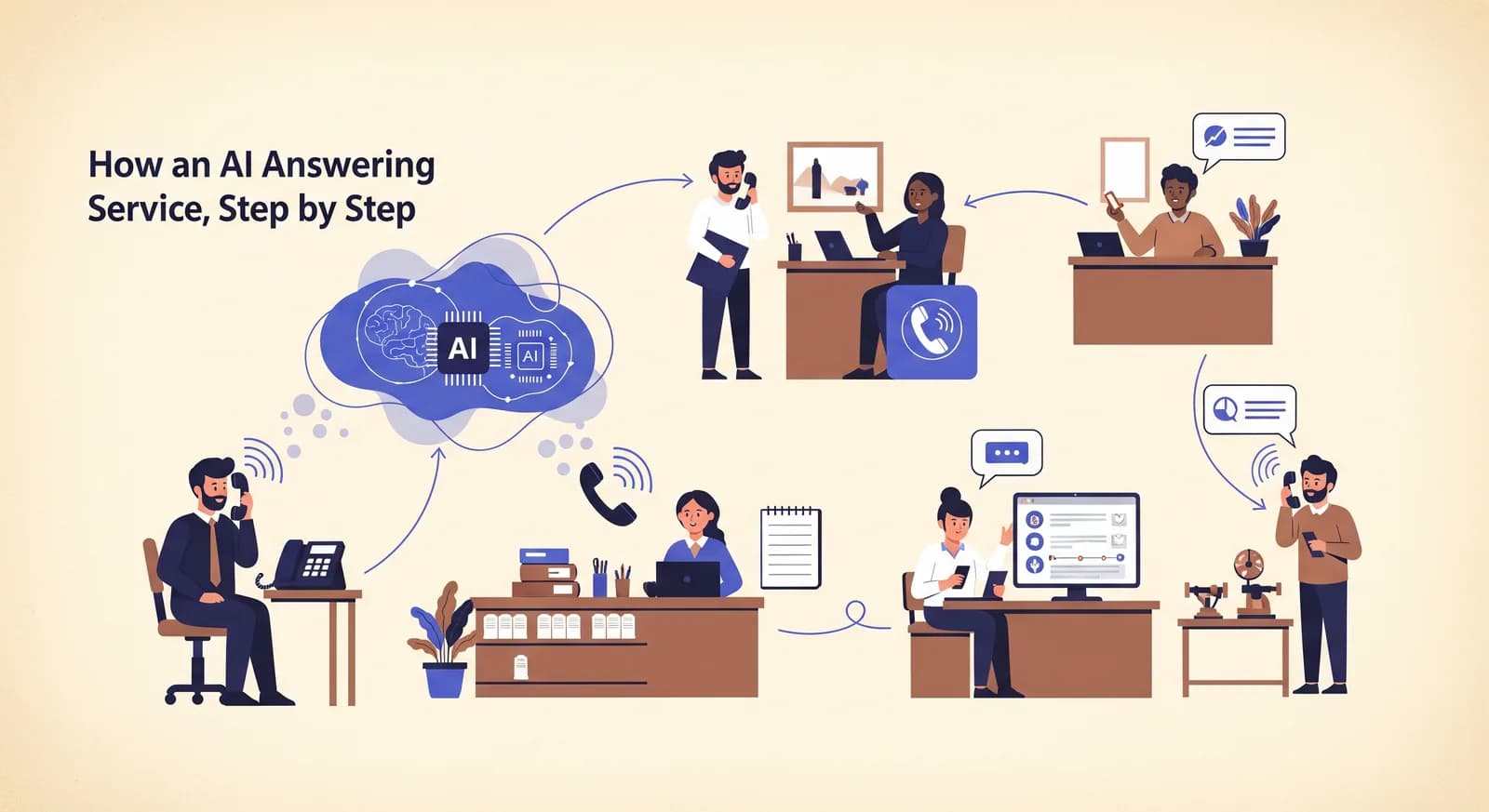
You forward your business line, someone calls, and thirty seconds later a booking appears in your inbox with a full transcript. It feels like sleight of hand. It isn't. An AI answering service is a chain of ordinary, well-understood steps, each doing one job and handing off to the next. This is that chain, explained the way you'd explain it to a friend over coffee.
Most articles about this either wave their hands ("AI understands your callers!") or drown you in jargon about transformers and tokens. Neither helps you decide whether to trust the thing with your phone. So we're going to do something different: walk the whole path a single call takes, from the moment it rings to the moment you read the summary, and be honest about where the seams are.
The 30-second tour
Before we zoom in, here's the whole thing in one breath. A caller dials your number. Your phone system forwards that call to the AI service instead of ringing your desk. The AI answers, converts the caller's speech into text, works out what they actually want, decides how to respond, converts its reply back into a spoken voice, and talks. This loop repeats for each turn of the conversation. When the call ends, the AI writes up what happened and sends it to you. That's it. Five or six moving parts, each of which we'll now take apart.
The reason it feels instant is that these steps are fast and overlapping. The AI starts transcribing while the caller is still talking, and starts forming a reply before the caller has fully stopped. To the person on the phone it feels like a normal, if slightly patient, conversation.
Step 1: the call gets forwarded
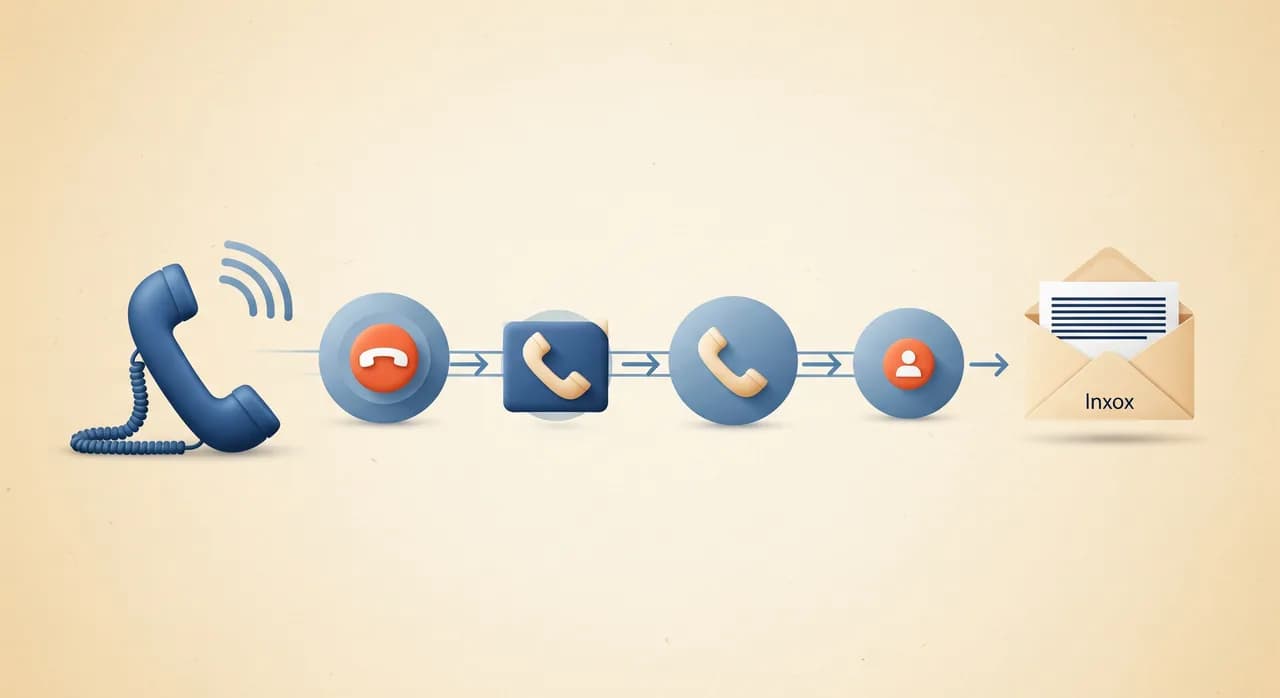
Nothing about your phone number changes. You keep the number printed on your van, your website, and your business cards. What changes is a single setting at your phone provider: call forwarding. You tell your carrier, "when my line is busy, unanswered after four rings, or always, send the call to this other number." That other number belongs to the AI service.
This is the same feature you've used for decades to bounce calls to your mobile. The AI service simply gives you a dedicated number to forward to. Because forwarding happens at the carrier level, the AI can pick up whether you're closed, on another call, or just don't want to be interrupted while you're elbow-deep in an engine.
- Always forward — every call goes to the AI first. Good for after-hours-only setups or fully hands-off lines.
- Forward when busy — the AI catches overflow while you're already on a call, so a second caller never hears a busy tone.
- Forward when unanswered — your desk rings first; if nobody grabs it in a few rings, the AI answers instead of the call dying.
Step 2: answering and listening
The AI picks up and plays a greeting — usually the one you wrote in setup, something like "Thanks for calling Maple Street Dental, how can I help?" From that instant, it is doing two things at once: playing audio out to the caller, and capturing the audio coming back in.
The incoming audio is just a stream of sound. On its own it means nothing to a computer — it's air pressure turned into numbers. The next job is to turn that sound into words, and that job has a name most people have heard without knowing it: speech recognition.
Step 3: speech becomes text
Speech recognition, or speech-to-text, is the part you already use every day. It's the same family of technology behind the dictation button on your phone and the automatic captions on videos. It listens to the audio and produces a written line: "hi um yeah I wanted to book a cleaning for next Tuesday if you've got anything in the afternoon."
Modern speech recognition is remarkably good, but it isn't magic and it's honest to say so. It handles accents, background noise, and people trailing off mid-sentence far better than the clunky "press 1 for sales" systems of the past. Where it struggles is exactly where a human would: a caller shouting over a leaf blower, a wildly unusual surname, or three people talking at once. Good services are tuned to ask for a repeat when they're unsure, rather than guess and get it wrong.
One subtlety worth knowing: the AI doesn't wait for the caller to finish their whole speech before transcribing. It streams the text as the words arrive, so by the time someone stops talking, the transcript is essentially already done. That's a big part of why replies come so quickly.
Step 4: working out what they mean
Now the AI has a line of text. The hard, interesting part is turning that text into meaning — figuring out the caller's intent. From "can I move my Thursday appointment to Friday?" it needs to understand three things: this is an existing customer, they want to reschedule, and the target is Friday. From "do you do dogs or just cats?" it needs to recognise a question about which services you offer, and answer from your profile.
This is where a large language model does the heavy lifting — the same kind of technology behind the assistants you've read about. But it isn't answering from thin air or from the whole internet. A good answering service gives the model a tight, private brief: your business profile. The services you listed, your hours, your prices, your policies, your address, the questions you get asked most. The model reasons over the caller's words and that brief together.
“The intelligence isn't in knowing everything. It's in knowing your business, and admitting when it doesn't know something.”
That grounding is the whole game. It's why the AI can say "we're open until six on weekdays and closed Sundays" — not because it guessed, but because you typed those hours into a wizard once. And it's why, when someone asks something outside the brief ("does the vet also board rabbits overnight?"), a well-built service should take a message rather than invent an answer. An assistant that makes things up is worse than no assistant at all.
Step 5: deciding what to do
Understanding the request is one thing; acting on it is another. Depending on intent, the AI takes one of a handful of paths. Answer a question from the profile. Book or reschedule an appointment. Take a message with a callback number. Or, when the caller clearly needs a person, gather the essentials and promise the owner will ring back.
- 1It answers directlyFor anything covered by your profile — hours, location, whether you take walk-ins, what a service includes — the AI just tells the caller, in a natural sentence, no menu required.
- 2It books or reschedulesWhen the intent is an appointment, it collects the who, what and when, checks against the rules you set, and confirms a slot or offers alternatives.
- 3It takes a messageFor anything it can't or shouldn't handle — a complaint, a bespoke quote, a question outside your profile — it captures the details and the caller's number so you can follow up.
- 4It hands off gracefullyIf a caller asks to speak to a human, or the situation is clearly sensitive, it doesn't stonewall. It takes the message or arranges a callback, and it doesn't pretend to be a person when asked.
Step 6: speaking back
The AI has decided what to say — but so far that decision is just text. The final step of the loop turns text back into a voice the caller can hear. This is text-to-speech, and it's the mirror image of Step 3. The synthesized voices used today are a long way from the flat, robotic drone you remember; they pause, breathe, and rise and fall in a way that mostly sounds like a person having a slightly-too-calm day.
Then the loop closes. The caller hears the reply, responds, and the whole cycle — listen, transcribe, understand, decide, speak — runs again for the next turn. A three-minute call might go around this loop a dozen times, each pass taking a second or so. From the caller's side it's just a conversation. Under the hood it's the same five steps, repeated.
“Listen, transcribe, understand, decide, speak — then do it again. A conversation is just that loop, running fast.”
Step 7: the summary lands in your inbox
When the call ends, the last job runs. The AI has the full transcript of everything said, so it writes up what mattered: who called, what they wanted, what was agreed, and any action left for you. That summary — plus the raw transcript, and often the audio recording — arrives in your inbox or wherever you've asked to be notified.
This is the part owners tell us they didn't expect to love. You're not listening back to voicemails and scribbling notes. You get a clean brief: "New patient, wants a cleaning, prefers Tuesday afternoons, number on file, booked for the 14th at 3pm." You skim it in five seconds and move on. Nothing falls through the cracks because everything is written down and searchable.
Putting it together: one call, end to end
Let's follow a single call all the way through. Imagine a two-chair hair salon, mid-afternoon, both stylists busy. A caller wants to book a colour.
- The line is busy, so the carrier forwards the call to the AI number.
- The AI answers: "Thanks for calling Bloom Studio, how can I help?" and starts listening.
- The caller says they'd like a colour appointment this Saturday. Speech recognition turns that into text as they speak.
- The AI reads the intent — new booking, colour service, Saturday — and checks the salon profile for Saturday availability and how long a colour takes.
- It decides to offer two open slots, then speaks them back: "I've got 10am or 2pm on Saturday — which suits?"
- The caller picks 2pm and gives their name and number. The AI confirms and closes the call.
- Seconds later the owner gets a summary: new colour booking, Saturday 2pm, name and number attached.
The whole thing took under two minutes, the owner never touched the phone, and the caller — who might otherwise have hung up on a busy tone and called a competitor — is booked in. That's the entire value in one call, and it's just the seven steps above doing their jobs.
Where the seams are (the honest bit)
No technology is seamless, and you'll trust this one more if you know where it can fray. Very noisy calls make speech recognition work harder and occasionally mishear a name — which is why good setups confirm details back to the caller. Highly unusual or emotional requests are better handed to a human, and a well-built assistant knows to do that rather than muddle through.
There's also the fact that the AI only knows what you tell it. A thin, half-finished profile produces vague answers; a rich one, with your real hours and your most common questions, produces sharp ones. The quality you get out is closely tied to the ten minutes you spend describing your business. It rewards a little care up front, and that's a fair trade.
How you actually set this up
Knowing the mechanics, the setup makes more sense. You're really just filling in the two things the pipeline needs: the brief the AI reasons from, and the forwarding rule that sends calls its way.
- 1Describe your businessA short wizard asks for your services, hours, prices, address and common questions. This becomes the profile the AI grounds every answer in.
- 2Test it by callingRing your new assistant and try to trip it up. Ask the awkward questions your real callers ask. Tweak the profile until the answers are right.
- 3Forward your numberSet the forwarding rule at your carrier — always, on busy, or on no-answer — pointing to the AI number. That's the switch that goes live.
- 4Watch the summaries roll inFrom then on, every handled call becomes a summary in your inbox. Refine the profile over the first week and it only gets sharper.
It typically takes a few minutes to describe the business and a moment to set the forwarding rule. There's no hardware, no new number to advertise, and nothing to install. Most owners run a free trial first, forwarding only after-hours calls, before handing over more.
Do I need special equipment or a new phone system?
Will callers know they're talking to an AI?
What happens if the AI can't answer a question?
How does it know my prices and hours?
How fast does it answer, and can it handle two calls at once?
What languages does it work in?
See the whole loop in action
Read the full walkthrough of how Vunoon answers, understands, and summarises your calls — then try it on your own line.
See how it works
Vunoon builds an AI phone assistant that answers your business calls 24/7 — it books appointments, answers common questions and sends you a summary of every conversation.