Missed Calls in Home Services: The Job Goes to the Next Result
For trades and home services, an unanswered phone rarely means a callback. It means the customer scrolls down and calls whoever picks up. Here is why that happens and what to do about it.
 Vunoon14 min read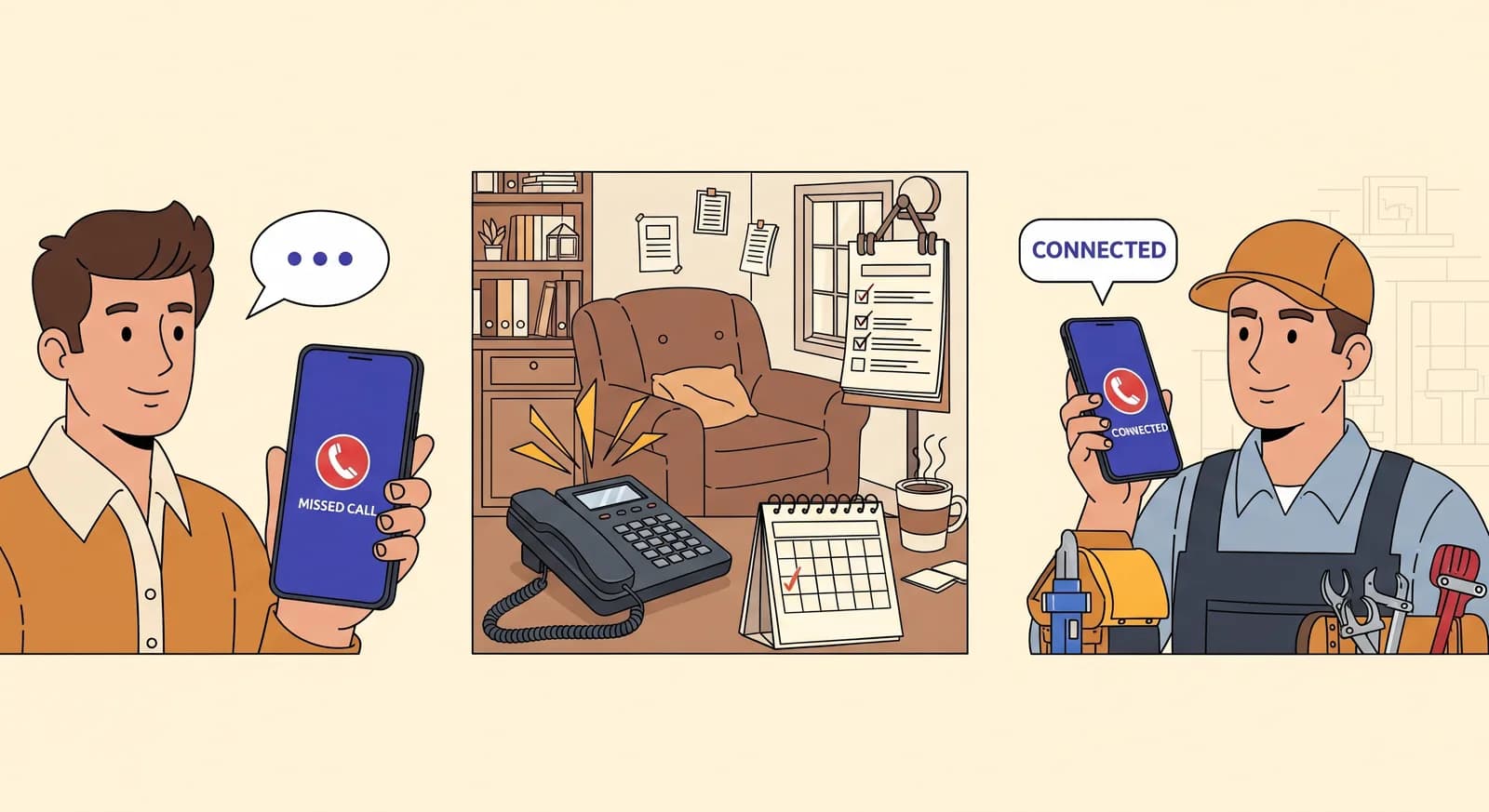
A customer with a leaking pipe does not leave a voicemail and wait. They hang up, look back at the list of five plumbers, and call the next one. Missed calls in home services are not a follow-up problem. They are a lost-job problem, decided in the ninety seconds before your phone stops ringing.
The one-call customer is not being rude
There is a comforting story business owners tell themselves about missed calls: the caller will try again later, or leave a message, or find them on the website. For a lot of industries that is roughly true. For home services it usually is not, and the reason has nothing to do with loyalty or patience.
Most calls to a trade come from a person with a specific, time-bound problem. A boiler that stopped overnight. A garage door stuck halfway with the car inside. A blocked drain backing up into the kitchen. Water somewhere it should not be. These are not calls to browse or compare. They are calls to get this handled today, and the caller has already lowered their standards to whoever can show up.
So when your line rings out, the caller is not annoyed at you personally. They simply have an open tab, three more numbers, and a growing puddle. Trying you again means the puddle gets bigger. The rational move is the next result, and people in a small emergency are very rational about the next result.
How urgent customers actually decide
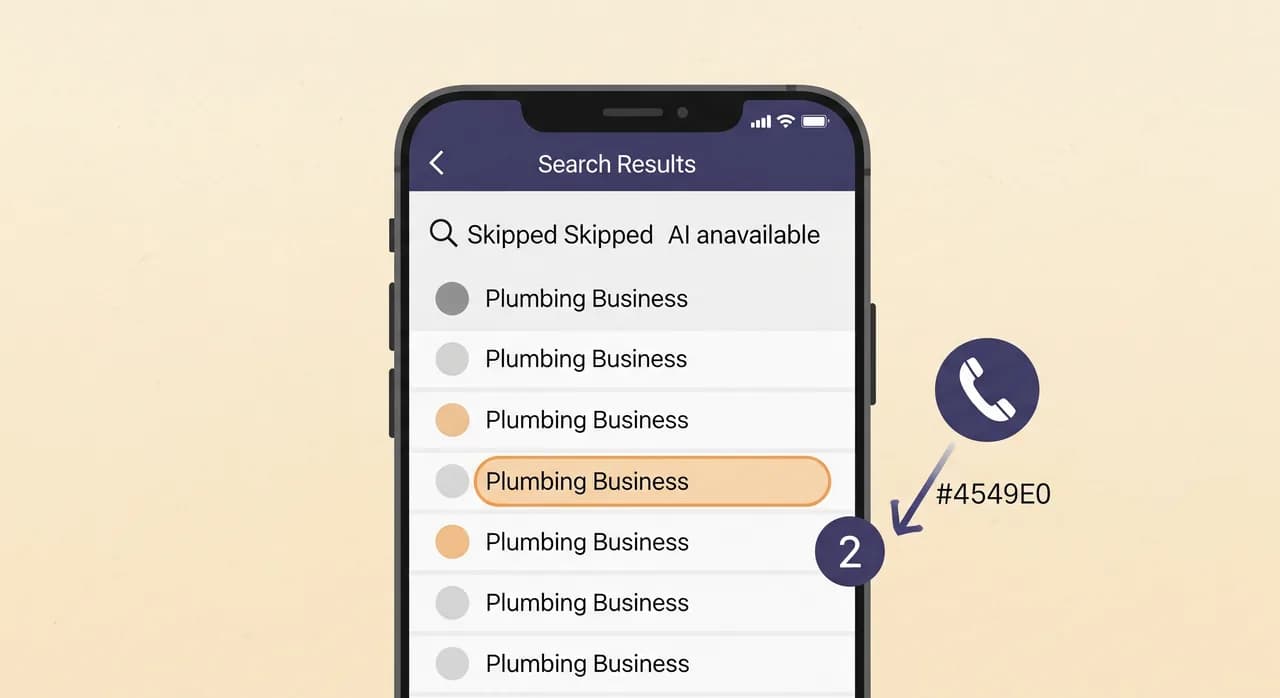
Picture the search itself. Someone types "emergency electrician near me" into their phone. They get a map pack with three businesses, then an organic list below. They do not read reviews line by line. They do not compare qualifications. In an urgent-need moment the decision collapses into one question: who answers first and can come soonest?
The caller works top to bottom. Result one rings out. Result two goes to a full voicemail box. Result three answers, sounds calm, says "I can have someone with you by four," and the search is over. Results four and five never get dialled. The winner is not the best electrician on the list. The winner is the first one who picked up and gave a clear answer.
This is the part that stings for good businesses. Your reviews, your years of experience, your fair pricing — none of it enters the decision if the phone is not answered. The caller cannot value what they cannot reach. In that moment your entire reputation is represented by a ringtone, and a ringtone loses to a human voice every time.
Why you miss the calls you would most want to answer
Here is the cruel timing of it. The calls you miss are almost never the tyre-kickers. They are missed precisely because you are doing the work you already won.
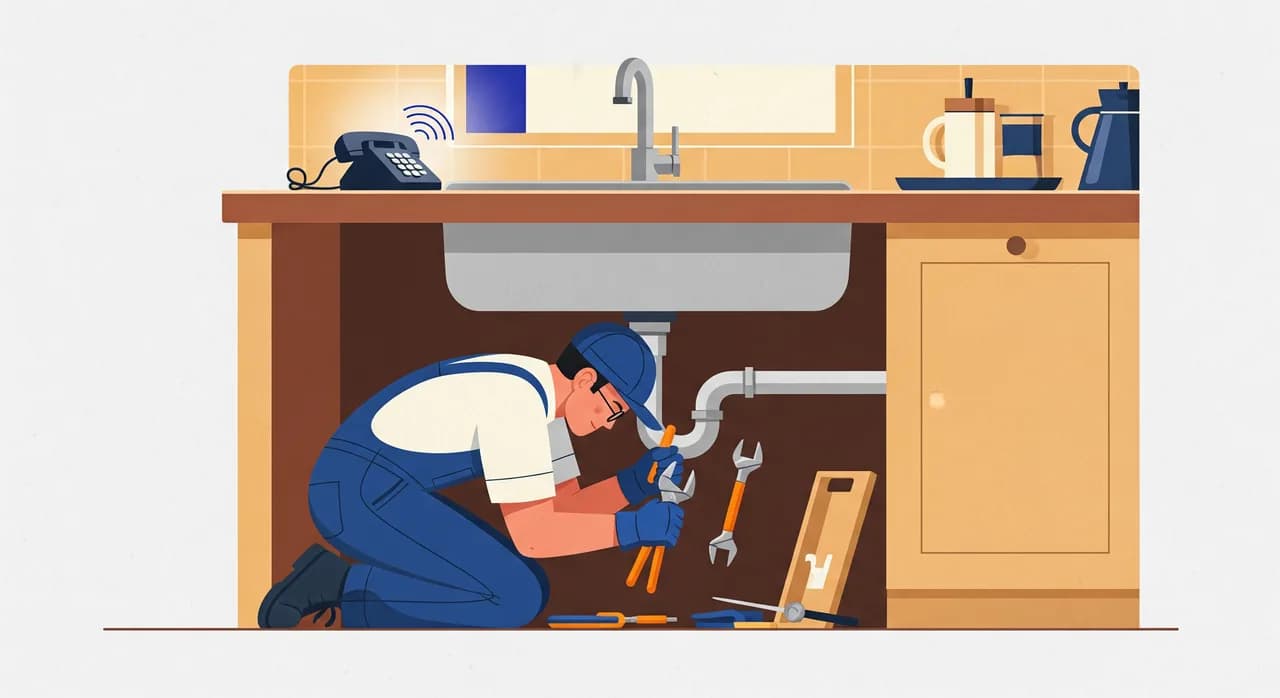
- You are under a sink or up a ladder with both hands occupied and the phone in the van.
- You are driving between jobs and cannot safely answer.
- You are mid-conversation with the customer in front of you — and stepping away to take a call feels rude, so you let it ring.
- It is after hours or the weekend, which is exactly when boilers fail and pipes burst.
- You are getting two calls at once during a busy spell and can only hold one line.
Notice that every single one of these is a sign the business is working. The busier and more successful you are, the more calls you miss, and the more good jobs quietly leak out the bottom of the funnel. It is a tax on being good at your trade, and most owners never see the bill because the caller who went elsewhere never tells them.
“The busier and more successful you are, the more calls you miss. Missed calls are a tax on being good at your trade.”
What a missed call is actually worth
It is easy to wave this away as a few lost enquiries. Do the arithmetic once and it stops feeling small. Home-services jobs are rarely cheap. A single boiler repair, a rewiring quote, a drain clear, a driveway job — one of those can be worth more than a week of small purchases at a shop.
Say you miss two callable enquiries a day. Some are duds. But even if one in three would have booked, that is roughly one lost job every day and a half. Over a month that is fifteen to twenty jobs you never knew existed. You do not see them as losses because they never entered your calendar. They show up as a competitor's good month instead.
Voicemail is not the safety net you think it is
Many trades treat voicemail as a backstop. "If they really want us, they'll leave a message." But urgent callers rarely do. Leaving a voicemail feels like shouting into a void — no idea if it was heard, no idea when you will call back, and meanwhile the problem is still active. So they hang up on the beep and dial the next number instead.
Even the messages you do get arrive with a delay you cannot control. You finish the job, wash up, check the phone, and call back forty minutes later — by which point the caller has already booked someone else and now has to awkwardly turn you down. You did the callback right and still lost the job. The problem was never your effort. It was the gap between the ring and the return call.
There is a second, quieter cost. A full or clumsy voicemail also signals something to the caller: this business might be hard to reach later too. If they cannot get you when they are trying to give you money, they assume they will not get you when there is a problem with the work. The unanswered phone becomes a review before they have hired you.
The callback race you usually lose
Suppose you are diligent. You catch missed calls at the next break and call everyone back within the hour. That is genuinely better than most, and it will still lose you a large share of urgent jobs, for a simple reason: you are racing a competitor who already answered.
By the time you call back, the caller has often already spoken to someone who answered live, given their address, and agreed a time. Your callback lands as an interruption to a decision that is already made. The best you can hope for is to be the backup if the first person cancels. That is a much worse position than being the person who picked up, and you got there by doing everything right except the one thing that mattered — answering in the moment.
“A perfect callback still loses to an imperfect answer. In home services, presence beats polish.”
What answering live actually buys you
It is worth being precise about why a live answer wins, because it is not just about being first. Answering in the moment does three things a callback cannot.
- 1It stops the searchThe instant someone picks up and can help, the caller stops working down the list. Every result below you becomes irrelevant. You have removed your competitors from the decision without them ever getting a chance to compete.
- 2It captures the details while they are freshA live conversation gets the address, the nature of the problem, the urgency, and a rough idea of the job — all in one go. No phone tag, no half-remembered voicemail, no callback where they have to explain it all again.
- 3It sets the tone of the relationshipA calm, competent answer at the worst moment of someone's week tells them exactly what kind of business you are. That first impression carries into the quote, the visit, and the review far more than a slick website ever will.
None of this requires you to say yes to every job on the spot. It just requires the caller to reach a real, sensible voice, get their problem acknowledged, and come away with a clear next step. That is the whole game, and it is entirely about the first ten seconds of the call.
The obvious fixes, and where they fall short
Owners try to plug the gap in a few familiar ways. Each helps a little and each has a ceiling worth knowing about before you pin your hopes on it.
- Answer everything yourself. Noble, and impossible past a certain volume. You cannot be on a roof and on the phone at once, and answering mid-job annoys the customer in front of you.
- Hire a receptionist or office manager. Effective for larger outfits, but it is a full salary, they work set hours, and boilers do not fail on a nine-to-five schedule.
- Use a traditional answering service. They pick up, but often as a generic script that takes a message and little else — which puts you back in the callback race, just with a middleman.
- Send calls to a partner or spouse. Works until they are busy, out, or would rather not be your unpaid switchboard.
- Add a website contact form. Fine for non-urgent enquiries. Useless for the person with water coming through the ceiling right now.
The common thread is that every option is either limited by human hours or lands you back in the same trap: a message instead of a live answer. The urgent caller does not want to be a message. They want to hear that help is coming, now.
Where an AI phone assistant fits
This is the specific gap Vunoon is built for. It answers your calls when you cannot — under the sink, on the motorway, at three in the morning, or on the second line when the first is busy. It greets the caller, answers the questions it can from the details you set up (your services, your area, your hours, your typical prices), and either books the job or takes a proper structured message. Then it sends you a summary and a full transcript so you know exactly what happened before you even ring back.
Crucially, it answers live, on the first ring, every time. That is the thing that stops the search. A caller with a burst pipe reaches a calm voice that says the business handles that, confirms the area is covered, and takes the details — so they stop dialling and wait for you, instead of moving to result number four.
It is not a replacement for you or for a skilled human on complex calls. What it replaces is the ringtone. Instead of your worst-case scenario being a missed call and a lost job, your worst case becomes a well-captured message with a name, a number, an address, and a clear description waiting for you the moment you put your tools down.

Setting it up without turning it into a project
The reason most trades never fix their missed-call problem is not that they do not care. It is that every fix sounds like admin they do not have time for. So it is worth saying plainly what getting started actually looks like.
- 1Describe your businessA short wizard asks what you do, the areas you cover, your hours, and the questions you get asked most. This is the same stuff you already say on the phone ten times a day.
- 2Talk to it yourselfBefore it touches a real customer, you call it and play the awkward caller. Ask about a job you do not do, an area you do not cover, a weird edge case. Adjust the answers until it sounds like your business.
- 3Forward your numberPoint your line to the assistant for the times you cannot answer — after hours, or on every call you do not pick up within a few rings. You stay in control of when it steps in.
- 4Read the transcriptsEvery call arrives as a summary and transcript. In the first week you will see exactly what callers ask and where the assistant hesitated, and you tune it from there.
It works across 25-plus languages, which quietly solves another home-services headache: the customer who is more comfortable in a different language and would otherwise have hung up and called someone who could understand them. There is a free trial, so you can measure the missed calls it catches before deciding it is worth keeping.
How to tell whether it is actually working
Do not judge this on feelings. Judge it on the calls that used to vanish. In the first two weeks, the assistant's log becomes a record of demand you were previously invisible to.
- Count the after-hours calls it caught that would have hit voicemail before. Every one of those is a job you had no chance of winning last month.
- Look at how many became bookings or solid callbacks versus how many were noise. This is your real conversion, not a guess.
- Note the ones you would have lost mid-job — the call that came in while you were on a roof, now sitting neatly in your inbox with all the details.
- Watch whether callers wait for you instead of moving on, which shows up as people who took the callback rather than booking a competitor in the meantime.
Multiply the extra jobs by your average value and compare it to what the tool costs. For most trades the honest answer is that a single caught job pays for months of it, and the rest is upside. If that does not hold true for your business, the trial will tell you, and you can walk away having lost nothing but a couple of weeks of curiosity.
Do people in home services really not call back if I miss them?
Isn't a quick callback within the hour good enough?
Won't customers be annoyed to reach an AI instead of me?
What happens if a caller asks something the assistant doesn't know?
How long does it take to set up for a trade business?
Stop handing jobs to the next result
See how Vunoon answers the calls you can't — after hours, mid-job, or on the second line — so urgent customers wait for you instead of scrolling down. Set it up in minutes and try it free.
See how never-miss-a-call works
Vunoon builds an AI phone assistant that answers your business calls 24/7 — it books appointments, answers common questions and sends you a summary of every conversation.