The Small Business Phone Bottleneck: One Line, One Pair of Hands
Follow an owner-operator through a single Tuesday and watch the maths of one phone line and one person collide with reality — and see where the leaks actually are.
 Vunoon15 min read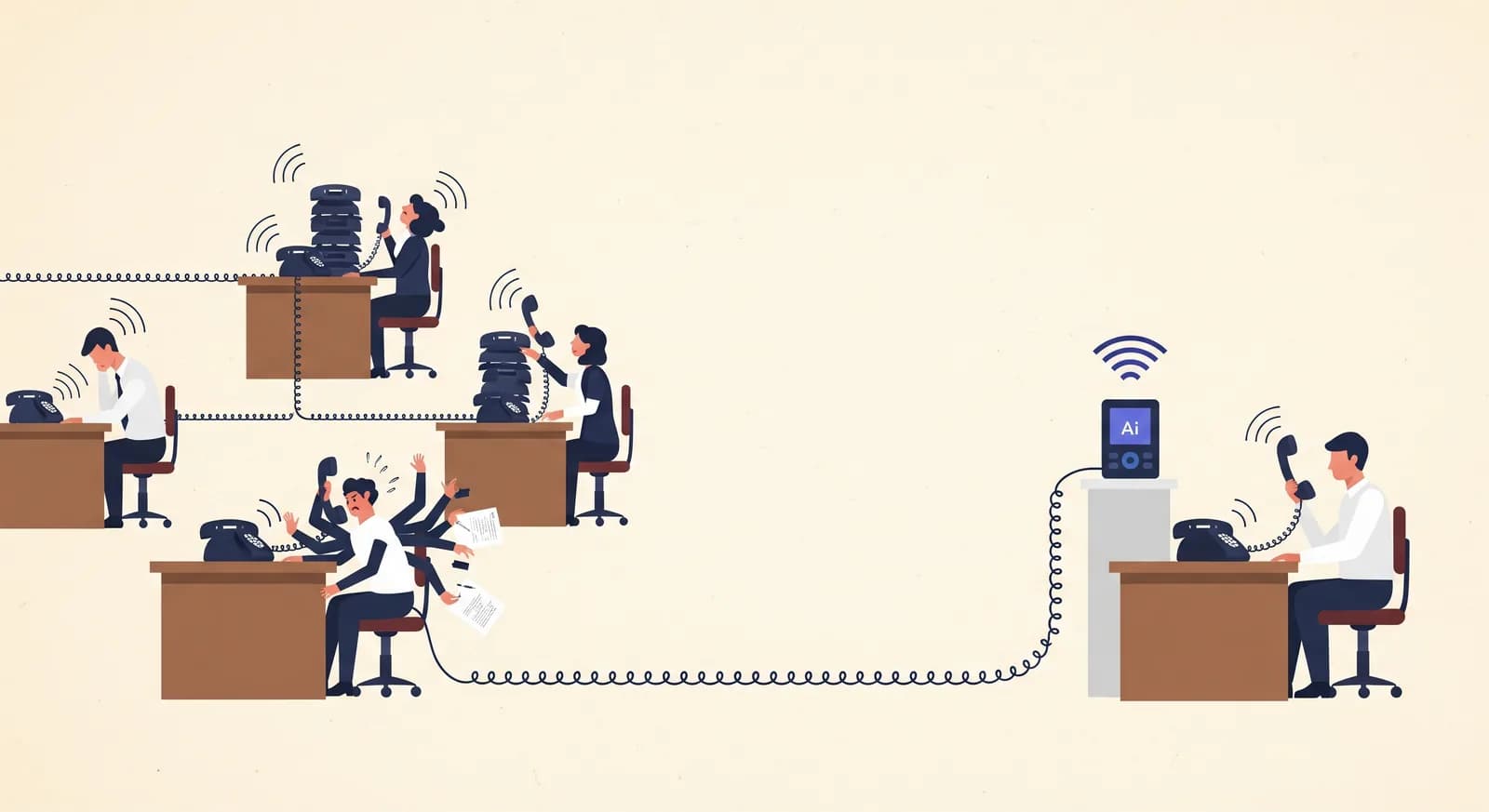
The second call always arrives at the worst possible moment. You are already on the phone, both hands are busy, and somewhere out there a stranger with money to spend is listening to it ring. This is the small business phone bottleneck, and it is not a discipline problem. It is arithmetic.
Let's follow one person through one ordinary Tuesday. Call her the owner of a two-chair salon, a three-van plumbing outfit, a small dental practice — the exact trade barely matters. What matters is the shape of her day: one phone number, one voice to answer it, and a queue of callers who all assume they are the only one dialling.
The shape of the small business phone bottleneck
A bottleneck is a place where flow narrows. Water through a funnel, cars through a lane closure, callers through a single handset. The defining feature is that throughput is capped no matter how much is trying to get through. When five people call in ten minutes and one person can hold one conversation at a time, four of those calls do not fail because the owner is slow or careless. They fail because there is exactly one lane.
Most advice for owners treats missed calls as a motivation issue — pick up faster, check voicemail more, hire when you're busy. But you can't will a second mouth into existence. While you're quoting a job on line one, line two rings into the void whether you're a saint or a slacker. The bottleneck doesn't care about your work ethic.
There's a second, sneakier property. The bottleneck is invisible from the inside. The owner on the phone hears one conversation. She does not hear the two callers who got voicemail and hung up, or the one who tried twice and then called the shop across town. Her day feels full and productive; the leak is silent by design. By the end of the day you'll be able to point at the exact places where work walked out the door — and none will be the fault of anyone who was there. The structure did it, which is oddly good news: structural problems have structural fixes.
07:30 — The morning already has a backlog
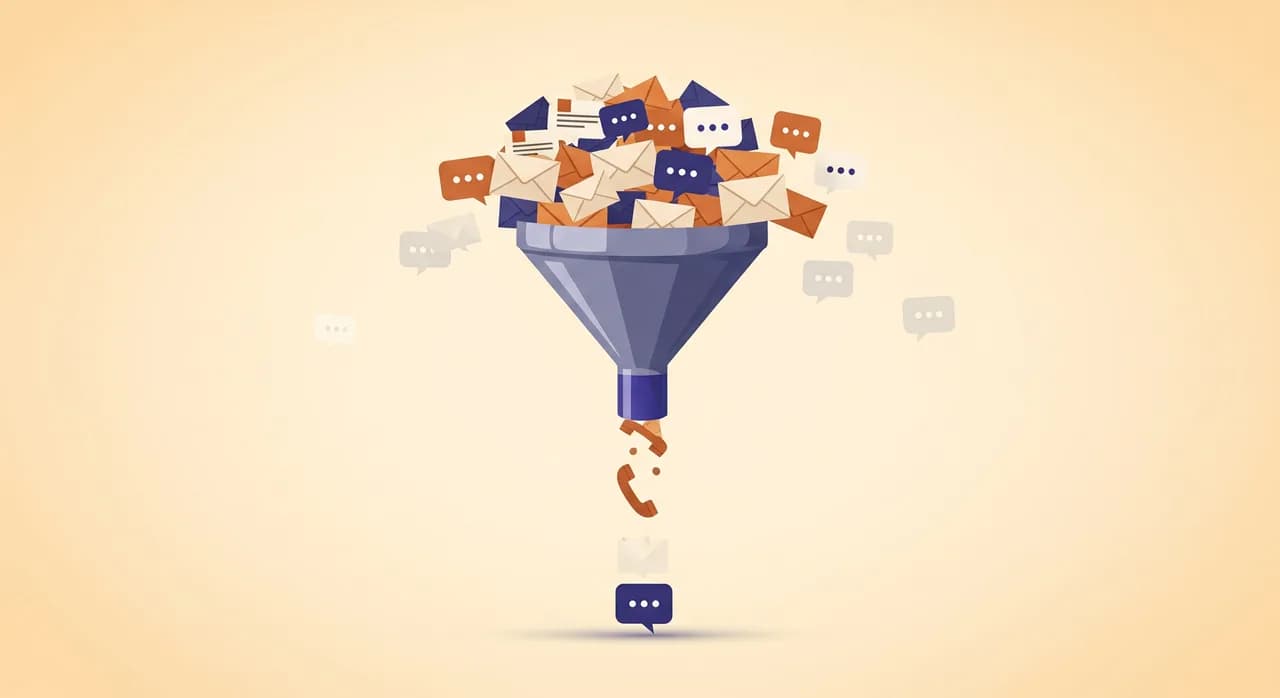
The day doesn't start at zero. Before she's unlocked the door there are three voicemails from last night, two texts, and a missed call from a number she doesn't recognise. This is the overnight accumulation — the calls that arrived after hours and have been waiting for a human to reappear.
She listens to the voicemails while the kettle boils. One is a supplier, one is a customer confirming an appointment, and one is a garbled hang-up that might have been a new job or might have been a wrong number. She'll never know. That's leak number one, and it happened before she was even awake.
Note what's happening structurally. The overnight callers didn't hit a bottleneck of capacity — they hit a bottleneck of time. There was nobody awake to answer. Same result, different cause: a call that needed a response and didn't get one in the window when it mattered.
09:15 — The first collision
The first proper collision of the day is textbook. She's on the phone with a regular, working out a reschedule — a five-minute conversation that genuinely needs her, because it involves a diary, a preference, and a bit of back-and-forth. Halfway through, call waiting beeps in her ear.
Now she has a choice, and every option is bad:
- Ignore the beep and finish the current call properly. The second caller gets voicemail or a busy tone.
- Ask the current caller to hold, swap over, and try to juggle two conversations. The first caller feels shunted; the second caller is confused about why she sounds distracted.
- Cut the current call short to grab the new one. Now the regular feels rushed, and you've traded a warm existing customer for an unknown.
There is no right answer here because the situation itself is the failure. Whichever way she jumps, someone's experience degrades. And she has to make this micro-decision in about two seconds, under mild stress, several times a day. The cognitive cost of that constant triage is real, even when no call is actually lost.
“There is no right answer to call waiting because the collision itself is the failure — every option just chooses who gets the worse experience.”
11:00 — Hands full, phone ringing
Here's the version that pure office advice ignores: the owner isn't sitting at a desk. She's mid-treatment, elbow-deep in an engine bay, up a ladder, or with a client in the chair. The phone rings and she physically cannot answer it without abandoning the paying job in front of her.
This is a different bottleneck again. It's not that she's on another call — it's that answering the phone and doing the work are the same person's job, and that person can only do one at a time. The trade is stark: interrupt the customer who is here and paying, or ignore the customer who is calling and might pay.
Most owners, sensibly, protect the person in front of them. You don't stop mid-haircut to quote a bathroom. So the ringing phone becomes a low background stress — a sound you've trained yourself to tune out, which is a polite way of saying you've trained yourself to lose those calls.
The arithmetic of a single missed call
It's tempting to shrug off one missed call. So let's do the honest maths without inventing precise statistics. Suppose, across a normal day of collisions and hands-full moments, ten calls go unanswered. Not a catastrophe — a normal Tuesday.
Some of those ten are junk: a supplier, a wrong number, a robocall. Say half. That leaves five real people who wanted something. Some will call back. Some won't. If even one of those five was a new customer who booked, and that customer's job — or their repeat visits over a year — is worth a meaningful sum, then the day's 'small' leak has a price tag that's easy to feel and hard to see.
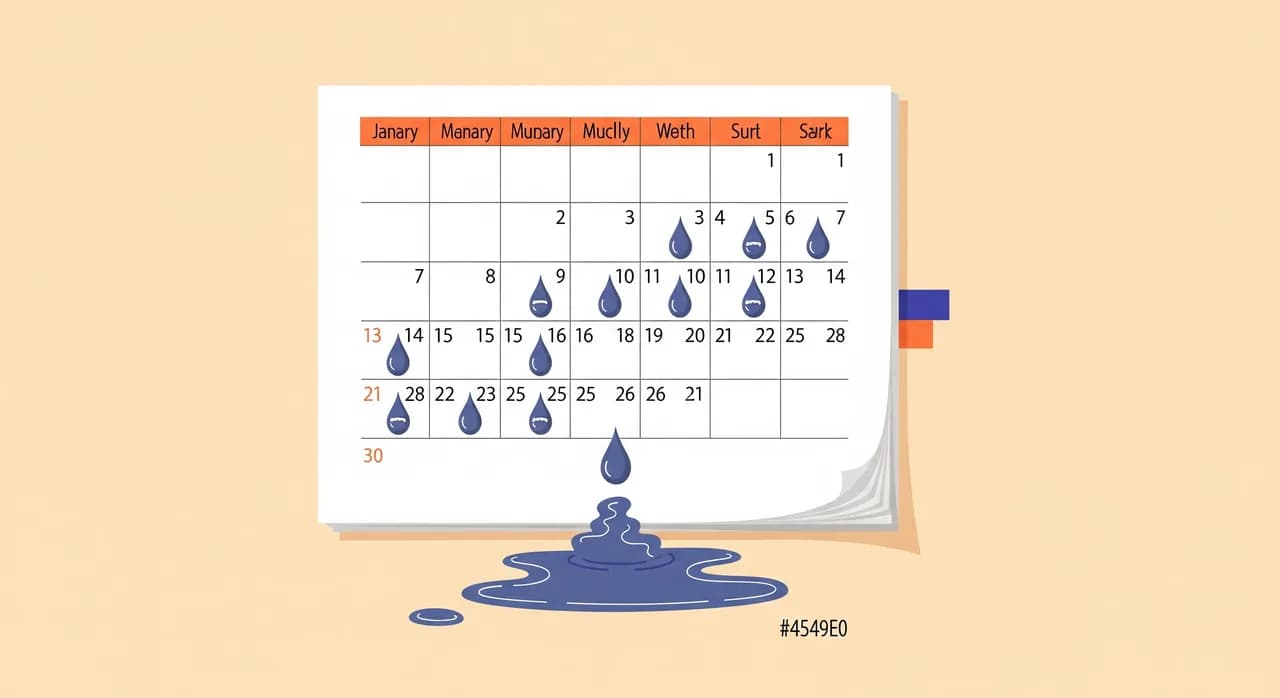
Multiply by the days in a month, then a year. The bottleneck isn't dramatic on any single Tuesday. It's a slow, steady drip that never shows up as a crisis, which is exactly why it survives for years. Nobody schedules an emergency meeting about a drip.
“The bottleneck is never a crisis on any single day. It's a slow drip that never triggers an emergency — which is precisely why it survives for years.”
13:30 — The lunch void
Even sole operators have to eat, use the bathroom, drive between jobs, and step out to the wholesaler. Each of those is a window where the phone is guaranteed unanswered. The lunch hour is a particularly cruel one, because it overlaps with when office workers — potential customers — have time to make personal calls.
So the moment your customers are most free to call, you're most likely to be unavailable. It's a scheduling mismatch nobody designed and nobody can fix by trying harder. You cannot be at the counter and at lunch simultaneously; the bottleneck is baked into being one person.
Why the usual fixes fall short
Owners aren't naive about this. Most have tried something. It's worth being honest about why the common patches only half-work, because that's what points at what would actually help.
Voicemail
Voicemail is where phone calls go to be ignored politely. A large share of callers hang up rather than leave a message, especially first-timers who have three other numbers to try. Voicemail catches the leak only if the caller is patient and motivated — which, for a new lead comparing options, they usually aren't.
The missed-call text-back
Auto-texting people who hit voicemail is better than nothing, and for some businesses it genuinely helps. But it's a consolation prize: the caller wanted an answer now, in the moment they were thinking about you, and instead they get a text minutes later asking them to re-engage. Some will. Momentum, though, is a perishable good — a text ten minutes later is chasing a caller who has already moved on to the next result.
Hiring a receptionist
A dedicated human who answers the phone is the classic answer, and for a busy enough business it's the right one. But it's a full salary, plus recruitment, holiday cover, sick days, and the awkward reality that a receptionist paid to sit and wait for calls is expensive during the many hours the phone is quiet. For a small operation, the numbers rarely stack up until you're already well past the pain of the bottleneck.
Forwarding to your mobile
Forwarding the business line to your personal mobile just relocates the bottleneck to your pocket. Now the collisions happen while you're driving, at your kid's football match, or asleep. You're more reachable and more frazzled, and you still can't take two calls at once.
16:15 — The overflow hour
Late afternoon is the day's second rush. People finishing work start dealing with their to-do list — book the dentist, chase the plumber, sort the car. For a lot of trades this hour carries a disproportionate share of the day's new-business calls, and it arrives exactly when the owner is trying to finish the last jobs and close up. This is where a day of small leaks turns into a flood. Three calls stack up in twenty minutes. She catches one, half-catches another while cashing out a customer, and misses the third entirely. Any of the three could have been the best job of the week. She'll never know which, and by tomorrow morning the callers who didn't get through will have booked elsewhere.
What this hour reveals is that the bottleneck isn't evenly distributed. It clusters. Calls arrive in bursts — a rush, a lull, a rush — and it's precisely during the bursts, when each call is most likely to be valuable, that a single line is most likely to drop them. The system fails hardest exactly when it matters most.
What actually fixes it: a second lane
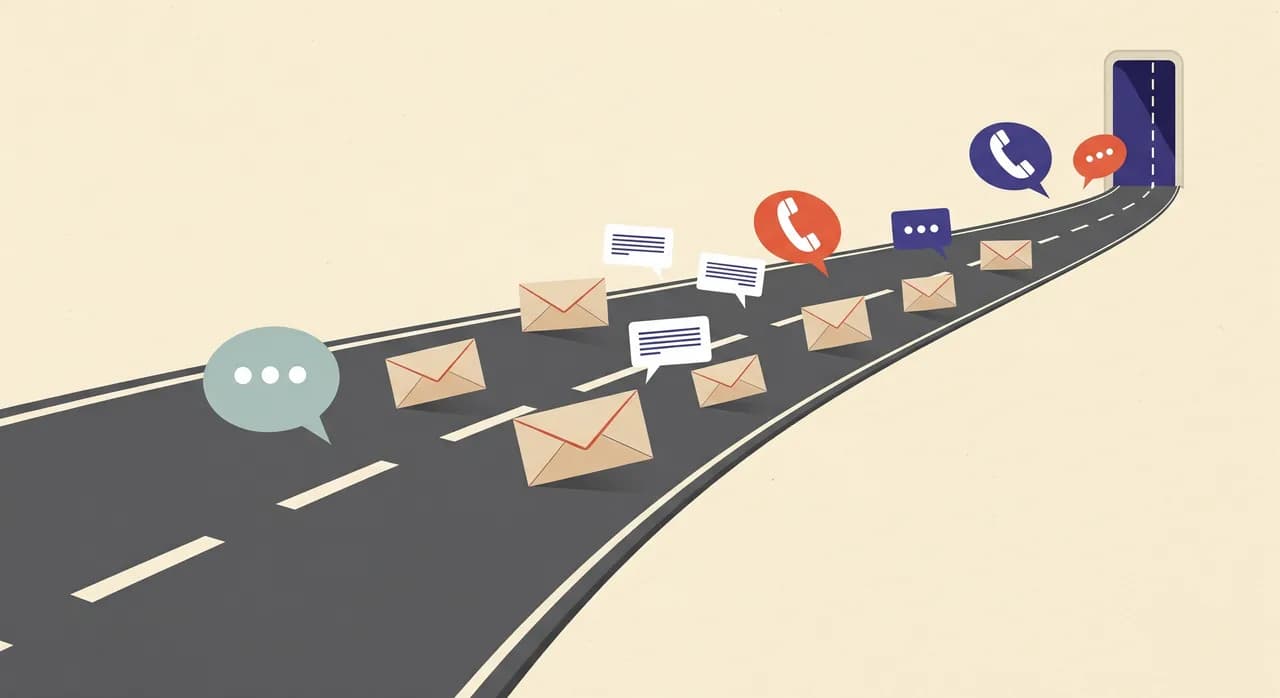
If the problem is that one caller can be handled at a time, the fix isn't to answer faster — it's to make the line handle more than one caller in parallel, and to keep it open during the hours and moments when no human can. That's the specific gap an AI phone assistant is built to fill.
Here's the honest version of what that means. When your line is busy or you can't get to it, the call rolls to an assistant that has read your business profile — your services, hours, and the answers you configured. It greets the caller, answers the common questions, takes a booking or a message, and sends you a summary and a transcript. It doesn't get flustered when three calls land at once, because there's no single handset to fight over. Overflow stops being a collision and becomes a queue that actually gets answered.
It's worth being clear about what it isn't. It's not a replacement for you on the calls that need a human — the delicate reschedule, the upset regular, the complicated quote. A good assistant hands those off gracefully: it takes a message or arranges a callback, and it doesn't pretend to be a person when someone asks. Its job is to catch the calls that were going to be lost anyway, not to stand between you and your best customers.
How it slots into the Tuesday we just watched
Replay the day with a second lane in place, and the leaks close in the order they appeared. Nothing about your actual work changes — you just stop being the single point of failure for every incoming call.
- 107:30 — the overnight backlogCalls that arrived after hours were greeted and handled at 2am. Instead of three cryptic voicemails, you open your phone to clear summaries: who called, what they wanted, what was booked.
- 209:15 — the call-waiting collisionThe second caller no longer hits voicemail. They're answered, their question handled or their booking taken, while you finish the reschedule properly. Nobody gets shunted.
- 311:00 — hands fullThe phone you couldn't reach mid-job gets answered anyway. You read what happened when you're free, instead of tuning out a ringing you've trained yourself to ignore.
- 413:30 — the lunch voidThe window when customers are most free to call is no longer the window you're least available. Lunch stops being a guaranteed dead zone.
- 516:15 — the overflow hourThe three-calls-in-twenty-minutes rush becomes three calls answered in parallel. The burst that used to break the system is exactly what the second lane is for.
Setup is deliberately quick and self-serve. You sign up, describe your business in a short wizard, and then — the part most owners appreciate — you test it by calling and talking to it yourself before you trust it with anything. When it sounds right, you forward your number, or just its overflow. It handles 25+ languages, which matters more than you'd expect in the overflow hour when a caller switches to their first language under pressure.
Being honest about the limits
A second lane is not a magic wand, and it's worth saying so plainly. An assistant answers from the profile you give it — if you haven't told it your prices or your policy on same-day bookings, it can't invent them, and it shouldn't. Garbage in, vague answers out. The businesses that get the most from it are the ones who spend twenty minutes writing down the answers they already give on the phone every day.
It also won't turn a bad offer into a good one. If callers are leaving because your prices are wrong or your availability is genuinely full, catching more of them just means hearing 'no thanks' more efficiently. The tool fixes the leak, not the product — that's still your job, and always will be. And there will always be calls that want a human and only a human. That's fine; that's the design. The point isn't to remove you from the phone. It's to make sure the phone stops being a single lane that drops a chunk of its traffic on a normal Tuesday.
What exactly is a small business phone bottleneck?
Why do I miss calls even when I'm not on the phone?
Isn't voicemail enough to catch the overflow?
How is an AI phone assistant different from just forwarding calls to my mobile?
Do I have to hand over my whole phone line?
Add a second lane before the next overflow hour
See how Vunoon catches the calls that collide, stack up, or arrive while your hands are full — set it up in minutes and test it by calling it yourself.
See how call overflow works
Vunoon builds an AI phone assistant that answers your business calls 24/7 — it books appointments, answers common questions and sends you a summary of every conversation.