Reviewing AI Receptionist Call Transcripts to Actually Improve It
Your AI phone assistant writes down every call. Spend fifteen minutes a week reading those transcripts and you turn a decent robot into a genuinely good one. Here is a simple loop for doing it.
 Vunoon15 min read
Most people set up an AI receptionist, forward their number, and never look back. That is a shame, because the single most useful thing about an AI answering the phone is not that it answers — it is that it takes notes. Every call becomes a transcript. Read a handful of them each week and you get an honest, unglamorous map of what your customers actually ask, where your assistant fumbles, and what you forgot to tell it. This is a guide to reading those transcripts on purpose.
Here is the mental shift that makes the difference. A human receptionist gets better on their own — they overhear the shop talk, they remember that Mrs. Alvarez always asks about parking, they pick up your tone over months. An AI receptionist does not learn by osmosis. It knows exactly what you told it and nothing more. The call transcripts are how it tells you what it should have known. You just have to listen.
The good news: this is not a data-science project. You do not need dashboards, tagging taxonomies, or a spare afternoon. Fifteen minutes on a quiet morning, once a week, is enough to keep the thing sharp. Let me walk you through what to look for and what to do about it.
Why the transcripts are the part that matters
When Vunoon answers a call, it sends you a short summary and a full transcript of what was said — the caller's words and the assistant's replies, in order. Owners tend to skim the summary and archive the rest. But the summary is the polished version. The transcript is where you see the assistant hesitate, misunderstand a request, or cheerfully invite someone to book a service you stopped offering last spring.
Think of it this way. You cannot sit next to your receptionist all day and coach every call. But you can read the ones that went sideways after the fact, and unlike a person, the fix you make sticks perfectly and applies to every future call at once. That is the whole trick: one edit, applied forever. A single well-spotted gap in the knowledge base can quietly rescue dozens of future callers who would have otherwise heard "I'm not sure about that."

There is a second, quieter benefit. Reading transcripts is the fastest market research you will ever do. Your callers tell you, in their own words, what they want, what confuses them, and how they describe their problems. "Do you do the gel ones that don't chip?" "Is the guy who did my brakes still there?" "Can I bring my dog if he's on a lead?" That is language you can put on your website, your booking form, and your assistant's own answers.
Set up the habit before you set up the analysis
The reason transcript review fails is almost never the review itself — it is that nobody remembers to do it. So before we get clever, pin down the boring logistics. Pick a fixed slot: Monday before you open, or Friday after the last customer leaves. Put it in the calendar as a repeating fifteen-minute block. Treat it like counting the till.
You do not read every call. If you take forty calls a week, reading all forty is a chore you will quit by week three. Instead, sample. Read the ones the assistant flagged as unresolved or handed off, plus a random five or six of the rest. The flagged ones show you failures; the random sample shows you whether the "successful" calls were actually good, or just didn't complain.
A simple triage rubric: four buckets
You need a way to sort what you read without overthinking it. Every call falls into one of four buckets. Keep them in your head, or jot the bucket letter next to each transcript. Do not build a spreadsheet on day one — the buckets are enough.
- A — Clean win. The caller asked, the assistant answered correctly, the call ended well (booking made, message taken, question resolved). Nothing to do. Skim and move on.
- B — Unanswered question. The caller asked something reasonable and the assistant didn't know. "Do you take Amex?" "Is there wheelchair access?" This is the highest-value bucket — it is a direct instruction for what to add.
- C — Awkward turn. The assistant technically answered, but clumsily: too long-winded, repeated itself, misheard a name, or gave a stiff reply where a warm one belonged. The information was right; the delivery was off.
- D — Wrong or stale. The assistant said something that is no longer true, or flatly incorrect. Old hours, a discontinued service, a price that changed. This is urgent — every one of these is actively misinforming customers.
Fix D first, always. A wrong answer is worse than no answer, because the caller acts on it and shows up annoyed. Then B, because filling gaps is where the assistant gets visibly smarter. Then C, because polish compounds over time. A-bucket calls need nothing except a moment of quiet satisfaction.
“A wrong answer is worse than no answer — the caller acts on it and shows up annoyed. Fix the stale facts before you fix anything else.”
What the unanswered questions are really telling you
The B bucket is worth lingering on, because there are two kinds of gap and they get fixed differently. The first is a plain missing fact — you simply never told the assistant whether you validate parking. Easy: add it to the business profile and you are done. The second kind is sneakier. It is a question you get repeatedly that reveals something about how you present your business.
Imagine a two-chair dental practice whose transcripts keep showing callers asking, "Are you the ones near the old post office or the new one?" That is not really a knowledge gap in the assistant — it is a sign your address is confusing and you might want a landmark on your website too. Or a hair salon where three callers a week ask whether you do men's cuts. If you do, and people keep asking, your assistant's opening line — and probably your signage — is under-selling half your services.
Closing the loop: turning notes into edits
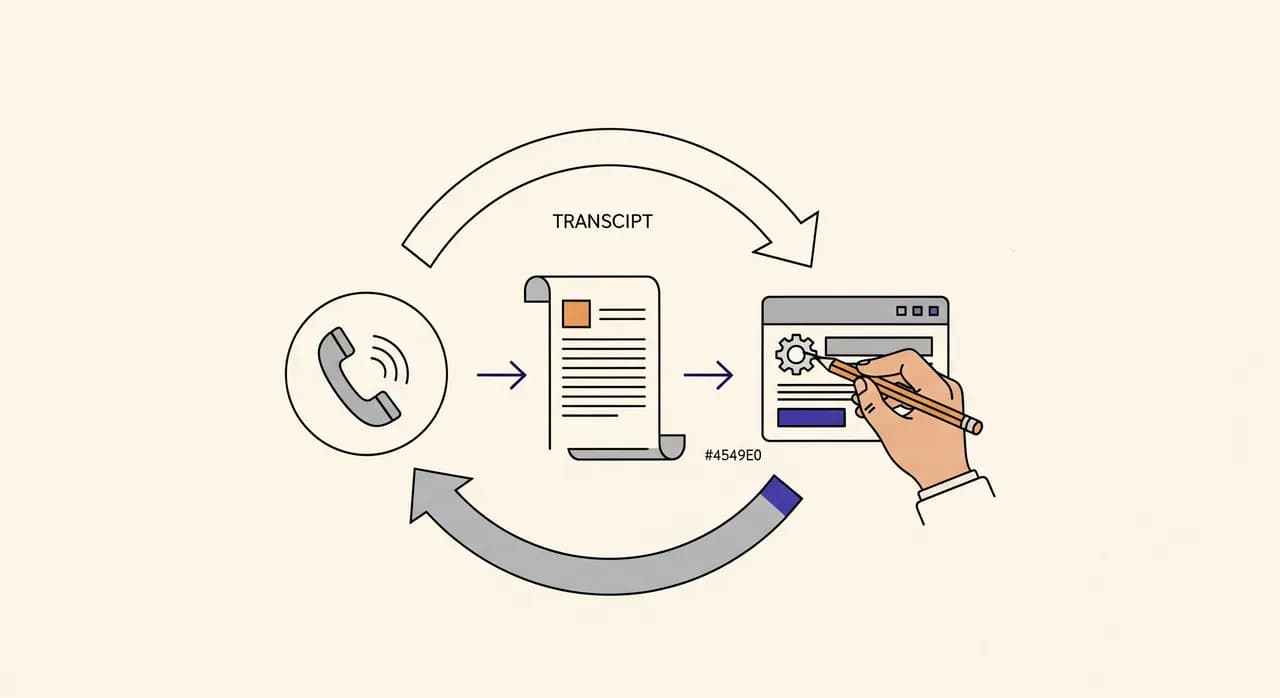
Reading is only half of it. The point of transcript review is to feed the fixes back in. In Vunoon this happens in the same short business profile you filled out during setup — the description of your services, hours, prices, policies, and the way you like to greet people. There is no retraining, no waiting. You edit the profile, and the next call already knows.
- 1Batch your notesAs you read, keep a scratch list: "add Amex, fix Saturday hours, mention we do men's cuts, soften the goodbye." Don't jump into the settings mid-read — you'll lose your place and your rhythm.
- 2Fix the D bucket immediatelyAnything wrong or stale goes in first. Correct the hours, remove the discontinued service, update the price. These take seconds and stop active misinformation.
- 3Fill the B bucket gapsAdd the missing facts to the profile in plain language, the way you'd tell a new employee. "We validate parking for the lot next door." "Yes, we see walk-ins, but appointments jump the queue."
- 4Tune the C bucket deliveryAdjust the tone or shorten a stock answer. If the assistant rambled about your cancellation policy, give it a tighter version. If the greeting felt cold, warm it up in your own words.
- 5Test it by callingBefore you close the laptop, phone your own assistant and ask the exact questions you just fixed. Ten seconds of testing beats discovering next week that the edit didn't take the way you meant.
That last step is the one people skip and regret. The assistant answers from what you wrote, and what you wrote in your head is not always what landed on the page. Calling it yourself and hearing the new answer out loud catches the difference in seconds. It also feels good — you get to watch the fix work.
Reading for tone, not just facts
Facts are easy to audit — a hour is right or wrong. Tone is harder and it is where a good assistant separates itself from a merely functional one. When you read the C-bucket calls, ask yourself: would I have said it that way? Did it sound like my business, or like a call centre?
Common tone problems have simple fixes. If the assistant answers a yes/no question with a paragraph, tell it to be brief. If it sounds overly formal for a casual trade — say a surf shop or a neighbourhood café — loosen the greeting. If it apologises too much, it will read as unsure. The trick is to write the profile in the voice you actually want, because the assistant mirrors the language you give it. Stiff instructions produce a stiff assistant.
Pay special attention to the handoffs
Every transcript where the assistant took a message or offered a callback is a small confession: "I couldn't finish this one." Sometimes that is correct behaviour — a caller wanting to negotiate a complex quote should reach a human. But sometimes the handoff happened because of a gap you can close, turning a message-taken into a booking-made.
So sort your handoffs into two piles. Good handoffs are the ones that should always reach you: sensitive situations, complaints, anything requiring judgement or a price you negotiate case by case. Leave those alone. Avoidable handoffs are the ones where the assistant took a message only because it didn't know a fact — if it had known your Tuesday availability, it would have booked the appointment on the spot. Every avoidable handoff you eliminate is a customer served immediately instead of waiting on a callback.
“Every avoidable handoff you eliminate turns a message-taken into a booking-made — a customer served now instead of waiting for you to call back.”
A realistic cadence, not a heroic one
Ambition kills this habit. Nobody sustains a daily deep-dive into call analytics while also running a business. So here is a cadence built for real life, scaled to how busy your line is.
| Weekly call volume | What to read | Time budget |
|---|---|---|
| Under 20 | Every unresolved or handoff call, plus a few random | 10 minutes |
| 20 to 60 | All flagged calls, random sample of 6 to 8 | 15 minutes |
| 60 to 150 | All flagged calls, sample from each day | 20 minutes |
| Over 150 | Flagged calls plus a themed dip each week | 25 minutes, split over two sittings |
The "themed dip" for high-volume lines is a nice technique: instead of reading broadly, pick one theme per week and read only calls about it. Week one, every call that mentioned pricing. Week two, every call about availability. Week three, first-time callers. Themed reading surfaces systemic issues a random sample would scatter and hide.
After a month or two of this, something nice happens: the B and D buckets shrink. You have caught the obvious gaps, corrected the stale facts, and most weeks are quiet. That is the goal. A mature assistant produces mostly A-bucket calls, and your fifteen minutes becomes a quick confidence check rather than a repair job.
What transcripts won't fix (an honest limit)
Let me be straight about the ceiling here, because honest limits build more trust than promises. Transcript review makes your assistant better at the calls it can already handle. It will not turn it into something it isn't. If a caller wants to argue about a bill, discuss a medical symptom, or negotiate a bespoke contract, the right move is still a handoff to you — and no amount of profile tuning should change that. Reading transcripts to eliminate those handoffs would be optimising in the wrong direction.
There is also a diminishing-returns point. Past a certain polish, further edits start making things worse — you over-script, the assistant gets brittle, and you spend twenty minutes chasing a phrasing nobody but you would notice. When your review sessions turn up nothing but A-bucket calls two or three weeks running, that is your cue to stop tinkering and just enjoy the quiet. You can always resume when your business changes: new services, new hours, a seasonal shift in what people call about.
The bonus: transcripts improve more than the assistant
Once you are in the habit, you will notice the transcripts telling you things that have nothing to do with the AI. They are a running record of demand. If a dozen callers this month asked about a service you don't offer, that is a business decision, not a settings tweak. If people keep asking for evening appointments and you keep saying no, the transcripts just quantified a gap in your hours. The phone was always your best market research; now it writes itself down.
You will also spot your own bottlenecks. A recurring "can I speak to someone about a refund" tells you your refund process is unclear on your website. A cluster of "do you still do X" tells you a change you made hasn't reached your customers. The assistant surfaces these because it patiently records every question a human receptionist would have absorbed and forgotten by lunchtime.
How often should I review my AI receptionist call transcripts?
Do I need to read every single transcript?
How do I actually fix a problem I spot in a transcript?
The assistant keeps taking messages instead of booking. Is that a problem?
Can reviewing transcripts make my assistant worse?
Is the transcript useful for anything besides tuning the AI?
See what your callers are really asking
Vunoon answers every call and hands you the full transcript, so the weekly review loop in this guide is built in from day one. Set it up in a few minutes and start reading.
Explore the transcript and summary features
Vunoon builds an AI phone assistant that answers your business calls 24/7 — it books appointments, answers common questions and sends you a summary of every conversation.