Handling Seasonal Call Volume: When Demand Outruns Your Front Desk
Every business has a busy season. The problem isn't that the phone rings more — it's that it rings more without any warning to the one person answering it. Here's what actually breaks, and what an overflow layer changes.
 Vunoon16 min read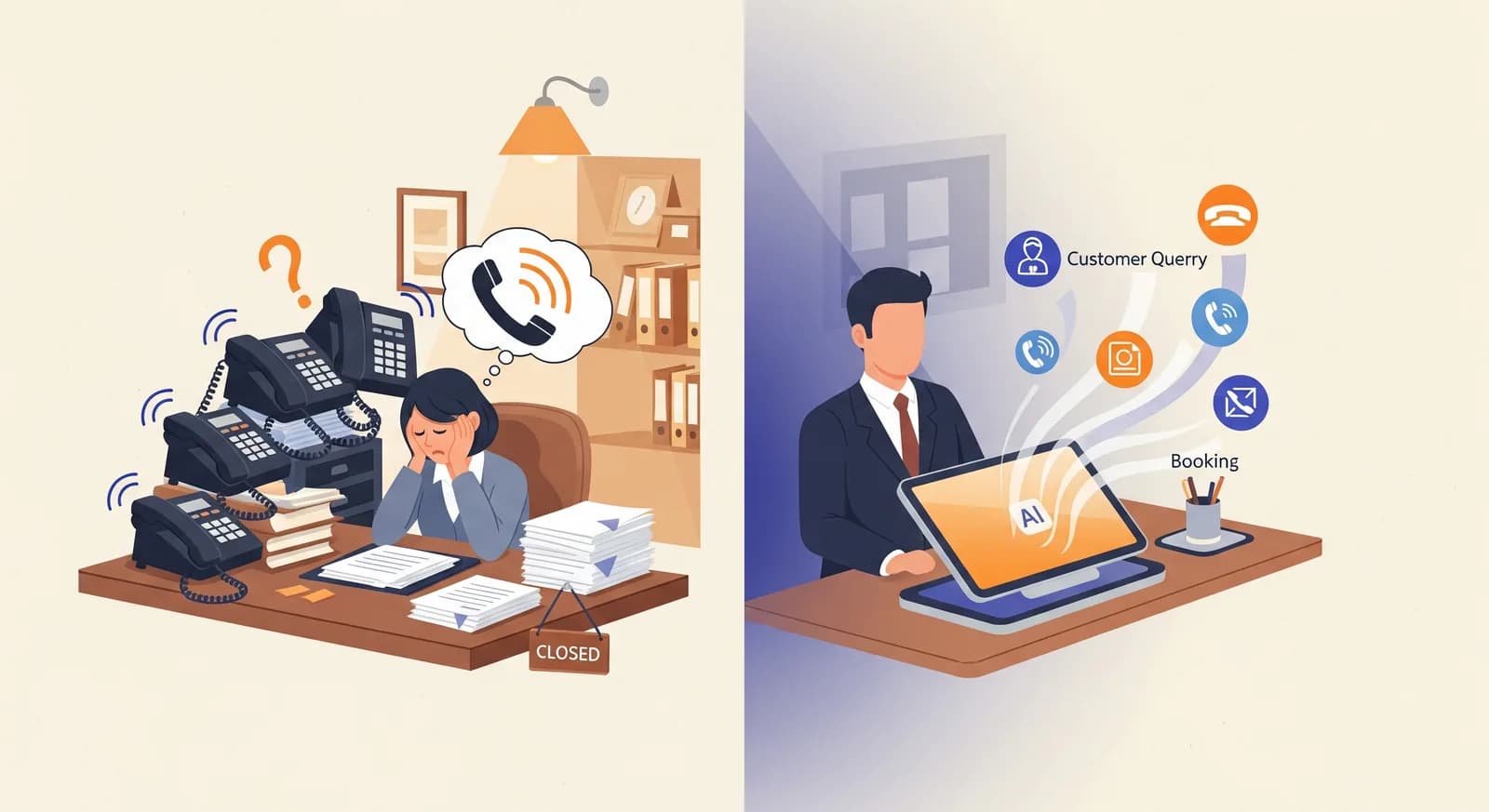
There is a week every year when your phone stops being a tool and starts being a problem. A driving school knows it: the first warm week of May, when every teenager who spent winter thinking about a licence decides today is the day. Your instructor is out on the road, your one office phone is ringing four times an hour, and the callers who don't get through don't leave a message — they call the school down the street. Handling seasonal call volume isn't about answering faster. It's about the calls you never even hear.
Most advice about phones treats call volume as if it's flat — a steady trickle you either handle or don't. Real businesses don't work like that. They have a shape to their year: a spring, a summer, a Monday-after-a-holiday, a heatwave weekend. And the cruel arithmetic of a small team is that you staff for the average and drown at the peak. You can't hire a receptionist for six frantic weeks and lay them off in October. So the peak just... happens to you.
This article is about that shape — where seasonal surges come from, why they punish a fixed-size front desk specifically, and what changes when calls that overflow your capacity go somewhere instead of nowhere. We'll walk through three concrete businesses, be honest about what an AI phone assistant can and can't do during a rush, and give you a way to think about your own calendar before your busy season arrives.
Why a predictable surge still catches you out
Here's the strange part: seasonal spikes are the most predictable thing about a business, and they still cause chaos. You know the tax deadline is in April. You know it gets hot in July. You know graduation season fills the driving school. The dates aren't a surprise. What surprises you is the concentration — the way demand that would be comfortable spread over three months arrives compressed into three weeks.
A fixed team has a ceiling. One person can hold roughly one conversation at a time, plus a couple on hold before callers give up. On a normal Tuesday that ceiling is invisible — you never touch it. During a surge you hit it before lunch, and every call above the ceiling doesn't queue politely; it evaporates. The caller hangs up and dials a competitor, and you have no record that they ever existed. You can't miss what you can't see, which is exactly why seasonal loss is so easy to under-count.
There's a second trap. During a surge, the calls you do answer get worse, not just fewer. A stressed person answering their fifth simultaneous inquiry rushes, forgets to ask for a callback number, books someone into a slot that's already taken. The quality of every answered call degrades under pressure — so the surge costs you twice: the calls you drop, and the ones you fumble because you were drowning.
Scenario one: a driving school before summer
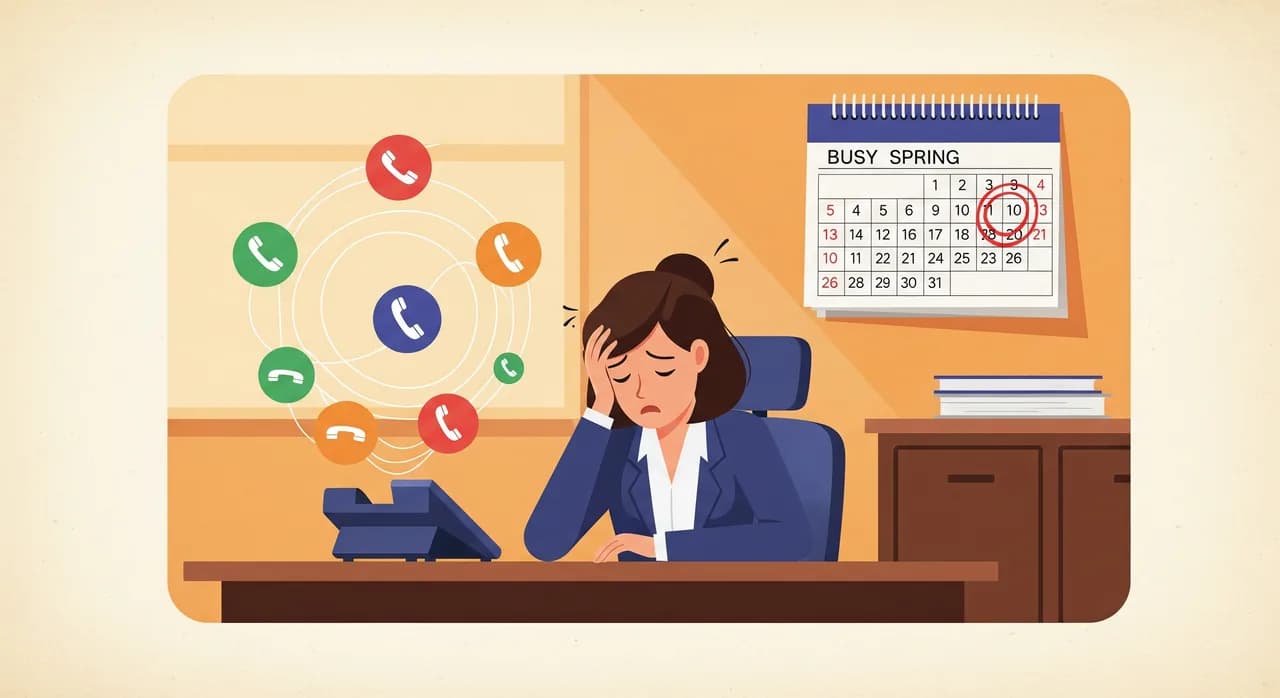
Imagine a two-instructor driving school. For most of the year, the phone is manageable: a few inquiries a day, some rescheduling, the occasional new sign-up. Then the weather turns. School holidays approach, and every parent who promised their kid lessons "this summer" starts calling at once. Volume triples in a fortnight.
The problem is structural, not lazy. The instructors are the product — when the phone rings hardest, they are physically in a car with a learner, hands nowhere near a phone. The one office phone catches what it can between lessons. So the busiest hours for calls are exactly the hours nobody is free to answer. A parent shopping around for summer slots will call three schools in an afternoon and book with whichever one picks up. Being second means being empty.
What does this surge actually need? Almost none of it is complicated. "Do you have space before August?" "How much is a package?" "Can my daughter start next week?" "What documents does she need for the theory test?" These are the same six questions asked two hundred times. The instructor's judgement is needed for maybe one call in ten — a nervous re-taker, a scheduling puzzle. The other nine are pure throughput, and throughput is precisely what a solo front desk can't scale.
“The busiest hours for calls are the exact hours the person who could answer is out driving. That mismatch is the whole problem.”
This is where an overflow layer earns its place. When the office line is engaged or nobody picks up within a few rings, the call rolls to an assistant that already knows the school's hours, package structure, and what documents a learner needs. It answers the six questions, notes who wants a slot before August, and drops a summary in the owner's inbox. The instructor calls back the one caller who genuinely needs a human — after the lesson, not during it — and none of the other nine vanished.
Scenario two: a tax office in spring
A small accounting or tax-prep office has the sharpest seasonal curve of almost any business. Eleven months of steady work, then a wall. As the filing deadline approaches, the phone becomes a siege: clients chasing appointments, new prospects who left it late, people asking which documents to bring, panicked questions about extensions.
The accountants, meanwhile, are heads-down doing the actual work — the work that has a hard legal deadline. Every minute answering "do you have any slots left?" is a minute not spent on a return. So the office faces an ugly trade-off during its most important weeks: answer the phone and fall behind on filings, or focus on filings and let the phone bleed new clients. Neither is a good answer, and most offices oscillate miserably between the two.
Notice what this scenario is not: it is not the tax office giving advice by robot. An AI phone assistant should never answer "can I deduct this?" It can, and should, say something honest like "that's a question for your accountant — let me take your details and have them call you back." The line between logistics and advice matters, and a well-configured assistant stays firmly on the logistics side. Handling seasonal call volume responsibly means the assistant knows what it doesn't know.
So the spring surge gets triaged. Existing clients confirming appointments and prospects asking whether the office is still taking on work get handled instantly. Anything that smells like actual tax advice gets captured as a message with a callback flag. The accountants come up for air twice a day, work a clean list of genuine callbacks, and keep filing. The deadline stops being a phone emergency and goes back to being a work emergency — which is at least the emergency they're trained for.
Scenario three: an HVAC company in a heatwave
Home services have a different, jaggeder pattern. A heating and cooling company doesn't get a gentle seasonal ramp — it gets a switch. The first proper heatwave, every air conditioner that was quietly failing all spring dies on the same afternoon, and the phone doesn't ring so much as detonate. The same happens with heating on the first hard frost. It is entirely predictable that it will happen; it is impossible to predict the exact day.
During that spike, the technicians are on rooftops and in crawlspaces. The owner is dispatching, buying parts, and trying to answer a phone that never stops. And the calls carry real urgency and real emotion — a family with a newborn and no cooling, a shop losing refrigerated stock. These callers will not leave a voicemail into silence. They will call the next company on the list within ninety seconds, and in a heatwave every company on that list is slammed, so the first to pick up wins the job outright.
Here the overflow assistant does something slightly different from the earlier scenarios: it does intake and triage under load. It answers immediately, gets the address and the nature of the problem, notes whether it's a no-cooling emergency versus a routine maintenance request, and puts an ordered list of jobs in front of the dispatcher. The owner isn't answering to book during the surge — the owner is answering to prioritise. That's a much better use of the one human who can't be cloned.
The common thread across all three
Three very different businesses, one identical failure mode. In each case the surge is predictable in the calendar but random in the hour. In each case the people who could answer are exactly the people doing the billable work. And in each case the majority of surge calls are simple, repetitive, and information-shaped — with a small minority that genuinely needs a human.
- The surge is concentrated. A season's worth of demand arrives in a few weeks, blowing past a fixed team's ceiling.
- Your best people are busy being busy. The hours calls peak are the hours instructors, accountants, and technicians are heads-down on the work.
- Most surge calls are simple. Hours, prices, availability, what to bring — asked over and over.
- A minority is precious. The one nervous client, the true emergency, the complex case still needs a human — and gets buried when you're drowning in the simple ones.
- The loss is invisible. Busy-line drops leave no voicemail and no trace, so you under-count the damage every year.
An overflow layer attacks all five at once. It absorbs the concentrated volume without needing a paycheque in the off-season. It works precisely when your humans can't. It handles the repetitive majority in its sleep. It flags the precious minority so a person gets to it deliberately. And it turns invisible drops into a logged, countable list — which, if nothing else, finally lets you see the size of the season you've been losing.
What 'overflow handling' actually means in practice
"Overflow" is a plumbing word, and the plumbing metaphor is right. You keep your existing setup exactly as it is — your number, your receptionist, your voicemail. The overflow assistant sits below the point where things back up. When your line is busy or rings past a threshold you choose, the call spills into the assistant instead of into a dead tone. On a quiet day it barely ever triggers. In a surge it catches everything above your capacity.
- 1Calls hit your team firstNothing changes on a normal day. Your phone rings, your people answer, life is fine. The assistant is dormant.
- 2Overflow condition tripsWhen the line is engaged or unanswered after a set number of rings, the call forwards automatically to the assistant. This is a standard carrier feature — busy/no-answer forwarding — pointed at Vunoon.
- 3The assistant answers on the profile you configuredIt greets the caller in your business's voice and answers from the hours, services, and details you set up in the wizard — including honest 'I'll have someone call you back' handoffs for anything beyond its remit.
- 4You get the summary, not the interruptionEvery overflow call arrives as a written summary plus transcript. You review a tidy list when you surface — not a phone screaming while you're on a roof or mid-return.
Crucially, this is not "replace the receptionist." A good receptionist answering a manageable line is better than any assistant. The point of overflow is the part above what one person can hold. You're not automating your front desk; you're giving it a relief valve that only opens when it's about to burst. The rest of the year, it costs you almost nothing and does almost nothing, which is exactly what you want from a valve.
“You're not automating your front desk. You're giving it a relief valve that only opens when it's about to burst.”
Setting it up before your season, not during it
The mistake is trying to solve this in the middle of the rush, when you have no time to configure anything and every hour is on fire. The whole advantage of a seasonal spike is that you can see it coming. Set the overflow up in your quiet weeks, test it while you're calm, and let it sit dormant until the season trips it. It's a fire drill, not a fire.
Getting the profile right takes an afternoon, not a project. Write down the ten questions you get asked most during your busy season — the real ones, in your customers' words. Note your current prices and availability rules. Decide, explicitly, the line between "the assistant can answer this" and "take a message for a human." That last decision is the important one: it's where you protect your judgement calls and your professional advice from being handled by a machine.
One more setup detail worth the effort: multilingual coverage. Seasonal surges often bring people who aren't your regulars — summer tourists calling the vacation rental, out-of-town families needing a repair. An assistant that answers in the caller's language during a rush, when you have zero spare capacity to find someone who speaks it, quietly saves jobs you'd otherwise never know you lost.
| Business | Surge trigger | Most common surge calls | What still needs a human |
|---|---|---|---|
| Driving school | First warm weeks before summer holidays | Availability, package questions, sign-ups | Nervous re-takers, tricky scheduling |
| Tax office | Approaching the filing deadline | Appointments, 'what do I bring', taking new clients? | Actual tax advice, complex cases |
| HVAC company | First heatwave or hard frost | No-cooling/no-heating emergencies, quotes | Prioritising the job order, dispatch |
The honest limitations
An overflow assistant is not magic, and pretending otherwise wastes your trust. It won't give professional advice, and it shouldn't — you don't want a machine improvising on tax law or a medical symptom. It won't handle a caller who insists on a human right now if no human is free; the best it can do is take a good message and set an honest expectation. And it's only as good as the profile you gave it: feed it wrong prices or vague hours and it will repeat your mistakes confidently, at scale.
It also won't fix a genuine capacity problem. If you truly cannot service the demand your season generates — not enough instructors, not enough technicians — then no phone layer will conjure more hours in the day. What overflow does is make sure that the demand you can service reaches you cleanly, and that the demand you can't is captured, ranked, and handled honestly rather than lost to a busy signal. That's a real, bounded benefit — which is the only kind worth promising.
Finally seeing the size of the season
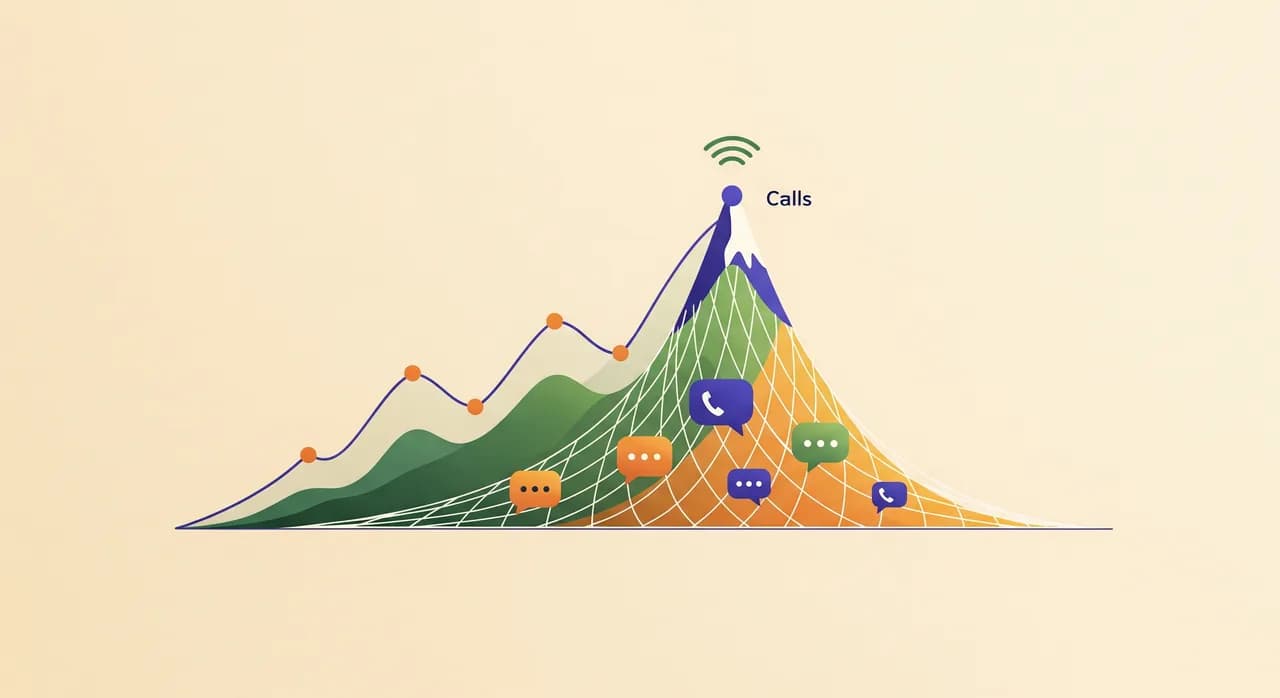
Here's the underrated benefit that shows up after your first surge with overflow in place: you get a number. For the first time you can see how many calls landed above your capacity, what they asked, how many wanted a booking. Most owners are quietly shocked. The season they thought was "busy" was actually leaking a meaningful slice of its revenue out through the busy signal every single year — they just never had a way to count it.
The arithmetic is unforgiving once you can do it. Ten overflow calls a day during a three-week peak, and say one in three would have booked. That's roughly seventy bookings you would previously have lost to a dead line — every year, on the same predictable calendar, without ever knowing. You don't need fabricated statistics to feel the weight of that; you just need your own overflow log and a slow afternoon to read it.
How is handling seasonal call volume different from just getting more voicemail?
Won't customers be annoyed to reach an assistant during my busy season?
Do I have to change my phone number or my current setup?
Can I turn it on only for the busy season?
What happens to calls that genuinely need me?
Set up your overflow before your season starts
Describe your business, test the assistant by calling it yourself, and have it ready to catch your peak — all before the phone starts detonating. Free trial, minutes to set up.
See how call overflow works
Vunoon builds an AI phone assistant that answers your business calls 24/7 — it books appointments, answers common questions and sends you a summary of every conversation.