Who Should Answer the Business Phone: Staff Between Tasks vs. a Dedicated Line
The 'whoever is free grabs it' model feels free, but interruption and lost calls make it the most expensive setup you have. Here is how to decide who should answer the business phone.
 Vunoon15 min read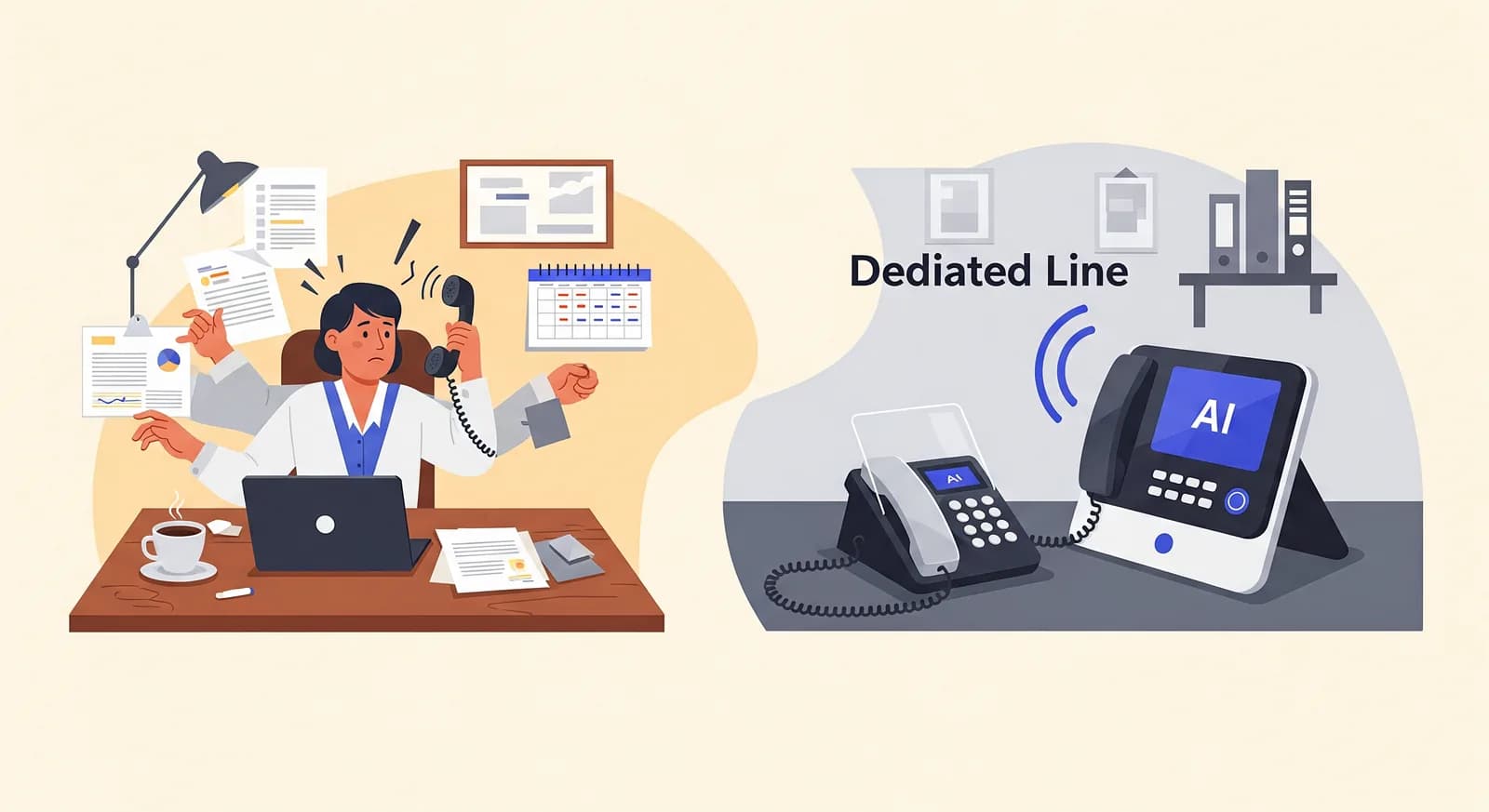
Most small businesses never actually decided who answers the phone. It just happened. Whoever is closest, whoever isn't mid-something, whoever feels guilty ignoring the third ring. That default has a name and a price, and once you can see both, the choice of who should answer the business phone gets a lot clearer.
Walk into almost any small shop, clinic, or workshop and watch the phone for an hour. You'll see the same pattern. It rings. Two people glance at it. One is helping a customer and can't move. The other is elbow-deep in something they'll now have to redo. After a beat, someone sighs and picks up. Or nobody does, and it goes to voicemail nobody checks until Thursday.
This is the ambient answering model — the phone is everyone's job, which quietly means it's no one's. It's the most common setup in businesses under twenty people, and it's almost never chosen on purpose. It's just what's left when nobody makes a decision. This article is about making the decision on purpose.
The default nobody actually chose
"Whoever's free picks up" sounds fair and flexible. In practice it's neither. There is rarely someone who is genuinely free during business hours in a small team — everyone is doing something. So the phone doesn't get answered by whoever is free; it gets answered by whoever is least good at ignoring it. That's usually your most conscientious person, which means your best worker keeps getting yanked off high-value tasks to read out opening hours.
The other half of the time, everyone is genuinely mid-task, so the call is silently declined by inaction. Nobody decided to lose that call. It just fell between people. And because no single person owns the phone, no single person feels responsible when a caller goes unhelped, so the problem never surfaces in a way that gets fixed.
The deeper issue is that ambient answering optimizes for the wrong thing. It minimizes the awkwardness of assigning a job nobody wants. It does not minimize interruptions, lost revenue, or the caller's experience — the three things that actually matter.
What an interruption actually costs
The tempting way to price the phone is by call length. A booking takes four minutes, so a call "costs" four minutes. That's wildly wrong, because the call doesn't just take the time you spend on it. It takes the time you spend getting back to what you were doing.
Think about the last time you were concentrating — pricing a job, cutting hair, reconciling the till, examining a patient. The phone rings. Even if you don't answer, your attention snapped. If you do answer, you've now dropped a thread you'll have to pick up again. Getting back into a focused task after a break isn't instant; there's a re-entry cost every single time. For deep, error-sensitive work, that recovery tax can dwarf the length of the call itself.
Now stack that across a day. Say the phone rings fifteen times between nine and five. If each ring costs a two-minute call plus several minutes of getting your head back in the game, you're not losing thirty minutes of phone time. You're losing an hour or more of your best-quality attention, sliced into fragments too small to do anything useful with. Fragmented time is the least productive time there is.
And the costs land where you can least afford them. The person who answers is often mid-service with a paying customer standing right there. Now that customer is watching your attention leave the room. You've interrupted the revenue in front of you to maybe capture revenue on the line — and quite often you botch a little of both.
“The phone doesn't cost you the length of the call. It costs you the length of the call plus every time your best worker has to find their place again.”
The inconsistency problem
There's a subtler cost to ambient answering that doesn't show up on any clock: callers get a different business depending on who picks up. One person knows Saturday hours changed last month; another doesn't and quotes the old ones. One quotes a price confidently; another says "I'll have to check" and never calls back. One takes a proper message; another scribbles a number on a receipt that's in the recycling by lunchtime.
This isn't anyone's fault. When answering the phone is a side duty for six people, six people carry slightly different, slightly outdated versions of the truth. Nobody was trained on it because it's not really anyone's job. The result is a business that sounds unreliable on the phone even when it's excellent in person.
Consider the small, common failures that erode trust before a customer ever walks in:
- The caller is told "someone will ring you back" and nobody does, because the message lived in one person's head.
- Two staff give two different prices for the same service, and the customer decides you're either disorganized or trying it on.
- A booking gets taken but not written into the system, so it collides with another one on the day.
- A simple question — do you take walk-ins? is there parking? — gets a shrug because whoever answered doesn't know.
- The phone is answered flustered and short, mid-task, and the caller quietly decides to try somewhere friendlier.
Calls lost mid-service — the worst-timed rings
The single most expensive moment in ambient answering is the call that arrives while everyone is with a customer. This is not a rare edge case; it's the norm, because the times your business is busiest in person are exactly the times other people are calling. Lunch rush, Saturday morning, the after-work wave — demand on the phone and demand at the counter peak together.
So the calls you most want — a new customer ready to book, at the moment they're motivated — arrive precisely when you're least able to take them. They ring out. They don't leave a voicemail, because most people under forty won't. They call the next place on the list, and that place answers, and you never knew the opportunity existed. You didn't lose a call. You lost a customer, silently, at your busiest and most profitable hour.
Do the arithmetic on your own numbers, honestly. If you miss even five real inquiry calls a week, and one in three would have booked, that's roughly seven or eight bookings a month walking straight to a competitor — from a phone that was "basically covered." For most small businesses that's not a rounding error. That's the difference between a good month and a flat one.
“Your busiest hour on the floor is your busiest hour on the phone. Ambient answering fails hardest exactly when it matters most.”
The dedicated-handling alternative
The opposite of ambient answering is dedicated handling: one clearly owned point of contact whose job — or whose entire function — is to answer well, every time, without being pulled off something else. Dedicated doesn't have to mean a full-time human receptionist. It means the phone is somebody's or something's actual responsibility, not a shared reflex.
There are really three ways to do dedicated handling, and they sit on a spectrum of cost and control.
A dedicated person
A receptionist or front-desk role whose primary job is the phone and the door. This is the gold standard for warmth and judgment — a good receptionist reads a caller, handles the odd situation, and makes people feel looked after. The catch is obvious: it's a salaried role, it needs coverage for breaks, sickness and holidays, and it only works during the hours you pay for. For a business that gets ten meaningful calls a day, a full-time hire is a lot of fixed cost for a job that's busy in bursts.
An outsourced answering service
A third-party team answers in your name and passes messages along. This solves coverage and takes the ringing off your floor. The trade-off is knowledge and consistency: an outside agent handling dozens of businesses won't know your prices, your quirks, or your Saturday hours the way you do, so they often end up taking a message rather than actually helping — which pushes the real work back to you anyway.
A dedicated AI line
An AI phone assistant answers every call on the first ring, using a profile of your business — the services, hours, and prices you configured — and either handles the inquiry or takes a proper message and sends you the transcript. It's dedicated in the sense that matters most: it never gets pulled off to do something else, never has an off day, and answers call number one and call number fifteen exactly the same way. It's not warm in the way a great human is, and it shouldn't pretend to be. But for the routine bulk of calls, consistency and availability beat improvisation.
Comparing the models honestly
No option is perfect, and anyone who tells you otherwise is selling you something. Here's an honest read on how the four approaches trade off against each other on the things that actually decide the outcome.
| Coverage | Consistency | Interrupts your work | Fixed cost | |
|---|---|---|---|---|
| Staff between tasks | Patchy — depends who's free | Low — varies by person | High — constantly | Low (but hidden) |
| Dedicated person | Their hours only | High while present | None | High |
| Outsourced service | Broad | Medium — limited knowledge | None | Medium |
| Dedicated AI line | 24/7 | High — same every call | None | Low |
The point of the table isn't to crown a winner. It's to show that "staff between tasks" — the option most businesses run by default — is the only one that scores badly on almost every column while feeling free. Its cost is real; it's just hidden in fragmented attention and calls you never knew you missed.
Why hybrid is usually the right answer
For most small businesses, the smart move isn't to pick one model and force every call through it. It's to route calls by what kind of call it is. The mistake with ambient answering is treating every ring as equally urgent and equally worth interrupting a human. They aren't.
Roughly speaking, your calls fall into three buckets. The routine bulk — hours, prices, "are you open," simple bookings — is high-volume and low-judgment, and it's exactly what interrupts you most and rewards a human least. The genuinely complex — a delicate complaint, an unusual request, a big-ticket negotiation — deserves a real person's warmth and judgment. And the after-hours and overflow calls are the ones you currently lose entirely.
A hybrid setup matches each bucket to the right handler. The routine bulk goes to a dedicated line — human or AI — so it stops interrupting the floor. The complex calls get escalated to the right person, ideally with a message and context so they can call back prepared instead of ambushed. The after-hours and overflow calls get caught instead of dropped. Your people stay on the work they're actually good at, and no motivated caller hits a dead line.
- 1Watch your phone for one real weekNote when calls come in, who ends up answering, and roughly what each call was about. You're looking for patterns — the peak hours, the repeat questions, the calls that keep pulling one particular person off their work.
- 2Sort calls into routine vs. judgmentBe ruthless. Most calls are routine and don't need your most senior person. If a well-briefed newcomer could handle it from a one-page cheat sheet, it's routine — and it's a candidate for a dedicated line.
- 3Give the routine bulk a dedicated handlerThis is where an AI line earns its keep: it answers every routine call instantly from your business profile, so the ringing stops interrupting the floor. Reserve your humans for the calls that actually need them.
- 4Set clear escalation and callback rulesDecide what always reaches a human, and how. A good handoff takes a message plus context and routes it to the right person, so callbacks happen prepared — not "someone will get back to you" into the void.
- 5Review the transcripts and adjustWhen every call leaves a summary and transcript, you can finally see what people actually ask, fix the questions your assistant fumbles, and tighten the routing over a few weeks.
None of this requires ripping out your phone system or hiring anyone. It requires deciding, once, that the phone is a designed part of your operation rather than an interruption you tolerate.
Where an AI line fits — and where it doesn't
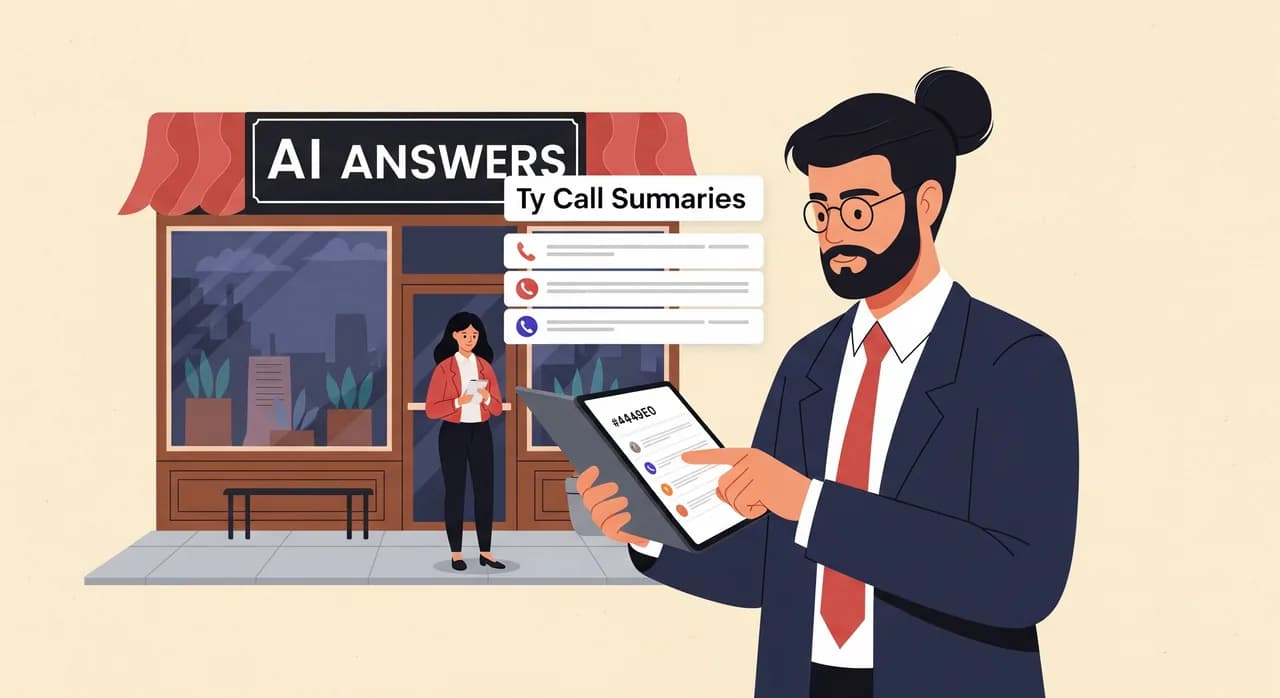
It's worth being straight about this, because overclaiming helps no one. An AI phone assistant is very good at the routine bulk: answering instantly, 24/7, in whatever language the caller speaks, from a profile you set up in a few minutes describing your services, hours, and prices. It answers the tenth caller as patiently as the first, takes bookings and messages, and sends you a summary and transcript of every call so nothing lives in one person's head.
What it is not is a replacement for human judgment on the hard calls. A grieving pet owner, a furious customer, a negotiation with nuance — those want a person. A well-built assistant knows its limits: it doesn't pretend to be human when asked, and it hands off gracefully, taking a message or arranging a callback rather than bluffing. Used that way, it doesn't replace your team. It stops your team from being interrupted by calls that never needed them, and it catches the ones they were losing.
Making the decision for your business
So, who should answer the business phone? The honest answer is: not "whoever's free," and not always the same one thing. Start by naming the costs you're currently paying invisibly — the interrupted focus, the inconsistent answers, the busy-hour calls you never knew you lost. Then decide, deliberately, which calls deserve a human and which just need to be handled reliably.
For a very small team with low, complex call volume and a naturally quiet phone, a well-drilled shared approach with clear ownership might genuinely be fine — as long as it's a choice, not an accident. For almost everyone else, the answer is some flavor of hybrid: protect your people's attention by giving the routine calls a dedicated handler, keep humans for the calls that need them, and stop losing the after-hours and overflow calls entirely.
The mistake isn't choosing humans over AI or AI over humans. The mistake is not choosing at all — letting the phone stay everyone's job, which means it stays nobody's, which means it stays your most expensive and least visible leak.
Who should answer the business phone in a small team?
Isn't having staff answer between tasks the cheapest option?
Do I need a full-time receptionist to handle the phone properly?
What's a hybrid phone-answering setup?
Can an AI assistant handle calls without sounding fake?
Stop losing the calls you never see
Give your routine calls a dedicated handler and protect your team's focus. Set up an AI line from your own business profile in minutes, test it yourself, then forward your number when you're ready.
See how the dedicated line works
Vunoon builds an AI phone assistant that answers your business calls 24/7 — it books appointments, answers common questions and sends you a summary of every conversation.