Business Phone Coverage During Vacation: Close Up Without Losing Customers
How a small team can take a real break — the summer shutdown, an owner's holiday, a long weekend — without letting the phone quietly hand your customers to the shop down the road.
 Vunoon16 min read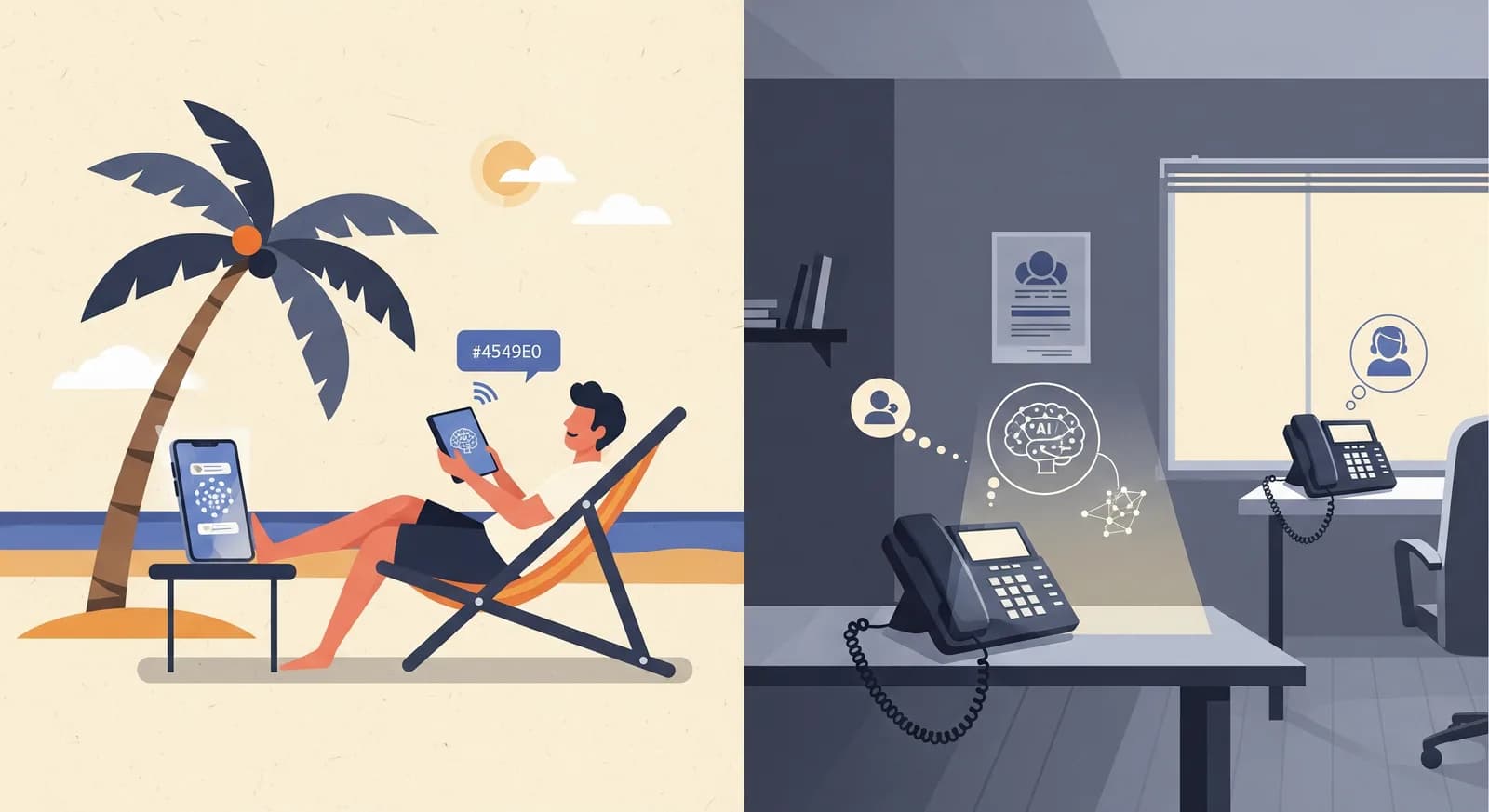
You've earned the week off. The problem isn't your right to a holiday — it's the phone. It doesn't know you're on a beach. It rings on Tuesday morning like every other Tuesday, and if nobody answers, the caller doesn't leave a heartfelt note wishing you a lovely break. They hang up and dial the next business on the list.
This is the quiet math of the small-business vacation. A closed shop is fine — everyone understands closed. An unanswered shop is different. To the caller there's no visible difference between "the owner is in Croatia" and "this place has gone out of business." Both sound like dead air. And the caller has a problem to solve today, so they solve it with someone who picks up.
Good business phone coverage during vacation isn't about pretending you're open. It's about making sure the closure is communicated, contained, and reversible — so the people who call while you're away are still your customers when you get back. This guide walks through how to do that whether you're a solo operator taking a long weekend or a small team doing a full August shutdown.
What actually happens when the phone rings and nobody answers
Picture a two-person physiotherapy practice. Both therapists close for a shared week in July. Nine calls come in over those seven days. That doesn't sound like a catastrophe — nine calls, how bad can it be?
Except three of those callers are existing patients who wanted to rebook and would have happily taken a slot in the week after you return. Two are new referrals from a GP — the kind of caller who cost you nothing to acquire and won't call twice. One has an insurance question that a thirty-second answer would have resolved. When you get back, your voicemail has one message on it (people under 40 rarely leave voicemail), and you have no idea the other eight ever happened. You didn't lose nine calls. You lost the bookings inside them, and you lost them invisibly.
That invisibility is the real danger. A missed call doesn't announce itself. There's no red number that says "you just lost €340 of work." So the cost of poor vacation coverage never shows up as a line you can see — it shows up as a quiet, permanent dip you attribute to "a slow month."
“A closed sign is understood. Dead air on the phone is indistinguishable from going out of business.”

The three kinds of callers you get while you're away
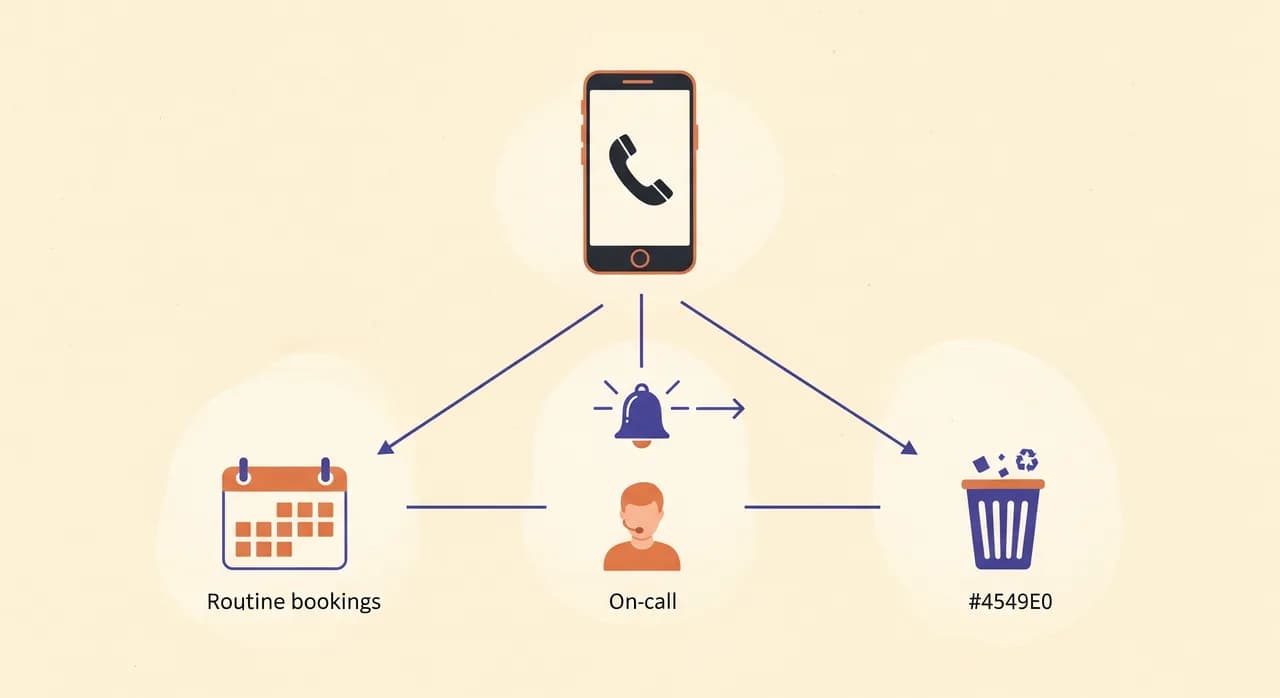
Before you can plan coverage, it helps to sort the incoming calls, because they don't all deserve the same treatment. Almost everyone who phones a closed small business falls into one of three buckets.
- Can wait — should be captured. The vast majority. Someone wants to book, reschedule, ask a price, or check your hours. They don't need you now; they need to be acknowledged and slotted in for when you're back. Lose these and you lose real revenue quietly.
- Genuinely urgent — should be escalated. A burst pipe for a plumber, a boarding client's pet issue for a vet, a locked-out tenant for a property manager. Rare, but the one call where silence does actual harm. These need a defined path to a real human — you, a partner, or an on-call contact.
- Noise — should be filtered. Cold sales calls, wrong numbers, someone trying to sell you a better electricity tariff. You want zero of your holiday spent on these, and zero of them escalated to anyone.
The whole art of vacation phone coverage is a sorting problem: capture bucket one gracefully, route bucket two reliably, and make bucket three disappear. A plain voicemail greeting treats all three identically — which is why it fails all three.
Why the classic "we're closed, leave a message" voicemail quietly fails
The default move is to record a new voicemail greeting: "Thanks for calling, we're closed until the 12th, please leave a message." It feels responsible. It mostly isn't, for reasons worth being honest about.
Most people won't leave one. Leaving voicemail feels like shouting into a void — the caller has no idea if or when it'll be heard. A large share simply hang up when they hear the beep and dial the next number instead. You've announced you're closed, which is good, but you've done nothing to keep the caller.
It captures the wrong thing. Even when someone does leave a message, you often get a name and half a phone number mumbled at the end. No context, no preferred time, no sense of whether it's urgent. You come back to a stack of these and have to play detective, calling people back who've already booked elsewhere.
It can't tell urgent from routine. The burst pipe and the "do you do gel nails" enquiry land in the same inbox, unheard, until you're back at your desk. Voicemail has exactly one setting, and it's "wait until the human returns." That's fine for the price question and a genuine problem for the emergency.
The message that keeps customers instead of losing them
Whatever handles your calls — a person, a machine, or an answering service — the words matter more than the mechanism. A good closed-for-vacation message does four things in about fifteen seconds, and it does them in that order.
- 1Confirm they reached the right placeSay your business name immediately. A caller who's unsure they dialled correctly is already half gone. "You've reached Meadow Lane Dental" resolves that in two seconds.
- 2State the closure and — crucially — the return dateNot just "we're closed" but "we're closed for our summer break and reopen Monday the 18th." A specific return date reassures. "Closed until further notice" sounds like a business in trouble.
- 3Offer a next step that isn't "call back later"This is where most messages stop and most customers leave. Instead: "I can take your details and book you a slot for the week we reopen" or "leave your number and we'll call you first thing on the 18th." Give the caller a reason to stay on the line.
- 4Provide an out for genuine emergenciesOne sentence: "If this is urgent, I can pass an emergency message straight to the on-call number." Now the one caller who truly needs a human has a path, and everyone else self-selects out of it.
Notice what this message never does: it never apologises three times, never lists your entire opening-hours schedule for the rest of the year, and never says "your call is important to us" — the phrase that, through overuse, now signals the opposite. It's warm, specific, and it always ends with something the caller can do.
Book into the future instead of just taking messages
Here's the single most valuable thing vacation coverage can do, and the thing voicemail structurally cannot: fill your first week back before you're even back.
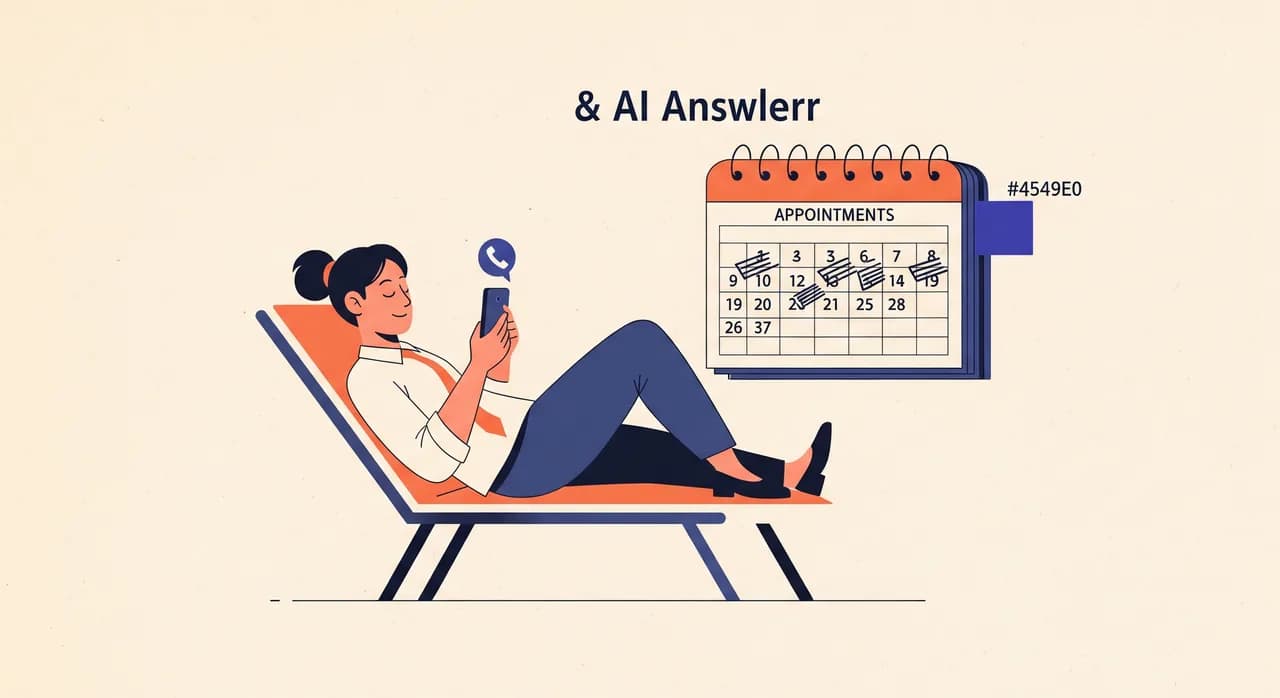
Think about the difference. Option A: you return to eleven messages and spend your first morning back playing phone tag, catching maybe half of them because the rest have moved on. Option B: while you were away, callers who wanted to book were offered slots in your reopening week, gave their details, and are now sitting in your diary. You come back to a calendar that's already earning, not an inbox that's a chore.
You don't need to hand out confirmed appointments on the spot to make this work. Even a soft version — "I'll pencil you in for Tuesday the 19th at 10 and the owner will confirm by text when they're back" — is dramatically better than a message, because the caller now feels held. They've been given a specific time and a specific reason to expect a call. They stop shopping around. That psychological difference, from "I left a message and I'm not sure" to "I have a provisional slot," is the whole ballgame.
“The best vacation coverage doesn't just avoid losing bookings — it fills your first week back before you've unpacked.”
Setting up urgent-only escalation so your holiday stays a holiday
The reason many owners never truly switch off is the fear of the one call that mattered. So they keep their phone on, glance at it on the beach, and never fully rest — which defeats the point of leaving. The fix is a deliberate escalation rule, not vigilance.
The principle: everything is routine until proven urgent, and only proven-urgent reaches a human. You decide in advance what counts as urgent for your specific trade, and everything that doesn't meet that bar gets captured for later without disturbing anyone. For a plumber, "no water" or "active leak" is urgent; "quote for a new bathroom" is not. For a vet, a distressed animal is urgent; a routine vaccination booking is not. Write the rule down before you leave; don't improvise it from a lounger.
- Define "urgent" narrowly and in your own words. The narrower the definition, the fewer false alarms interrupt your break — and the more you'll trust the system enough to actually rest.
- Name a single escalation contact, not "whoever's around." If it's a team, one named person is on call at a time. Shared responsibility on holiday means nobody answers and everybody assumes someone else did.
- Decide the channel. A text or push with the caller's number and a one-line summary is usually enough — the on-call person can call back on their terms rather than being cold-transferred mid-dinner.
- Give routine callers a satisfying non-urgent path too. If "not urgent" just means "you get nothing," people will exaggerate urgency to get attention. Capture them well and the temptation vanishes.
Your options for actually covering the phone
There's no single right answer — it depends on your call volume, your trade, and how much of your break you're willing to trade for peace of mind. Here's an honest comparison of the realistic choices.
| Option | Captures bookings well? | Handles urgent? | Cost to your holiday |
|---|---|---|---|
| Just voicemail | No — most hang up | No | Low money, high lost work |
| Divert to your mobile | Yes | Yes | High — it isn't a holiday |
| Ask a staff member to cover | Sometimes | Sometimes | Ruins their week instead of yours |
| Human answering service | Yes, if briefed well | Yes | Ongoing cost, needs setup |
| AI phone assistant | Yes, 24/7 | Yes, if configured | Setup time, then hands-off |
Diverting to your own mobile is the most common choice and the worst one — it guarantees you'll be answering the phone in your swimsuit, which is not a holiday, it's a change of scenery. Leaning on a team member just moves the burden onto someone who also deserves a break and who may not want the responsibility. A human answering service can work well but needs a clear brief and carries a monthly cost whether you're away or not.
Where an AI phone assistant fits — and where it doesn't
This is what Vunoon is built for, so let's be straight about what it does and what it can't. Vunoon answers your phone around the clock in a natural voice. For vacation coverage, you tell it you're closed and when you reopen, and it does the four-step message properly on every call: names your business, gives the return date, offers to take details or provisionally book a slot in your reopening week, and offers an escalation path for anything genuinely urgent.
Because it can hold a real conversation, it captures far more than voicemail: a name, a number, what the caller wanted, and their preferred time — all written up as a structured summary and transcript sent to you after each call. When you're back, you don't sift voicemails; you read a tidy list of who called and what they needed, with several already slotted into your first week. Callers you'd otherwise have lost are simply waiting for you.
For the urgent ones, you configure what counts as an emergency for your trade, and Vunoon routes those to whoever's on call while letting everything else wait quietly. It works in 25+ languages, which matters if your summer callers include tourists or a mixed local community. Setup is self-serve: sign up, describe your business in a short wizard, talk to it yourself to check it sounds right, and forward your number when you leave. Forward it back when you return.
Solo operators vs. small teams: the plan changes slightly
If you're a solo operator
The whole point is that you are the escalation contact and there's no backup, so you want your "urgent" bar set high and your routine capture set generous. Ideally, almost nothing reaches you, and what does is genuinely worth interrupting a holiday for. Everything else lands as a bookable slot or a callback for the day you return. The measure of success is simple: how few times did your phone buzz, and how full is your first week back?
If you're a small team doing a full shutdown
When everyone's off at once, the danger is diffusion of responsibility. Assign a single named on-call person per day or per stretch, and make sure the coverage system routes emergencies to that person specifically, not to a group chat where everyone assumes someone else has it. Agree in advance what's worth calling someone back from holiday for. And brief whoever or whatever answers with the same script, so a caller who phones twice hears a consistent story.
A ten-minute pre-vacation phone checklist
Do this the day before you leave, not the morning of — you want time to test it. None of it takes long once your coverage is set up.
- 1Set your return date everywhereThe phone message, your website, your Google Business Profile, your door sign, and any booking page. Inconsistent dates confuse callers and undermine trust.
- 2Update the phone greeting to the four-step messageBusiness name, return date, next step, emergency path. If you're using an assistant, switch it into your away mode and confirm the wording.
- 3Confirm the escalation rule and the on-call contactOne named person, a clear definition of urgent, and the channel they'll be reached on. Tell them they're on call.
- 4Open up your reopening week for provisional bookingsMake sure whatever's answering can actually offer real slots in your first week back, so calls turn into diary entries.
- 5Test it end to endCall your own line as a routine booker and again as an emergency. Check the summaries arrive and the escalation reaches the right phone.
- 6Set a reminder to switch everything backComing back to find you're still in away mode a week later is its own small disaster. Diary it for your first morning.
What good coverage looks like the week you're back
You can judge whether your vacation coverage worked by the shape of your first day back. With voicemail, that day is spent on damage control: returning calls, apologising for the delay, discovering how many people didn't bother to leave a message and are now gone.
With proper coverage, the first day is the opposite. You open a list of every call: who rang, what they wanted, which ones already booked provisional slots, and the one or two that needed a real answer (which you handled at the time). You confirm the provisional bookings with a quick round of texts, follow up the few open questions, and by lunchtime you're not recovering from your holiday — you're running a business that never actually stopped serving customers, even while it was closed. That's the whole goal: a break that costs you nothing but the time off.
How do I cover my business phone during a vacation without diverting it to my personal mobile?
What should a closed-for-vacation phone message actually say?
Is voicemail enough for a short holiday?
How do I make sure only genuinely urgent calls interrupt my break?
Can callers book appointments while I'm away?
Take your holiday. Let the phone keep working.
Set Vunoon to answer while you're away — it books callers into your reopening week, sends you a summary of every call, and escalates only the emergencies. Set up in minutes and forward your number when you leave.
Set up vacation coverage
Vunoon builds an AI phone assistant that answers your business calls 24/7 — it books appointments, answers common questions and sends you a summary of every conversation.