When AI Should Hand Off to a Human — and How the Handoff Actually Happens
An AI receptionist earns trust not by handling everything, but by knowing exactly when to step aside. Here's the philosophy and the felt experience of a good human handoff.
 Vunoon15 min read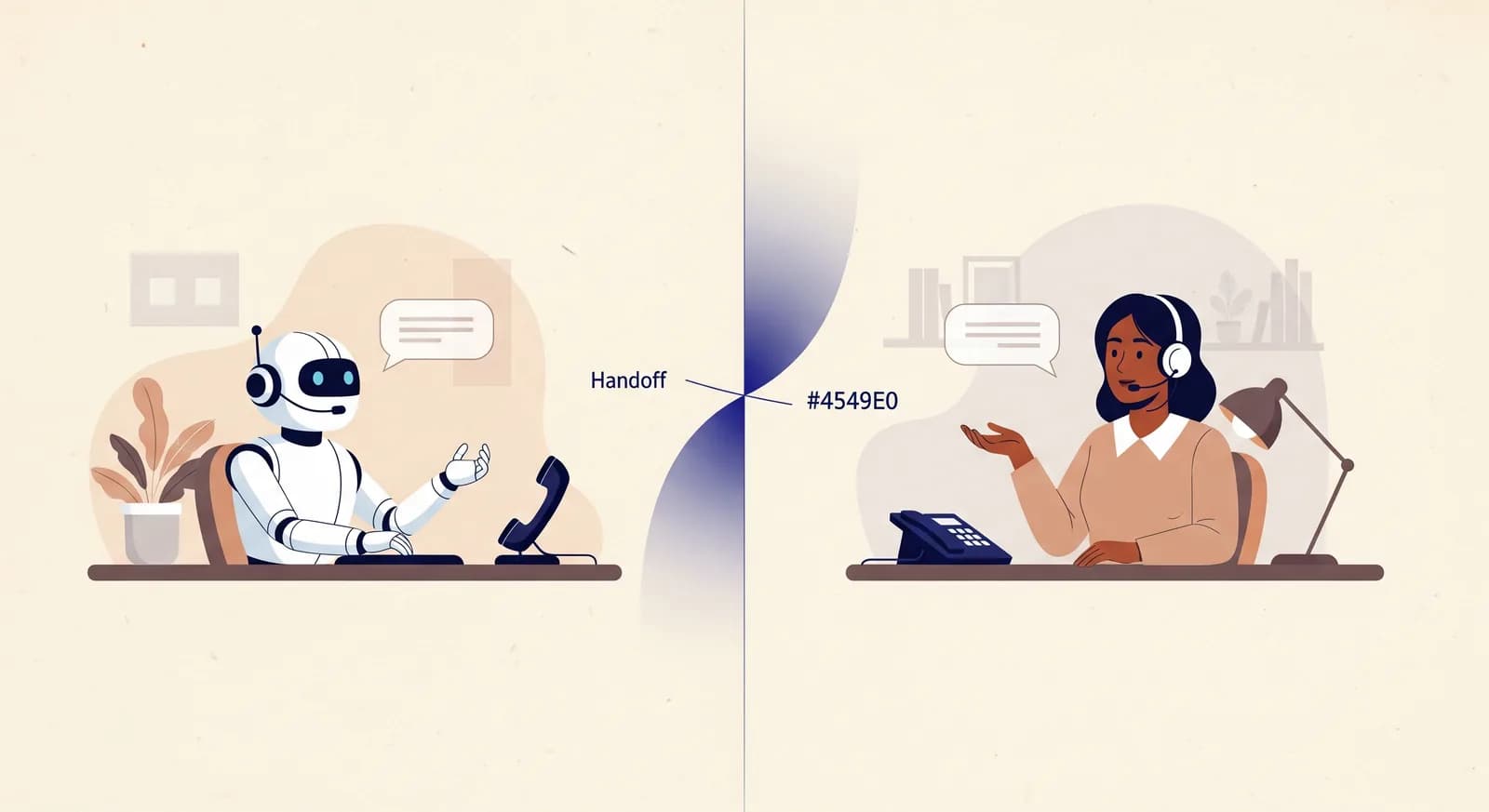
The mark of a good AI receptionist is not how many calls it handles alone. It's how gracefully it steps aside when it shouldn't be handling one. A confident handoff to a human is a feature, not a failure — and the callers who need it most are usually the ones worth the most to your business.
There's a fantasy sold about AI phone assistants: that the right one will absorb every call, resolve every question, and never bother a human again. It's a tidy pitch and it's mostly untrue. Any assistant that never hands off is either lying to callers or badly configured — because some calls genuinely require a person, and a caller who senses they're stuck in a loop with a machine that can't help is a caller you've lost.
So the useful question isn't "can AI handle my calls?" It's "when should the AI stop handling this call and get a human involved — and what does that transition feel like from the other end of the line?" That's the ai receptionist human handoff, and it's the part most people never think about until it goes wrong. This piece is about the philosophy and the user experience of that moment: the signals that should trigger it, what the caller hears, and why an assistant that knows its limits is worth more than one that pretends it has none.
Why the handoff is the whole point, not a footnote
Think about the calls a small business actually gets. Most are routine: what are your hours, do you have availability Thursday, how much is a basic service, can I move my appointment. An AI receptionist should own those completely — they're the bread and butter, and they're exactly the calls that pile up unanswered when you're busy or closed.
But sprinkled through that routine flow are the calls that carry disproportionate weight. The upset customer whose order arrived broken. The prospect ready to spend real money on a complicated job. The person describing a situation the AI has never been briefed on. These are the calls where a wrong or robotic answer costs you a relationship, a review, or a sale. And they're the calls where a human — even a human calling back in twenty minutes — is worth more than instant AI resolution.
So the design goal isn't maximum automation. It's correct routing: let the machine own the volume, and make sure the high-stakes minority reaches a person cleanly. An AI that handles 85% of calls flawlessly and hands off the other 15% at the right moments is far better for your business than one that stubbornly handles 100% and mishandles the 15% that mattered most.
“An assistant that never hands off isn't more capable — it's just worse at knowing when it's out of its depth.”
The three signals that should trigger a handoff
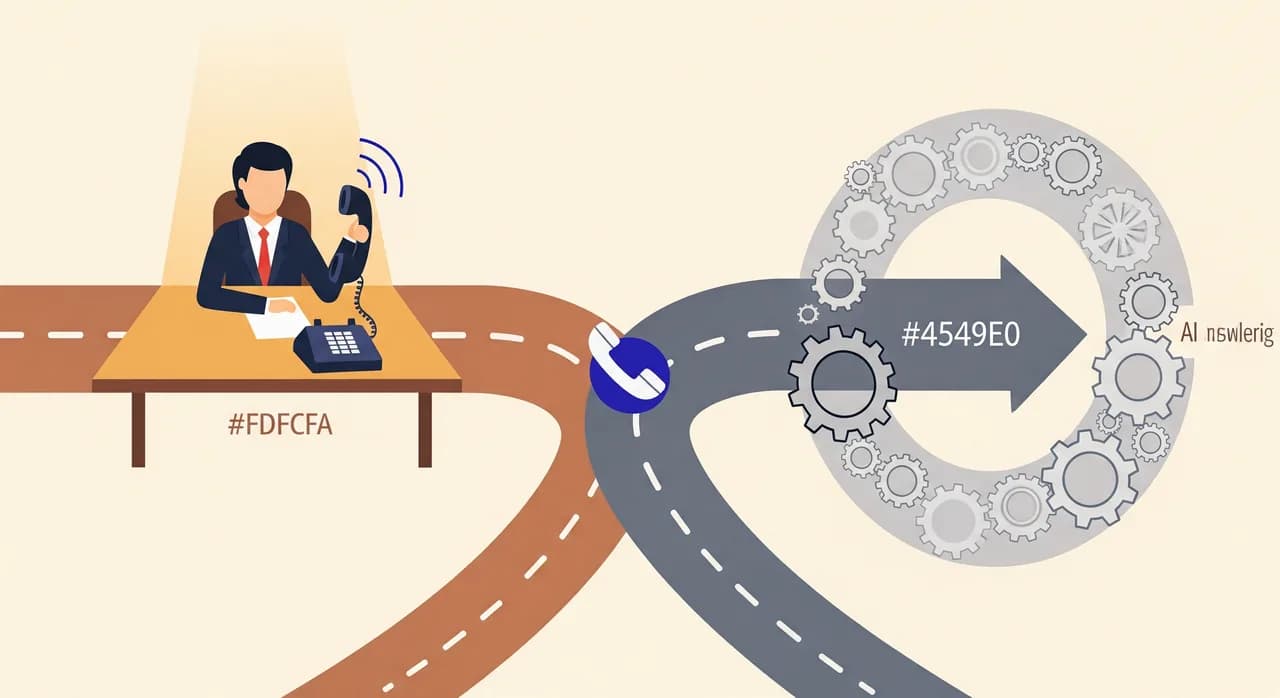
Escalation shouldn't be random or based on the AI "giving up" mid-sentence. Good handoffs are triggered by recognizable signals that fall into three families: the caller is distressed, the request is complex, or the caller explicitly asks for a person. Each one deserves a different response.
Signal one: distress — the emotional trigger
When someone is angry, upset, frightened, or grieving, the content of what they want matters less than how they feel saying it. A caller shouting "this is the third time I've called about this" doesn't need a cheerful bot walking them through a menu. They need to feel heard, and usually they need a person.
A well-behaved assistant should pick up on emotional intensity — repeated frustration, raised urgency, words that signal a real problem — and shift its posture immediately. Not by arguing or defending, but by acknowledging and offering the fastest route to a human. "I can hear this has been frustrating. Let me take down exactly what's happened and make sure the owner calls you back personally today" does more good than any attempt to resolve it in the moment. The handoff is the empathy.
Signal two: complexity — the competence trigger
Some requests are simply beyond what any assistant should attempt from a business profile. A custom quote that depends on seeing the job. A question about a niche edge case the owner never documented. A negotiation. A decision that involves judgment, discretion, or liability. These aren't failures of the AI — they're the boundary of what should be automated at all.
The honest move here is for the assistant to recognize it's reaching the edge of its knowledge and say so plainly, rather than improvising. An AI that confidently invents an answer is far more dangerous than one that says "that's a great question for the owner — let me get you a callback." Made-up prices, wrong policies, and confident guesses erode trust fast, and they're exactly the kind of thing you find out about weeks later when a customer holds you to something you never said.
- Custom or conditional pricing — anything that depends on details the AI can't assess should be handed off, not estimated.
- Unfamiliar territory — if the request falls outside the business profile, the AI takes a message rather than guessing.
- Anything with legal or safety weight — commitments, contracts, medical or legal specifics: capture the intent, escalate the decision.
- Multi-step problems that clearly need back-and-forth judgment rather than a lookup.
Signal three: the explicit ask — the respect trigger
This is the simplest signal and the one most often mishandled: the caller says "can I speak to a real person?" The only acceptable response is to honor it quickly and without friction. No looping them back into menus, no "I can help you with that," no three more attempts to deflect. When someone asks for a human, the request itself is the whole message — they've decided the machine isn't the right channel for this call, and they're usually right.
A good assistant also never pretends to be human when asked directly. If a caller says "am I talking to a robot?", it should answer honestly. Deception buys nothing and costs everything the moment it's discovered — and callers discover it. Honesty about being an assistant, paired with a fast route to a person on request, is what keeps the whole arrangement feeling fair rather than manipulative.
What the caller actually experiences during a handoff
Signals are the trigger. But the part that decides whether a handoff feels smooth or infuriating is the transition itself — the ten seconds between the AI realizing it should step aside and the caller getting what they need. A clumsy handoff can undo all the goodwill a good conversation built.
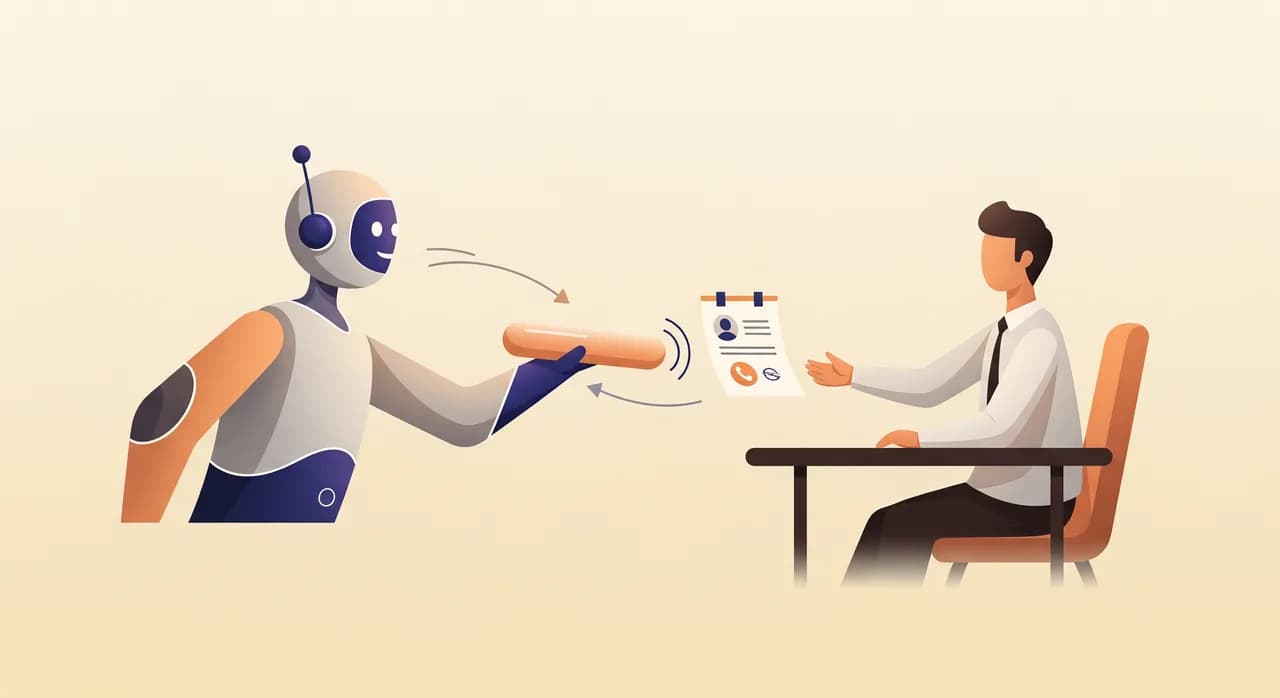
The worst version is familiar to everyone: you explain your whole problem to one system, get transferred, and have to explain it all over again from scratch. That second explanation is where callers give up. So the quality of a handoff is measured almost entirely by how much context survives the transition.
The two shapes a handoff can take
In practice a handoff resolves into one of two forms, and which one you want depends on how your business runs. There's no universally correct choice — it's a tradeoff between immediacy and your own availability.
| Live transfer | Message + callback | |
|---|---|---|
| Caller experience | Connected to a person now, no wait for an answer | Told clearly they'll get a call back, then hangs up |
| Best for | Available staff, urgent or high-value calls | Solo owners, after-hours, focus time |
| Risk | Rings out to no one if nobody's free | Callback has to actually happen, promptly |
| What the AI passes along | A quick spoken summary before connecting | Full transcript, contact details, and the ask, by message |
The failure mode to avoid with live transfer is transferring a caller into a void — ringing a phone nobody answers so the caller ends up back where they started, now more annoyed. If there's real doubt someone will pick up, a confident "the owner will call you back within the hour" often beats a gamble on a live connection. A promise kept beats a transfer dropped.
What a graceful transition sounds like
Whichever shape you choose, the moment of handoff should do three small things well. First, acknowledge — let the caller know it heard them and that a person is the right next step. Second, set expectations — say plainly what happens next and roughly when. Third, preserve context — capture what was said so the human isn't starting from zero.
- 1Acknowledge and reframe"That's exactly the kind of thing the owner should answer directly — let me make sure this gets to them." The caller now knows escalation is a good sign, not a dead end.
- 2Capture what mattersName, number, the specific request, and any detail already given. The point is that nobody has to repeat themselves. A short recap the caller can confirm — "so that's a broken item on order 4-1-2, and you'd like a replacement" — makes them feel handled.
- 3Set a concrete expectation"You'll get a call back this afternoon" beats "someone will be in touch." Vague promises read as brush-offs; specific ones read as commitments.
- 4Deliver the context to the humanThe owner gets a summary and full transcript of the call — so when they ring back, they already know the situation and can lead with a solution instead of a question.
That last step is where the whole system either pays off or falls apart. If the human returns the call cold, the AI added a delay and nothing else. If they return it already knowing the caller's name, problem, and what was promised, the caller experiences something rare: a business that seems to have its act together, where every part talks to every other part.
“A handoff is only as good as the context that survives it. Everything else is theater.”
Why "AI plus human" beats either one alone
It's tempting to frame this as AI versus people — as if the goal were to see how much you can take away from humans. That framing misses the actual win. The strongest setup is neither pure automation nor pure human labor. It's a division of labor that plays to what each is genuinely good at.
AI is tireless, instant, and never has a bad day. It'll answer the hundredth "are you open Sunday" with the same patience as the first, at 2 a.m., in whatever language the caller speaks. What it lacks is judgment, real empathy, and the authority to make discretionary calls. People have exactly those things — and exactly none of the patience for answering the same trivial question forty times an hour.
So pair them. Let the AI absorb the volume and the repetition, which frees your people from the low-value churn that burns them out. Then route the emotionally loaded and genuinely complex calls to those same people, now unburdened enough to give each one real attention. The AI makes your humans available for the calls that deserve a human. That's the actual mechanism — not replacement, reallocation.
There's a quieter benefit too. When your people only see the escalated calls, those calls come pre-packaged with context — who's calling, what they need, what's already been said. Your team stops being switchboard operators and starts being problem-solvers. Over months, that changes the texture of the job, not just the call volume.
Being honest about the limits
It would be easy to end here on a clean note, but honesty about the failure modes is exactly what builds trust — so let's name them. Handoffs are where AI phone systems most often disappoint, and knowing the traps helps you avoid them.
The first trap is the callback that never comes. Message-and-callback only works if the callback happens, promptly. If you set up an assistant that promises returns you don't deliver, you've built a machine for generating disappointment at scale. The system is only as trustworthy as the human on the other end of the promise.
The second is over-escalation. An assistant tuned too nervously will hand off calls it could easily have handled, dumping trivia back onto your desk and defeating the point. The other extreme — under-escalation, where the AI clings to a call it should have released — is worse, because it's the upset customer who suffers. Getting the threshold right is a tuning exercise, and it's worth revisiting after you've heard real calls.
- Set clear escalation rules up front, then adjust once you've reviewed real transcripts — the right threshold reveals itself in practice.
- Make sure someone owns the callbacks. A handoff without follow-through is worse than no handoff at all.
- Decide live-transfer availability honestly. Don't route to a phone that won't be answered; a reliable callback beats a dropped transfer.
- Read the summaries. The transcript-and-summary trail is where you'll spot patterns — questions you should add to the profile, or calls that shouldn't have been escalated.
How this works in practice with Vunoon
Vunoon is built around this idea rather than against it. It answers your calls 24/7, handles the routine questions from the profile you set up, and takes bookings and messages — but it's designed to step aside cleanly when it should. It won't pretend to be human when a caller asks, and it doesn't improvise answers to things it wasn't told.
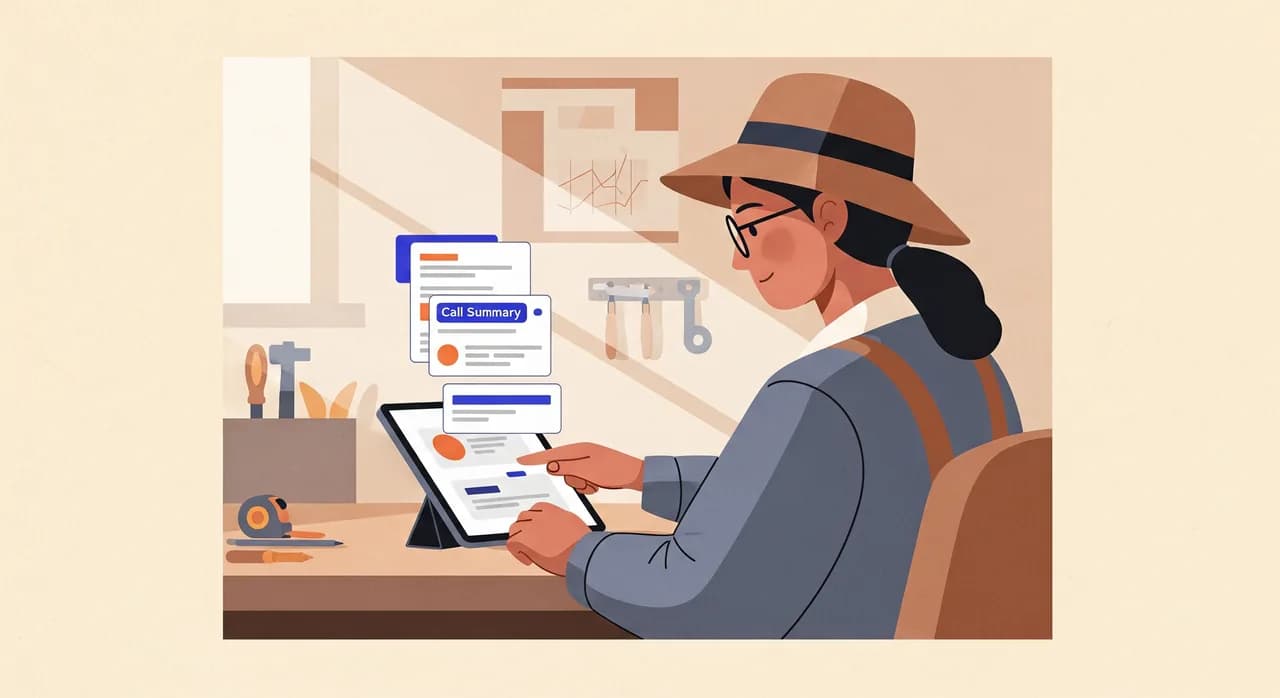
When a call needs a person, Vunoon captures the caller's details and the full request, then hands it to you as a summary plus transcript of the whole conversation. So whether you've set it to transfer live or to take a message for callback, the human side of the handoff starts with context, not a blank page. You're not answering "who's this and what do they want" — you already know.
Setup is self-serve and takes minutes: describe your business in a short wizard, talk to the assistant yourself to hear how it handles things, and forward your number when you're happy. You can hear exactly how it behaves — including how it escalates — before a single real caller reaches it. If you want the mechanics of configuring escalation rules specifically, that's a setup topic in its own right; here the point is simply that a good handoff is a design choice, and it's one worth getting right.
When should an AI receptionist hand off to a human?
What happens to the caller during an AI-to-human handoff?
Will an AI phone assistant pretend to be a real person?
Is live transfer or message-and-callback better?
Doesn't handing off calls defeat the purpose of automation?
Hear how it hands off — before a single real caller does
Set up Vunoon in minutes, describe your business, and talk to the assistant yourself. Try asking for a human and see exactly how it steps aside.
Try the assistant free
Vunoon builds an AI phone assistant that answers your business calls 24/7 — it books appointments, answers common questions and sends you a summary of every conversation.