AI Answering vs. Missed-Call Text-Back: Save or Salvage?
A missed-call text-back service apologizes after the phone stops ringing. An AI answering assistant stops the ring from being missed at all. Here is how the two actually compare, and when you might want both.
 Vunoon15 min read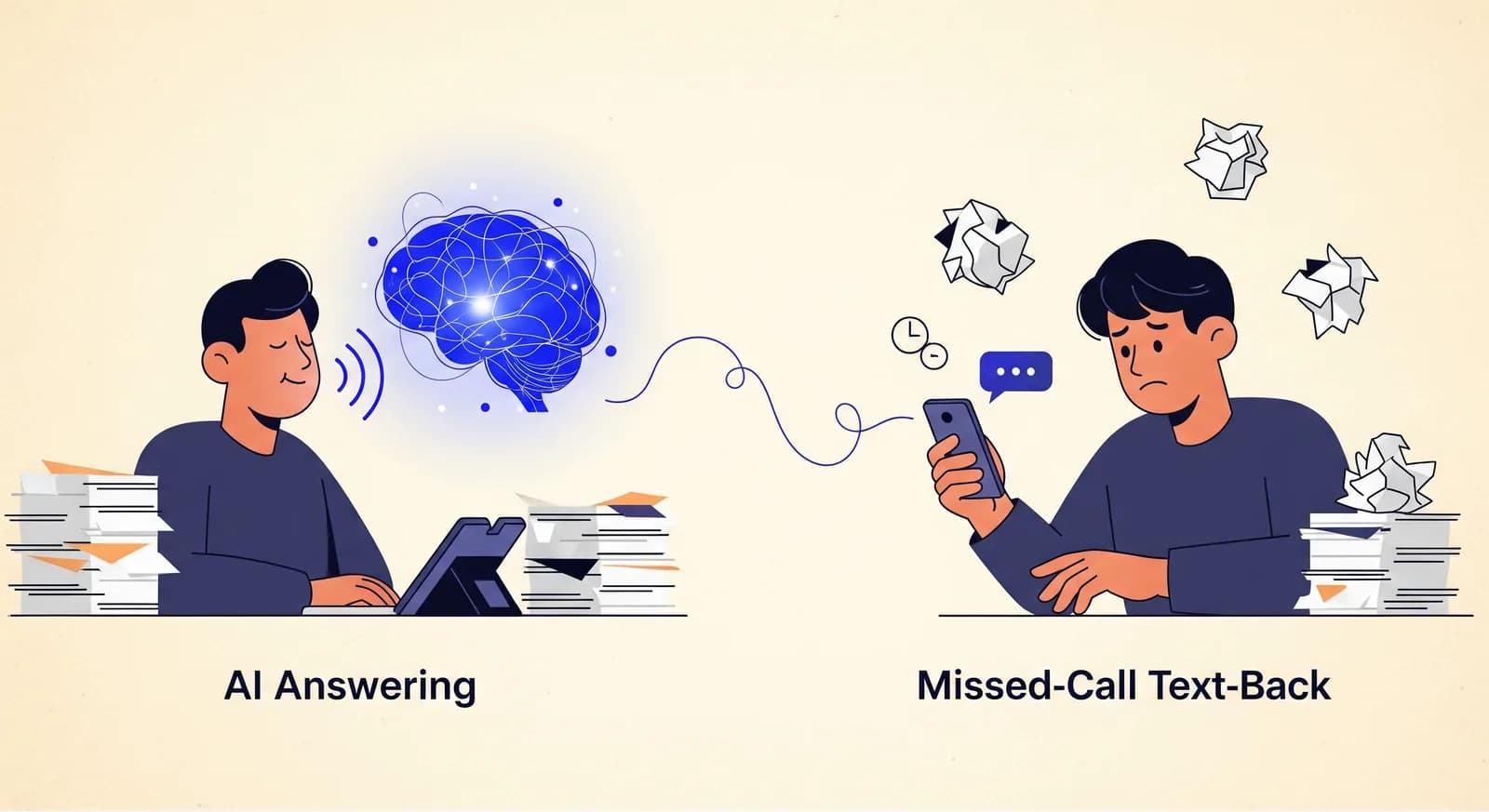
Two tools promise to fix the same problem — the calls you don't pick up. One texts the caller back after they've already given up. The other answers before they ever hang up. That difference sounds small until you look at where the money actually leaks out.
If you run a small business, you've probably seen an ad for a missed call text back service: someone calls, you don't answer, and a few seconds later they get an automatic SMS — "Sorry we missed you! How can we help?" It's a clever patch. It's also a patch. The call still went unanswered; you're just trying to catch the person as they walk out the door.
An AI answering assistant takes a different swing at the same problem. Instead of apologizing for the miss, it picks up. It greets the caller in your business's voice, answers their question, books the appointment or takes a message, and sends you a summary. Same goal — don't lose the lead — but a completely different moment of intervention.
This article is a genuine comparison, not a sales pitch dressed as one. Text-back tools are useful, and there are situations where an SMS follow-up beats a live pickup. But if you only ever install one of these, the order in which they intercept the call matters more than any feature list. Let's get specific.
Save vs. salvage: two different moments in the same call
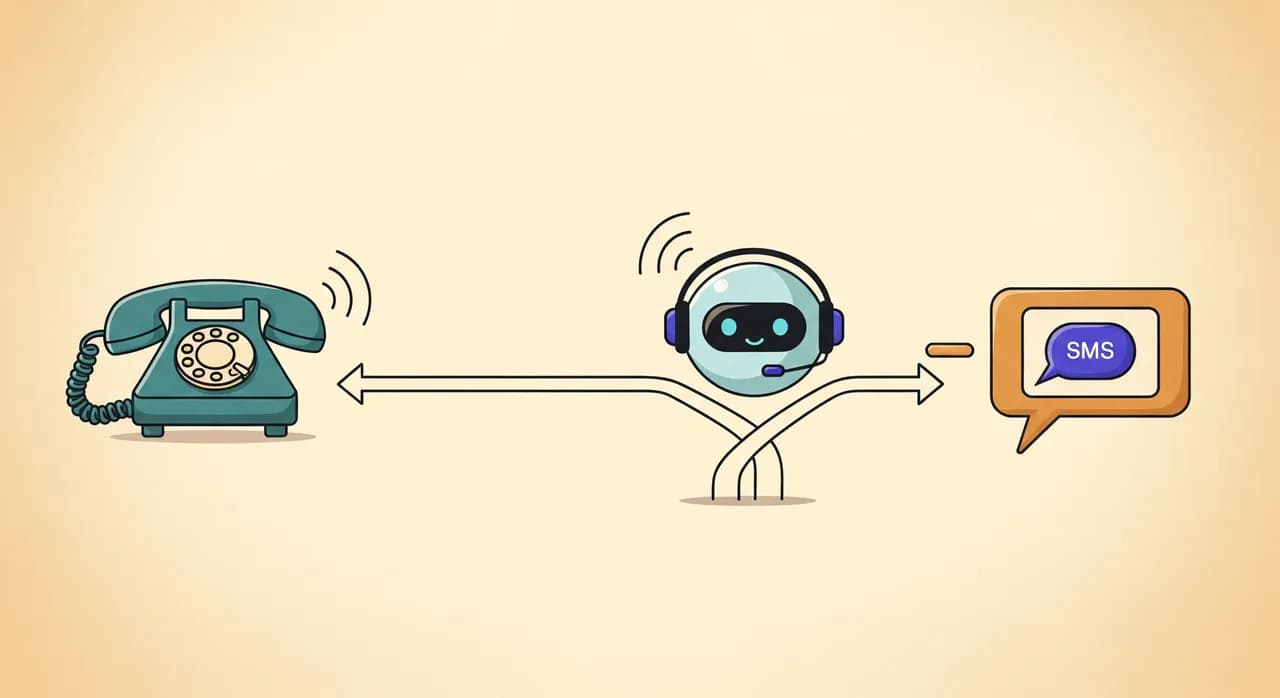
The cleanest way to understand these tools is on a timeline. A call has a beginning (ring), a middle (answered or not), and an aftermath (the caller decides what to do next). Text-back and AI answering operate at different points on that line.
A missed-call text-back service lives entirely in the aftermath. It only fires after a call has failed to connect. By the time the SMS lands, the caller has already experienced the thing you were trying to avoid: they called, and nobody was there. The text is damage control.
An AI answering assistant lives in the middle. It converts a would-be missed call into an answered one. The caller never reaches the aftermath, because their reason for calling got handled while they were still on the line. In one model you're salvaging a lead; in the other you're saving the call outright.
“Text-back says "sorry we missed you." Answering means there was nothing to miss.”
This isn't just a semantic distinction. Human behaviour changes fast in those few seconds after a call fails. Someone who wanted a plumber at 8pm because water is coming through the ceiling is not going to wait for a text — they're already dialling the next number on the search results. The moment you intervene decides how much of the lead is left to win.
Recovery rates: what actually converts?
Nobody can hand you a universal conversion number that's honest — it depends wildly on your trade, your prices, and your callers. But we can reason clearly about the mechanics of recovery, which is more useful than a made-up statistic.
With a text-back service, recovery depends on three things all going right: the caller sees the SMS, the caller still cares by the time they see it, and the caller is willing to switch from a phone call to a text conversation. Each of those is a leak. Plenty of people don't read texts from unknown numbers. Plenty have already booked elsewhere. And a lot of callers who chose to phone did so precisely because they didn't want to type — asking them to text back is asking them to do the thing they avoided.
With an AI assistant, recovery depends on one thing: the caller stays on the line long enough to get an answer. If they do, the intent is captured at its peak — the moment they were motivated enough to call. There's no channel switch, no waiting, no second decision to make. That's structurally a shorter path with fewer places to lose people.
There's also the quiet cost of tone. An apology text sets the relationship on a slightly apologetic footing before you've done anything. A call that just gets answered — competently, in your business's voice — sets it on a confident one. First impressions during a buying decision aren't nothing.
Caller effort: the hidden tax on every lead
Think about the amount of work you're asking a stranger to do to give you money. Economists call it friction; call it effort. Every unit of effort you push onto the caller is a chance for them to quit.
A text-back flow puts the effort on the caller. They have to notice the SMS, decide it's worth a reply, compose a message describing what they need, wait for you (or a bot) to respond, and possibly go back and forth several times before anything is actually booked. It's a slow, typed negotiation — and it's happening on their initiative, not yours.
A live answer puts the effort on the assistant. The caller just talks. "Do you do same-day drain unblocking? I'm in the north of town." The assistant checks the profile, confirms, offers a slot, and takes the details. The caller did what they always intended to do — have a quick conversation — and it's already resolved.
- Text-back: caller reads → decides → types → waits → clarifies → maybe books. Six chances to drop out.
- AI answering: caller talks → gets answer → confirms. Three, and none of them require switching devices or channels.
- The demographic catch: older callers and people in a hurry are far more likely to abandon a text thread than a voice call — and those are often your highest-intent leads.
None of this means text is bad. For some conversations text is genuinely better — sending an address, a photo of a broken part, a quote to review later. The point is that text-back as a recovery mechanism front-loads friction at the worst possible moment: right after the caller's first attempt already failed.
Side by side, feature by feature
Here's the honest comparison across the dimensions that actually decide which tool earns its keep. Read it as "what does each one do well," not "which one wins everything."
| Dimension | Missed-call text-back | AI answering assistant |
|---|---|---|
| When it acts | After the call is missed | During the call, before it's missed |
| Caller experience | Reaches voicemail, then gets an SMS | Gets a real answer, no dead air |
| Effort on caller | High — must reply and type | Low — just keeps talking |
| Can it book on the spot | Only via back-and-forth texts | Yes, within the call |
| Handles questions | Not really — it prompts, you answer | Yes, from your business profile |
| Best channel fit | Callers who prefer texting anyway | Callers who chose to phone |
| Works when you're mid-job | Yes | Yes |
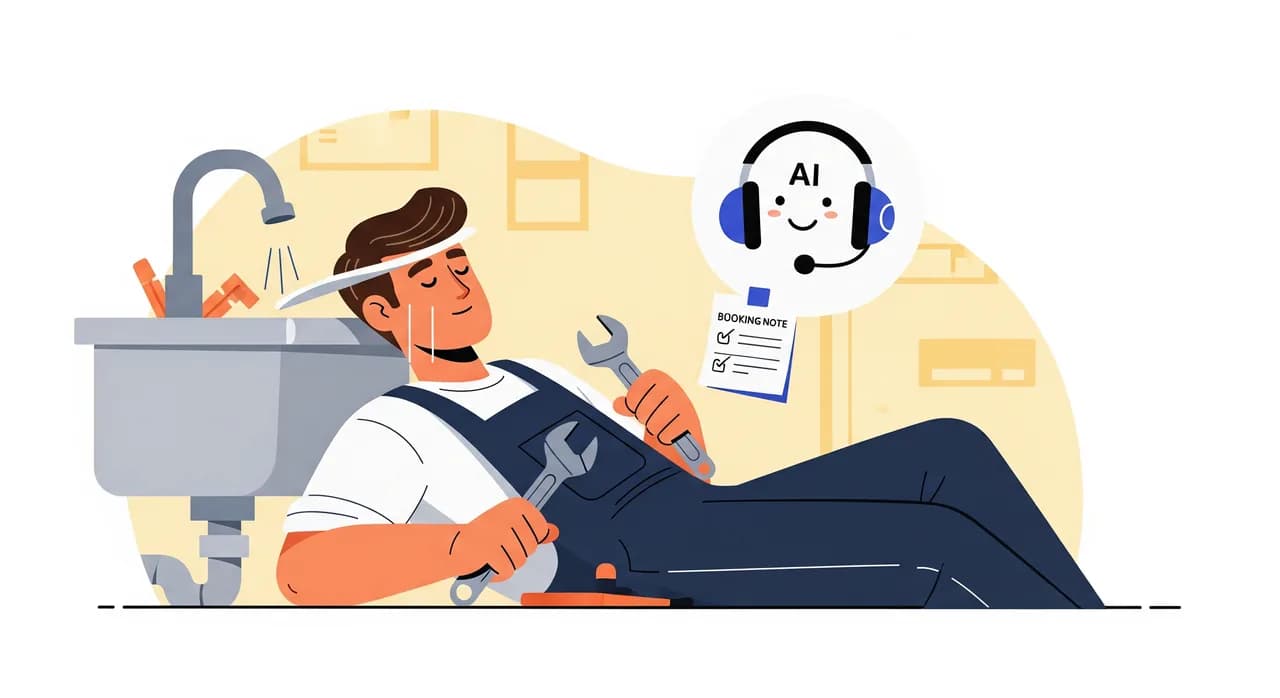
The row that matters most is "can it book on the spot." A text-back tool typically can't close anything by itself — it opens a thread and hands the actual work back to you or a human. An AI assistant can take the booking, capture the details, and drop a confirmed summary in your inbox before you've wiped your hands.
Cost per recovered lead, not cost per tool
It's tempting to compare these tools on their monthly sticker price. That's the wrong number. The right number is cost per recovered lead — how much you pay to turn a would-be lost call into actual work booked.
A cheap tool that recovers few leads is expensive. A pricier tool that recovers many is cheap. If a text-back service is inexpensive but only converts a small slice of missed calls (because of all that caller friction), your cost per recovered lead can quietly be higher than a tool that answers everything and closes more of it.
Run the arithmetic on your own numbers. Say you miss ten calls a week and one booked job is worth a few hundred to you. If text-back rescues one of those ten and answering rescues four, the answering tool is generating three extra jobs a week that the cheaper tool left on the table. At almost any realistic job value, three extra jobs a week dwarfs the difference in subscription cost. The sticker price stops mattering fast.
For what a live AI assistant costs, we keep pricing on a single page rather than bury it here — see /pricing. The point of this section isn't the number; it's the frame. Judge by recovered revenue, not by subscription.
When a text-back service genuinely wins
Now the honest part. There are real situations where an SMS follow-up is the better move — or at least a worthy complement. Pretending otherwise would be exactly the kind of one-sided marketing this blog tries not to do.
- 1Your callers skew young and text-firstIf most of your customers would rather text than talk in the first place — think a lot of D2C or younger-skewing services — a text thread isn't friction for them, it's their preferred channel. Meeting them there is smart.
- 2The next step is inherently writtenWhen the natural follow-up is a link, a form, a quote to review, or a photo the caller needs to send you, a text thread is the right container. Voice can't carry an attachment.
- 3You want a paper trail by defaultSome businesses like every enquiry to start as a written record. An SMS thread gives you that timestamped log without any extra work.
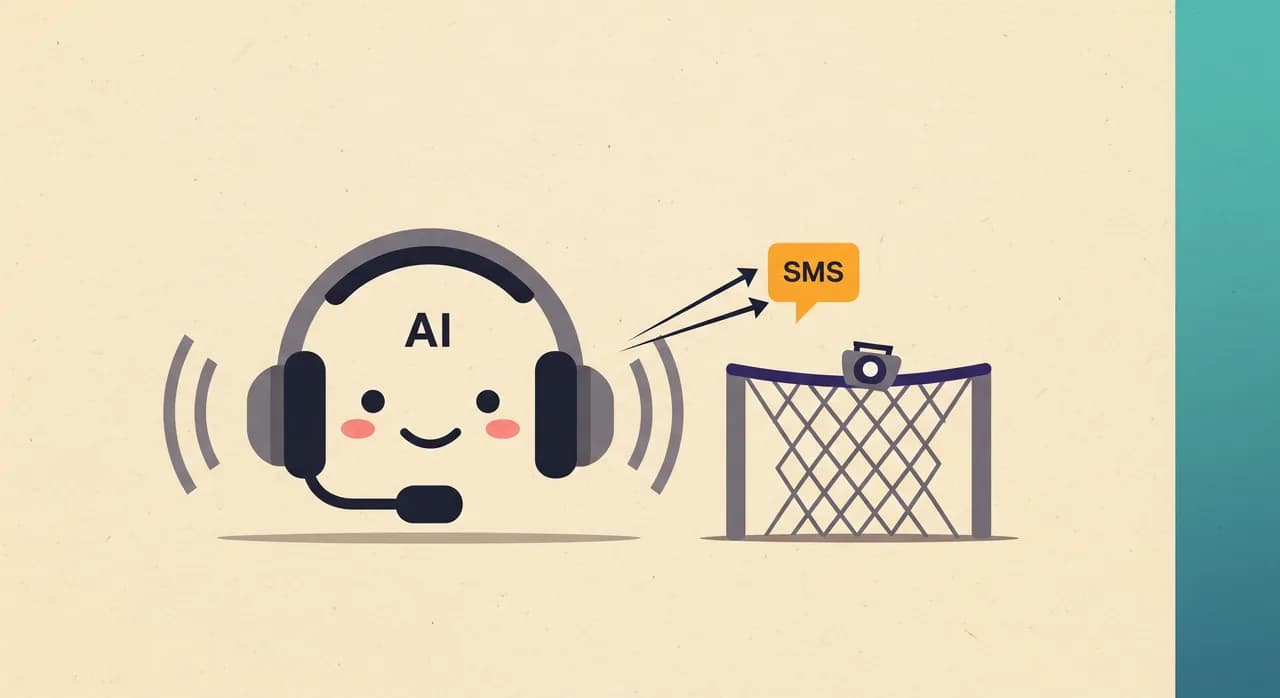
- 4It's a backstop for the rare true missEven with an assistant answering, a caller might hang up in the first second before anyone speaks. A text-back can catch that sliver — as a safety net, not the main net.
Notice the pattern: text-back shines when text is the destination anyway, or as a backstop behind a primary answer. What it does poorly is serve as your only line of defence, because it can't prevent the miss it exists to apologize for.
“Use text-back as a safety net behind a live answer — not as the net itself.”
When AI answering is the clear call
For most local, service-based businesses — the trades, clinics, salons, studios, repair shops, agencies — a live answer wins for reasons that are pretty structural.
- Your callers phoned on purpose. They wanted a fast, spoken answer. Giving them a text instead is a downgrade, not a save.
- Urgency is common. Burst pipe, locked out, pet in distress, tooth pain — these callers won't wait for an SMS. They'll call the next listing.
- The value per job is high enough that one recovered call pays for the tool. When a single booking covers a month of service, recovery rate is everything.
- You want to actually book, not just reply. Answering can close the loop inside the call; text-back mostly opens a task for later.
This is the case Vunoon is built for. It answers your business's calls around the clock, works through what the caller needs using the profile you set up, and either books them in or takes a clear message — then sends you the summary and transcript. If you want to see the specific shape of "never miss a call," that use case is written up on its own page.
Using both without overlap
You don't have to pick a side in a war. The strongest setup for many businesses is a live answer as the front line, with a text follow-up as the tidy-up crew. The trick is making sure they don't step on each other.
The clean division of labour looks like this. The AI assistant answers every call it can and handles the conversation. For the tiny fraction where the caller hangs up before anyone speaks — a genuine, unrecoverable-by-voice miss — a text-back fires as the backstop. And when a call is answered but the outcome is written by nature (send a quote, share a form, confirm an address), the assistant can trigger a follow-up text as a deliberate handoff, not an apology.
A five-minute way to decide
You don't need a spreadsheet. You need to answer a few blunt questions about your own callers and your own economics.
- 1Would your caller rather talk or type?Be honest about who phones you. If they picked the phone on purpose, a live answer respects that choice. If they'd shrug and text, text-back fits.
- 2How urgent is the typical call?If urgency is common, a delayed SMS loses to a competitor who picked up. Answering is the only tool that competes on speed.
- 3Can the tool close, or only open?Ask whether it can actually book the appointment on its own, or whether it just starts a thread that you finish. Closing is worth far more than opening.
- 4What's one recovered job worth to you?If the answer is 'a lot,' optimize for recovery rate and stop worrying about the subscription. If it's 'a little,' the cheaper tool may be enough.
For the overwhelming majority of businesses that answer "talk, urgent, and worth a lot," the front line should be a live answer, with text as backup. For the smaller set that answer "type, casual, low-value," a text-back service alone may be all the coverage you need.
The honest limits of each
Neither tool is magic, and you'll trust the one you choose more if you go in clear-eyed.
A text-back service can't answer a real question, can't reassure a nervous caller, and can't stop the caller from ringing your competitor in the meantime. It's a message, not a conversation. Its whole model assumes the caller is patient enough to wait and typey enough to reply — two assumptions that fail for a lot of high-intent calls.
An AI answering assistant has limits too. It won't pretend to be a human when a caller asks, and it shouldn't — it takes a message or arranges a callback instead. It answers from the profile you give it, so a vague setup produces vague answers; a good one takes a few honest minutes to describe your services, hours, and prices. And there are conversations that genuinely need you — the emotional ones, the judgment calls — where the right behaviour is a clean handoff, not a heroic bluff. A good assistant knows the difference.
What is a missed call text back service?
Is AI answering better than missed-call text-back?
Can I use both together?
Will a text-back tool book appointments for me?
Do callers actually reply to automated text-backs?
Answer the call, then keep text-back for the rare true miss
See how an AI assistant picks up your calls, answers from your business profile, and books the job on the line — with a summary waiting for you. Compare the approaches and try it on your own tricky questions first.
Compare answering vs. text-back
Vunoon builds an AI phone assistant that answers your business calls 24/7 — it books appointments, answers common questions and sends you a summary of every conversation.