AI Phone Assistant for Business: What It Can and Can't Do Today
An honest capability map for owners weighing an AI phone assistant for business — the calls it handles cleanly, the ones it should hand to a human, and how to tell them apart before you buy.
 Vunoon17 min read
Most articles about an AI phone assistant for business are written by someone trying to sell you one, so they tell you it can do everything. It can't. But the honest version — what it handles cleanly, what it fumbles, and where it should quietly step aside for a person — is far more useful, and it's the version that helps you decide whether to buy at all.
An AI phone assistant answers your business line, talks to the caller, and does something useful with the conversation. That's the whole promise. The interesting part is the gap between the demo and a Tuesday afternoon with three calls stacked up, a caller with a strong accent, and a question your setup never anticipated. This article is a map of that gap: capabilities you can lean on today, edge cases where the technology is still improving, and the handful of situations where a human simply belongs on the line.
We'll be specific throughout. Vague reassurance is how you end up disappointed, and honest limits are how you end up trusting the thing enough to actually forward your number to it.
How to read a capability map
The wrong question is "is AI good enough yet?" It's too broad to answer. A better frame borrows from how you'd think about hiring a smart, brand-new receptionist on their first morning. They can follow clear instructions, repeat facts they've been told, take a message, and stay unfailingly polite at 11pm. They cannot yet read the room the way a ten-year veteran does, improvise around a situation nobody documented, or make a judgement call that risks money or reputation.
An AI phone assistant sits in roughly the same place, with two twists. It's better than a new hire at consistency — it never gets tired, flustered, or short with the fifteenth caller — and it's worse at genuine improvisation. So the tasks it owns are the structured, repeatable ones. The tasks it should hand off are the ambiguous, high-stakes, emotionally-loaded ones. Everything in this guide is really about drawing that line in the right place for your business.
What an AI phone assistant does reliably today
Start with the good news, because it's genuinely good and it covers the majority of calls a small business gets. These are the tasks where the technology is mature, the failure rate is low, and the caller usually can't tell — or doesn't mind — that they're talking to software.
Answering every single call, instantly
This is the least glamorous capability and the most valuable. The assistant picks up on the first ring, at 9am, at 9pm, during your lunch rush, and while you're elbow-deep in a job with your phone across the room. It doesn't take breaks, doesn't have three lines ringing at once and let two roll to voicemail, and doesn't go home at five. If a business misses ten calls a week and each one was a potential booking, the arithmetic writes itself — that's ten chances a month to earn nothing, handed to whoever picks up next.
Answering the questions you're asked forty times a week
Opening hours. Where you're parked. Whether you do a particular service. How long a first appointment runs. Whether you take a certain payment method. These are the questions that eat a receptionist's day and that callers hate leaving a voicemail about. An AI phone assistant answers them from the profile you set up — the same facts, phrased naturally, every time, without the caller having to wait for a callback that might come tomorrow.
The key limit here is honest and important: it answers from what you told it. If your setup says nothing about weekend hours, it won't invent them. Good assistants say "I'm not certain about that — let me take a message so someone can confirm" rather than guessing. That restraint is a feature, not a bug, and we'll come back to it.
Taking bookings, messages, and callback requests
Capturing structured information is exactly what software is good at. Name, phone number, what they want, when they want it, whether it's urgent. The assistant asks the questions in order, confirms the details back so nothing's transcribed wrong, and drops a clean summary in your inbox. For many businesses this replaces the messy reality of a paper pad and half-remembered voicemails — every caller handled the same way, nothing lost between the phone and your calendar.
Switching languages without a fuss
This is one of the places AI quietly outperforms most small teams. An assistant can greet a caller, detect that they've switched to another language, and carry on in it — across 25-plus languages — without a second staff member and without the awkward "please hold" while someone finds the one colleague who speaks it. For a business in a tourist town, a border region, or a diverse city, that's not a nice-to-have; it's the difference between a booking and a hang-up.
Staying patient when a person wouldn't
The assistant doesn't have a bad morning. It won't be curt with a caller who's slow to explain, won't sigh at the third repeat of a phone number, and treats the last call of a brutal day exactly like the first. Consistency of tone is worth more than most owners expect. A caller who felt rushed by a stressed human remembers it; one who was calmly walked through their booking usually just remembers that it was easy.
“The tasks an AI phone assistant owns are the structured, repeatable ones. The tasks it should hand off are the ambiguous, high-stakes, emotionally-loaded ones.”
Where it gets harder — the honest edge cases
Now the parts nobody selling you software wants to dwell on. None of these are dealbreakers, and most have sensible workarounds, but you should walk in knowing they exist. An edge case isn't a failure — it's a situation where the assistant is more likely to slow down, ask twice, or hand off, and where your expectations should be set accordingly.
Genuinely bad audio
Speech recognition has come a very long way, and a normal call on a normal phone is handled fine — accents included. But a caller in a car with the window down, on a train, or on a two-bar signal that keeps dropping is hard for the assistant the same way they're hard for a person. The difference is that a human might catch three words and guess the meaning, while software is more likely to ask them to repeat. Sometimes that's the right move; sometimes it frustrates a caller who's already frustrated by their connection.
The question your setup never anticipated
You configured hours, services, and pricing. Then someone calls to ask whether you can accommodate a wheelchair, whether their dog can come in, or whether you'll do a slightly unusual variation of a service. If that fact isn't in your profile, the assistant has two honest options: say it doesn't know and take a message, or make something up. You want the first one. The edge case isn't that the assistant lacks the answer — no receptionist knows everything on day one — it's that a poorly built assistant might bluff. Choose one built to admit uncertainty, and this stops being a risk and becomes a to-do list of facts to add.
Tangled, multi-part requests
"I need to reschedule Tuesday, but only if my partner can also come, and if not, keep Tuesday but move it later, and by the way is the other therapist available instead?" A person can hold that whole knot in their head and untangle it live. An assistant handles the clean version — reschedule to a specific slot — very well, and handles the tangled version by simplifying it, asking clarifying questions, or capturing the whole thing as a message for you to sort out. That's usually acceptable. It's just not the same as a colleague who nods along and fixes it in thirty seconds.
Reading emotion and reacting to it
An assistant can be programmed to be warm, and modern voices are startlingly natural. What it doesn't do well is notice that a caller is upset in a way that changes what should happen next — an angry customer who needs a manager, a frightened one who needs reassurance, a grieving one who called the wrong number. It can be polite through all of it. It cannot yet feel the tremor in a voice and decide, on its own, that this call has stopped being routine. That judgement is exactly where a human should take over, and the best systems are built to make that handoff easy rather than pretending they don't need it.
What still belongs to a human — on purpose
Some things aren't edge cases that will improve with the next model. They're calls that should reach a person, and a well-designed AI phone assistant is built to route them there rather than to swallow them. Wanting the assistant to handle these would be wanting the wrong thing.
- Judgement calls with money or reputation on the line — a discount, a refund, an exception to your policy, a big custom quote. These are yours to make, and the assistant's job is to bring you the request cleanly, not to decide it.
- Advice you're licensed to give — a medical, legal, or financial opinion. The assistant should never offer it. It books you the appointment where a qualified human gives it.
- Emotionally serious situations — a bereavement, a complaint that's clearly about to become a formal one, a caller in distress. A person belongs here.
- Anything genuinely novel — a request so unusual that no setup could have foreseen it. The right outcome is a good message and a prompt callback, not an improvised answer.
- The caller who simply wants a human — when someone asks to speak to a person, the answer is to take a message or arrange a callback, not to talk them out of it.
Notice these aren't weaknesses to apologise for. Drawing this line clearly is what makes the whole arrangement trustworthy. An assistant that knew its own limits and handed off gracefully would be doing its job perfectly, even on the calls it never actually handles.
Honesty is a capability, too
There's a temptation to treat the limits above as things to hide from callers and gloss over in a sales page. The businesses that succeed with an AI phone assistant do the opposite. They lean into the honesty, because a caller who's told plainly "I'll take a message and someone will call you back within the hour" is happier than one strung along by an assistant pretending to know more than it does. The reliability you can count on and the limits you can name are two sides of the same thing — a tool that behaves predictably.
Does it pretend to be human? Should it?
Voices are good enough now that plenty of callers won't immediately realise they're talking to software, and some never do. That raises a fair question: is the assistant deceiving people? The honest answer is that a well-built one doesn't set out to. It sounds natural because natural is easier to talk to, not to trick anyone — and crucially, when a caller directly asks "am I speaking to a real person?", it should not lie. It says it's an assistant and offers to take a message or arrange a callback.
That's the ethical line and also the practical one. A caller who's been deceived and later finds out feels worse than one who knew from the start. The businesses that do this well treat the assistant as an obviously helpful front desk, not a decoy. It answers, it helps, and it's honest about what it is the moment the question comes up.
A realistic day, call by call
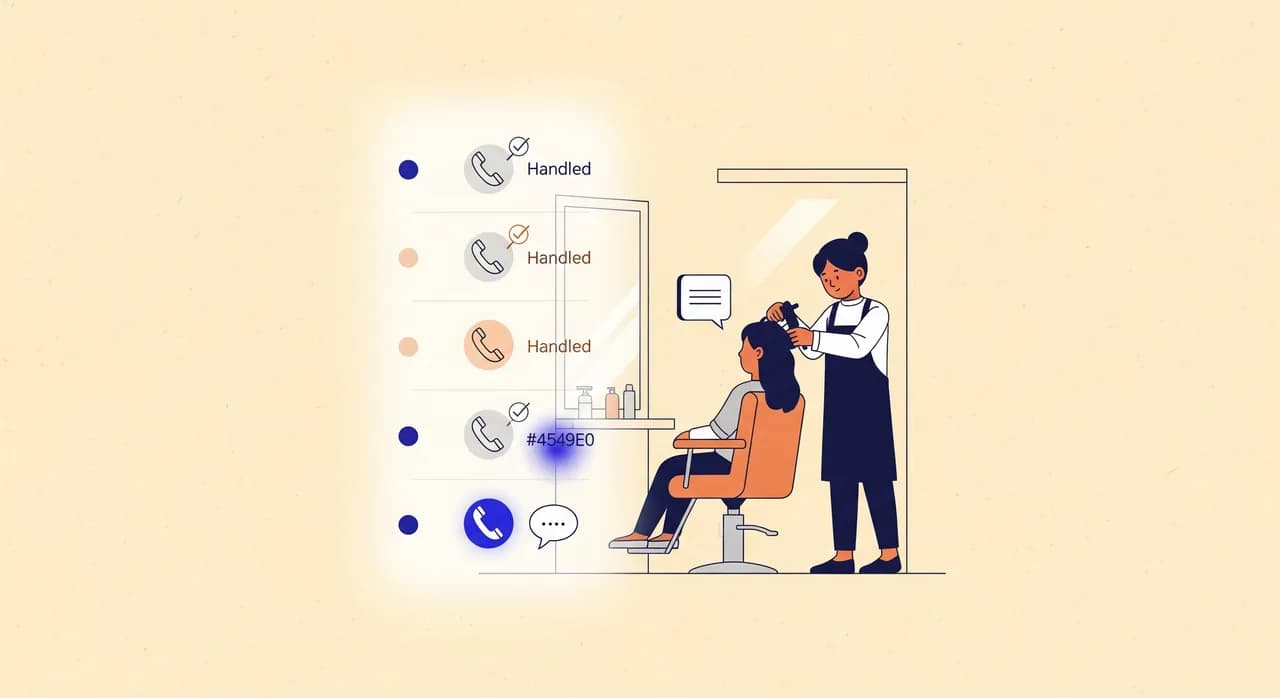
Abstract capability lists only get you so far. Imagine a two-chair hair salon that forwards its line to an assistant during busy hours. Here's what a plausible morning looks like — the wins and the handoffs together, because both are the point.
- 18:52 — a booking, handled cleanA regular wants a cut Thursday afternoon. The assistant offers a slot, confirms the name and number back, and logs it. Nobody at the salon touched the phone; the summary is already in the owner's inbox.
- 29:10 — a factual question, answeredSomeone asks if the salon does a particular treatment and whether there's parking nearby. Both facts are in the profile. Answered in twenty seconds, no callback needed, no interruption to the stylist mid-cut.
- 39:34 — an unanticipated question, handed off wellA caller asks about a service the salon has never offered. It's not in the setup. The assistant says it isn't sure and takes a message with the caller's number — no bluffing, no invented price. The owner adds the answer to the profile that evening so next time it's covered.
- 410:15 — an upset caller, escalatedSomeone rings unhappy about a previous visit, clearly wanting the owner. The assistant stays calm, doesn't try to resolve a complaint it has no authority over, and captures the details flagged as urgent. The owner calls back within the hour instead of finding out via a bad review.
- 510:40 — a language switch, no fussA tourist calls and switches to their own language mid-sentence. The assistant follows, books a walk-in slot, and the salon never had to find someone who speaks it.
Three of those calls the assistant owned outright. Two it handled by knowing its limits. That ratio — most calls resolved, the rest routed cleanly — is the realistic outcome for a typical small business, and it's a good deal even before you count the calls that would otherwise have gone unanswered entirely.
Setting realistic expectations before you buy
If you take one thing from this guide, make it this: an AI phone assistant is a very good front desk for structured calls and a disciplined message-taker for everything else. Buy it for the first part and you'll be happy. Buy it expecting a replacement for your best, most experienced employee and you'll be disappointed on the fifth call, because that's not what it is and no honest seller should claim it is.
The businesses that get the most out of one do three unglamorous things. They spend twenty minutes making the setup genuinely thorough, so fewer calls become "I'm not sure." They test it themselves — including with the awkward questions — before they trust it live. And they treat the message summaries as a to-do list, adding each new question to the profile so the assistant gets sharper every week. Do that, and the line between "can" and "can't" keeps moving in your favour.
| Task | Where it lands |
|---|---|
| Answering every call 24/7 | Reliable — a core strength |
| Repeated factual questions from your setup | Reliable |
| Taking bookings, messages, callbacks | Reliable, with a confirm-back step |
| Switching between languages | Reliable — often better than a small team |
| Very poor audio or dropping signal | Edge case — may ask to repeat or take a message |
| Questions your setup never covered | Edge case — should admit it and hand off, not bluff |
| Tangled, conditional multi-part requests | Edge case — simplifies or captures as a message |
| Judgement calls on money, refunds, exceptions | Human — routed to you on purpose |
| Medical, legal, or financial advice | Human — books the appointment, never advises |
| Upset or distressed callers | Human — escalated with the details flagged |
Can an AI phone assistant book appointments on its own?
What happens when the assistant doesn't know the answer?
Will callers know they're talking to AI?
Can it handle angry or upset callers?
How long does it take to set up an AI phone assistant for business?
Does it replace my receptionist?
See where the line falls for your business
The fastest way to judge what an AI phone assistant can and can't do for you is to build one for your business and throw your trickiest questions at it. Setup takes minutes, and you'll know within one test call whether it fits.
Build and test your assistant
Vunoon builds an AI phone assistant that answers your business calls 24/7 — it books appointments, answers common questions and sends you a summary of every conversation.