Does Your Small Business Need an AI Receptionist? 7 Signals to Check
Before you sign up for anything, it helps to know whether an AI receptionist for small business actually fits your situation. Here are seven honest signals that tell you — and a few that say you're fine as you are.
 Vunoon14 min read
There's a specific kind of tired that comes from your own phone. It rings while you're with a customer, and you feel the pull in two directions at once — the person in front of you and the person you can't see. Most days you let it ring. Some days you wonder how much that costs you. This article is a way to answer that question honestly, before you spend a cent on solving it.
An AI receptionist for small business answers your phone when you can't, talks to callers in plain language, books appointments or takes messages, and sends you a summary of every call. That's genuinely useful — but not for everyone, and not always yet. The worst outcome isn't buying one and hating it. It's the quieter waste of paying for something you don't need, or of ignoring a problem that's steadily bleeding money because you never measured it.
So this is a diagnostic, not a sales pitch. Below are seven signals. If three or more of them ring true, an AI receptionist is probably worth a serious look. If almost none do, you'll leave with a clear conscience and your money in your pocket. Either way you'll understand your own phone better than you do now.
Start with the one number that matters: your miss rate
Everything else follows from this. A miss rate is simply the share of incoming calls you don't answer live — the ones that hit voicemail, ring out, or get a hurried "can I call you back?" that never happens. Most owners badly underestimate it, because you only remember the calls you take, not the ones you never knew about.
You don't need special software to find it. Pull your phone records for the last month — your mobile carrier, your desk phone, or your VoIP dashboard all show inbound calls and their length. Count the calls that lasted under about ten seconds or went unanswered. That's a rough miss count. Divide by total inbound calls. Now you have a percentage instead of a feeling.
What counts as "bad" depends on your business. A furniture restorer who fields three calls a day and misses one has a very different problem than a dental practice missing twenty. So don't stop at the percentage — turn it into calls. If you miss five callers a week and each one, on average, was worth a booking, then the question is what a booking is worth to you. That single multiplication is the honest heart of this whole decision.
Signal 1: You miss calls because you're doing the actual work
This is the most common signal, and the most invisible. The hairdresser mid-colour, the plumber under a sink, the vet in surgery, the café owner in the lunch rush — none of you can drop what you're doing to answer a stranger. The work that pays you is the same work that stops you picking up. It's a structural trap, not a discipline problem, and no amount of "I should be better at answering" fixes it.
Here's why it stings more than a missed email. A caller who reaches voicemail rarely leaves one. They hang up and dial the next name on their search results — your competitor, who happened to be free at that second. You never see the lost job, so it never enters your accounting. It's the most expensive thing in your business precisely because it's invisible. If you recognise this pattern in yourself, that's a strong signal.
“A missed call isn't a message waiting for you. It's a customer already dialling someone else.”
Signal 2: A real chunk of your calls come after hours
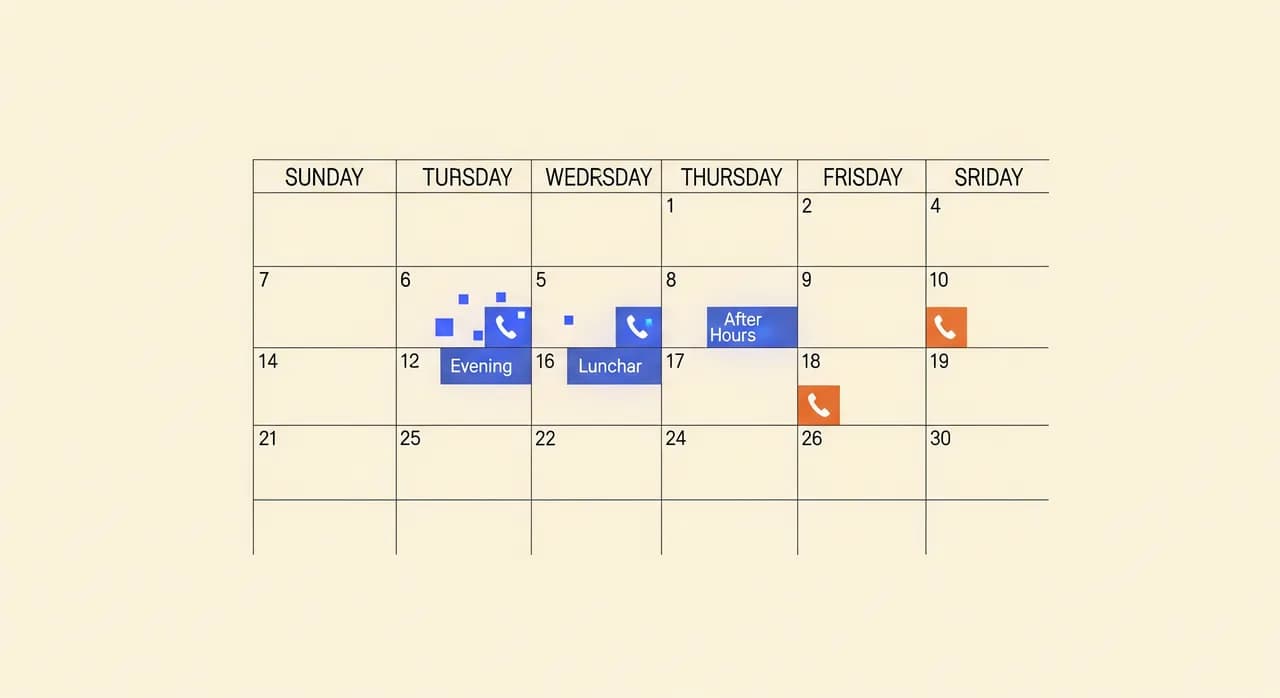
Look again at that call log, this time by time of day. If a meaningful slice of your inbound calls land in the evening, on weekends, or over lunch when you're closed, you have an after-hours problem — and it's one you literally cannot solve by working harder. You'd have to be on call every waking hour.
People call outside business hours for a reason: that's when they're free to deal with it. Someone thinking about a driving lesson, a physio appointment, or a table for Saturday often has that thought at 9pm on a Tuesday. If they hit voicemail, the impulse cools. By morning they've moved on. An assistant that answers at 9pm — takes the booking, or at least the details so you can follow up — captures intent at the exact moment it's hottest.
Signal 3: You answer the same handful of questions all day
Notice the shape of your calls. If a big share are variations on "Are you open on Sunday?", "Where do I park?", "Do you take walk-ins?", "How much is a standard cut?", or "Do you do gel nails?" — that's repetitive FAQ traffic. These calls aren't hard. They're just relentless, and every single one interrupts something.
This is the signal an AI receptionist handles most comfortably, because the answers are facts you already know and don't change much. You tell it your hours, your services, your standard prices, your address, and it answers callers from that profile — accurately, patiently, at two in the afternoon or two in the morning. It won't get flustered on the fortieth "do you validate parking" of the day. The tedium that wears you down is exactly what software doesn't feel.
- Opening hours and holidays — the single most-asked question in most local businesses.
- Services and prices — what you offer and roughly what it costs, straight from your profile.
- Location and access — where you are, parking, which entrance, step-free or not.
- Availability and booking — whether you take walk-ins, how far out you're booked, taking the appointment there and then.
- Policies — cancellation windows, deposits, what to bring.
If you read that list and thought "that's 70% of my calls," the maths is doing itself. Every one of those is a call you no longer have to interrupt your work for.
Signal 4: Answering the phone yourself is quietly costing you
Some owners do answer every call — and pay for it a different way. If you're the receptionist as well as the tradesperson, therapist, stylist, or chef, every call is a context switch. You stop, you talk, you hang up, and it takes a minute to get your head back into the job. Psychologists have a name for the cost of that reset; you have a simpler name for it — a ruined afternoon.
Worse, being on the phone in front of a paying customer sends an awkward signal. The person who booked your time is watching you attend to someone who didn't. Neither party leaves happy. If you find yourself apologising to the customer in the chair while fielding a booking for next week, that friction is a real, if unmeasured, cost — and a signal that something should be catching those calls for you.
Signal 5: Your phone coverage has holes you can't staff around
Maybe you already have someone on the front desk. Coverage still cracks in predictable places: the lunch break, sick days, holidays, the receptionist who's already on another line, the seasonal spike you can't justify hiring for. Hiring a second person to plug a gap that only opens for two hours a day is expensive and impractical. So the gap stays open, and calls fall into it.
This is where an AI receptionist tends to earn its keep not by replacing a person but by covering the seams — the overflow when the line's busy, the hour nobody's at the desk, the fortnight your receptionist is in Spain. Think of it as the colleague who never takes a break and never minds handling call number two while your human handles call number one. If your coverage problem is shape, not size, that's a strong signal.
Signal 6: A first phone call decides whether they choose you
For some businesses the phone is a convenience. For others it's the front door. If most of your new customers find you through search or a map, call once, and decide on the spot whether to book — then that first ring is a first impression you can't afford to fumble. A new patient choosing a dentist, a stressed pet owner, a homeowner with a leak: they're often calling two or three places and going with whoever picks up and sounds capable.
Voicemail loses that race by default. "Leave a message and we'll get back to you" is heard as "we're not here and we don't know when we will be." If your growth depends on converting cold callers into first bookings, and those callers are impatient by nature, the cost of a missed first call is a whole customer relationship — not one job. That raises the stakes on every signal above.
Signal 7: You genuinely don't know how many calls you're losing
This one's a little different. Not knowing isn't proof you have a problem — but it's a signal that you're flying blind on a channel that's often a business's biggest source of new customers. If you can't answer "how many calls did we miss last week?" within a rough margin, you can't make a confident decision either way.
The good news is that this is the cheapest signal to resolve. Do the two-minute audit above. Or, since most AI receptionists log and transcribe every call, running one for a couple of weeks on a free trial doubles as a measurement tool — suddenly you can see exactly what people were calling about, and when. Sometimes the biggest value in trying an assistant isn't the answering. It's finally seeing the demand that was always there and invisible.
“You can't decide whether to fix a leak you've never bothered to measure.”
The honest counter-list: signals you don't need one yet
A diagnostic that only ever points one way isn't a diagnostic. Here are the cases where you should probably save your money — for now.
- Your phone barely rings. If almost all your work comes through referrals, online booking, or walk-ins, and the phone is a formality, automating it solves a problem you don't have.
- You already answer nearly everything. A small solo operation where you comfortably catch every call and enjoy the personal contact may lose more than it gains.
- Your calls are genuinely complex from word one. If most callers need bespoke technical or clinical judgement immediately — not routing, not FAQs — the value is thinner, though message-taking may still help.
- You can't stand behind what it says. If your prices, hours, and services change constantly and you won't keep a profile current, any assistant, human or software, will give callers wrong answers.
- You'd never forward the number. If, for regulatory or personal reasons, you truly must answer every call yourself, the tool can't help until that changes.
Notice that even the counter-list isn't absolute. "Barely rings" businesses grow. "I answer everything" owners burn out. The point is to be honest about today, and to revisit it when your reality shifts.
Score yourself in three minutes
Enough theory. Run through the signals and give yourself a point for each honest yes. The point isn't a precise verdict — it's a nudge past the paralysis of not deciding.
- 1Count the missesPull last month's call log and work out how many callers you didn't reach. Turn the percentage into a weekly number of real people.
- 2Value one of themMultiply your weekly miss count by what a single new booking or job is typically worth to you. That's your rough monthly cost of doing nothing.
- 3Tick the signalsScore signals 1 to 7. Three or more strong yeses means it's worth a proper trial. One or two means keep an eye on it.
- 4Check the counter-listIf more than one item on the 'don't need it' list clearly applies, trust that and wait.
- 5Test before you commitIf you're on the fence, a free trial answers the question with your real calls rather than a guess. Setup is usually minutes, and you can talk to the assistant yourself before any caller does.
If the signals point yes, what actually happens next
Deciding you might need one and dreading a week of IT setup are two different fears, so it's worth deflating the second. Setting up a modern AI receptionist is self-serve and quick: you sign up, describe your business in a short wizard — hours, services, the questions you get asked, how you like to greet people — and then you call it yourself to hear how it handles things. Only when you're happy do you forward your number to it. Nothing about your existing phone changes until you decide.
It's also worth knowing the boundaries, because trust is built on honesty. A good assistant takes bookings and messages, answers from your profile, and hands off gracefully — it'll take a message or arrange a callback rather than bluff, and it won't pretend to be human when a caller asks. It isn't there to give medical or legal advice, or to handle the one genuinely delicate call that needs you. It's there to catch the ninety routine calls so you have the bandwidth for the ten that matter. Set expectations at that level and it tends to deliver.
How do I know if my small business really needs an AI receptionist?
Is an AI receptionist worth it for a very small or solo business?
Will an AI receptionist replace my front desk staff?
What if my calls are too complicated to automate?
Can I test an AI receptionist before committing?
See exactly how many calls you're losing
Set it up in minutes, describe your business, and call it yourself before any customer does. The trial doubles as an audit of the calls you've been missing all along.
Start your free trial
Vunoon builds an AI phone assistant that answers your business calls 24/7 — it books appointments, answers common questions and sends you a summary of every conversation.