AI Receptionist Booking Accuracy: How Errors Get Caught
An AI receptionist that takes bookings by phone lives or dies on accuracy. Here are the mechanics that keep the wrong name, wrong time, and wrong service out of your calendar.
 Vunoon15 min read
The nightmare isn't that an AI receptionist misses a call. It's that it takes one, sounds confident, and quietly books Mr. Kearns for Tuesday when he asked for Thursday. A missed call you can see. A wrong booking hides in your calendar until the customer shows up on the wrong day — or doesn't show up at all.
So before you hand your phone to any automated system, the question worth asking is not "can it talk?" but "how does it avoid getting the details wrong, and how would I even know if it did?" This piece is about the unglamorous mechanics of ai receptionist booking accuracy: the specific techniques that catch errors before they reach your calendar, the ones that catch them after, and an honest read on how often things still slip through.
Where phone bookings actually go wrong
It helps to be specific about what "an error" means, because there are several kinds and they fail in different ways. A booking has maybe four moving parts — who, what, when, and where to reach them — and each one has its own way of breaking.
- The name. Spoken names are the single biggest source of trouble. "Shaun" or "Sean"? "Katherine with a K or a C?" Over a phone line with a bit of background noise, a name you've never heard is a guess dressed up as a transcript.
- The time. "Half three" means 3:30 to most British ears and something else entirely to an American one. "The 8th" and "the 18th" are one dropped syllable apart. "Next Friday" is genuinely ambiguous — this Friday or the one after?
- The service. A caller says "just a trim" and means a full cut; they say "a filling" and it's actually a re-cement. The words people use rarely match the labels in your booking system.
- The callback number. Ten or eleven digits, said fast, is a memory test. One transposed digit and your confirmation text goes to a stranger.
A human receptionist gets these wrong too — that's why good ones repeat everything back and ask you to spell things. The point of a well-built AI receptionist isn't that it never mishears; it's that it's built to assume it might have, and to check. An error that's caught in the same call is a non-event. An error that reaches the calendar is a no-show, an angry customer, or an empty chair.
Repeat-back: the oldest trick that still works best
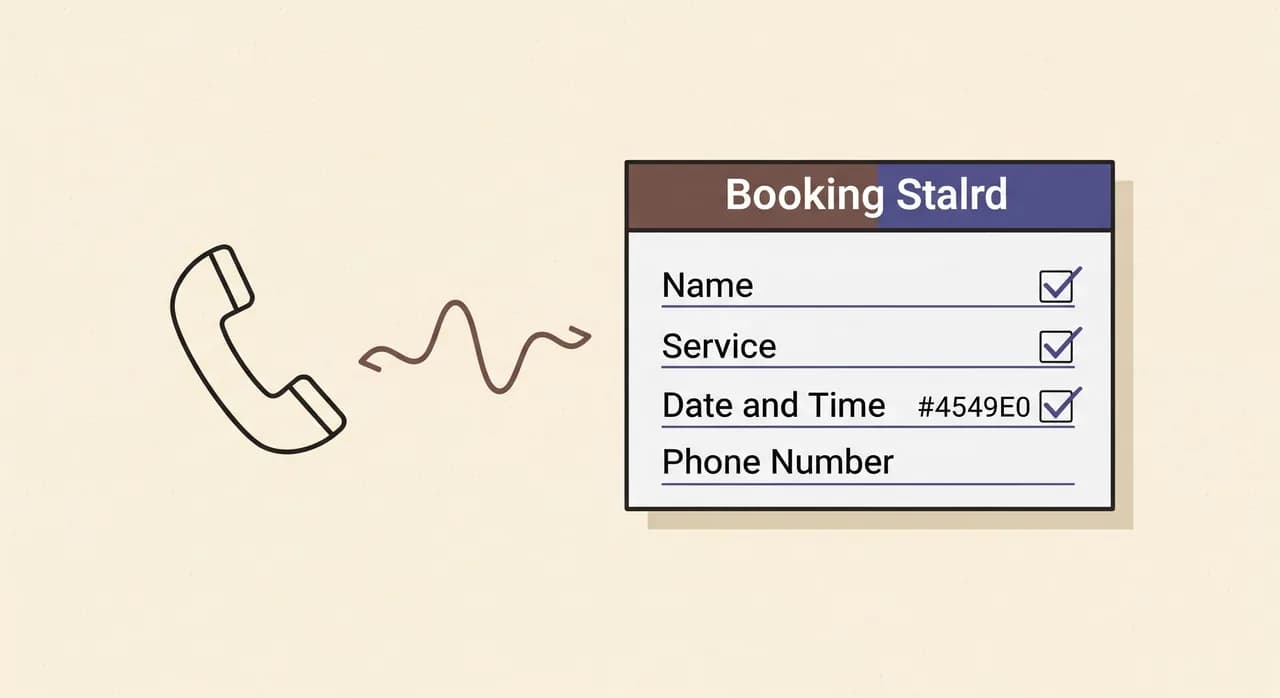
Ask any air traffic controller, any nurse taking a verbal medication order, any diner reading your order back at the counter, and you'll find the same protocol: read it back so the person who said it can catch the mistake. It works because the two people in the conversation have different information. The caller knows what they meant. The listener knows what they heard. Repeat-back is the only moment those two things get compared.
In practice, a well-designed AI receptionist doesn't just parrot a wall of text at the end. It confirms the parts that matter, in the caller's own terms, and it does it at the point where a correction is cheap. Something like: "Great — so that's a deep-tissue massage this Thursday, the 24th, at 2pm, and I've got your number ending 4-1-9. Does that all sound right?"
Notice what that sentence is doing. It converts "Thursday" into "Thursday the 24th" so a mismatch is obvious. It says the number back as digits, not as "your number," so a wrong one stands out. And it ends with a genuine yes/no gate — the booking isn't final until the caller agrees. If they say "no, the 25th," the fix costs three seconds. If nobody ever repeats it back, that same fix costs a no-show three days later.
Spelling the name — and why it's worth the extra ten seconds
Names deserve their own section because they're the field most likely to be wrong and the field where being wrong stings most. Nothing signals "a machine took this" faster than a confirmation text addressed to "Kathryn" when she's a Catherine, or a callback that opens with a butchered surname.
The fix is old-fashioned: for anything ambiguous, spell it back. A capable assistant will offer the spelling it heard — "and that's S-E-A-N?" — rather than demanding the caller spell it cold, which feels like an interrogation. When it's genuinely unsure, it asks. When the caller volunteers a spelling, it uses it verbatim instead of re-guessing. Some assistants will even fall back to the phonetic alphabet for a tricky surname, the same way a good human would: "N for November, G for Golf?"
There's a judgement call buried here, and it's worth getting right. Spell-checking every name is annoying and slow; spell-checking none of them is how you get a calendar full of near-misses. The sweet spot is to spell back names that the speech engine flagged as low-confidence or that don't match anything obvious, and to let the common, clearly-heard ones through. That's a setting worth understanding when you evaluate any system — does it know when to double-check, or does it treat every name the same?
“An error caught in the same call is a non-event. An error that reaches the calendar is a no-show.”
Structured fields beat free text — every time
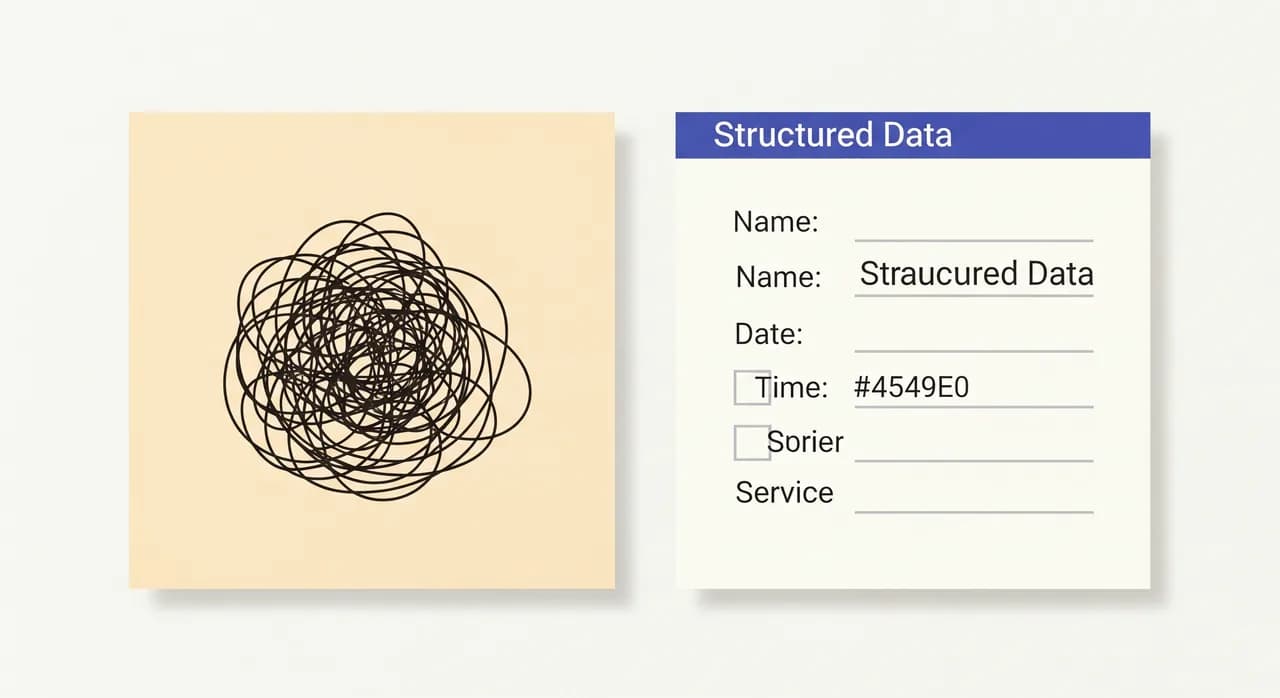
Here's a distinction that sounds technical but decides everything downstream. When your assistant listens, it can do one of two things with what it hears. It can dump a rough paragraph — "caller wants a haircut sometime thursday afternoon" — and hope you sort it out later. Or it can pull the conversation apart into defined fields: service = haircut, date = Thursday 24th, time = 2:00pm, name = Sean Kearns, phone = ends 419.
The second approach is worth insisting on, and here's why. A structured field can be validated. The system can ask: is that time actually within your opening hours? Is that a service you offer? Is that date in the past? Is that a real, well-formed phone number? Free text can't be checked against anything — it's just a note. Structure is what lets the machine catch its own mistakes before a human ever sees them.
- Opening-hours check. A caller asks for 8pm; the system knows you close at 6 and offers the nearest real slot instead of booking a ghost appointment.
- Service match. "A gel refill" maps to the actual service on your list, with its actual duration, so the slot it reserves is the right length.
- Date sanity. "Next Tuesday" resolves to a concrete date the assistant can say back — and it won't book something for a day that's already gone.
- Number format. A phone number that's too short or too long gets flagged and re-asked, right there in the call, instead of failing silently.
None of these checks are exotic. They're the same sanity checks a decent human learns in their first week. The difference is that a structured system applies them every single time, at 2am, on the hundredth call, without getting tired or distracted.
What good systems do when they're not sure
The real test of a booking assistant isn't the easy call where someone asks clearly for "a cut and colour next Wednesday at 10." It's the messy one. The caller mumbles, the line crackles, they change their mind halfway through, or they ask for something that doesn't quite fit. What the system does in that moment separates a trustworthy tool from a liability.
The dangerous behaviour is confident guessing — picking the most likely interpretation and booking it without flagging the uncertainty. That's how you get silent errors. The safe behaviour is to surface the doubt: ask a clarifying question, offer two options, or, when it genuinely can't resolve something, do the honest thing and take a message for you to call back.
That last point matters more than it sounds. A good assistant knows the limits of what it should decide on its own. If a caller wants to reschedule around a complication the system wasn't set up to handle, or asks for a service that isn't on the list, the right move isn't to improvise — it's to capture the request cleanly and hand it to you, with a summary, rather than fake a booking. A message you can act on beats a wrong booking you have to unpick.
The call summary: your second pair of eyes
Repeat-back catches errors during the call, while the caller can still correct them. But some slip past — the caller was distracted, said "yep" to a wrong detail, or the mishearing was subtle enough that neither party noticed. That's where the second layer earns its keep: the summary and transcript that lands in front of the business owner after every call.
This is the check that human receptionists mostly don't get. Once they hang up and scribble in the diary, the conversation is gone. A Vunoon call, by contrast, arrives as a tidy summary — who called, what they wanted, the booking it created — plus a full transcript you can scan in ten seconds. If something looks off, you catch it in the morning, not on the day of the appointment.
- 1Repeat-back, liveThe assistant confirms the key details out loud during the call. The caller can correct anything on the spot. Most errors die here.
- 2Field validation, silentBehind the scenes, structured fields get checked against your hours, services and formats. Impossible bookings get flagged before they're saved.
- 3Owner summary, afterYou receive a short summary plus transcript of every call. The rare error that survived the first two layers is easy to spot and fix before it costs you a slot.
Three layers, each catching a different slice. No single one is perfect. Together they get you to a place where the errors that actually reach a customer are genuinely rare — and, crucially, visible when they happen. Visibility is the whole game. A system that hides its mistakes is worse than one that makes a few and shows you all of them.
“A system that hides its mistakes is worse than one that makes a few and shows you all of them.”
What error rate should you honestly expect?
Time for the honest part, because the marketing answer — "zero errors!" — is a lie, and you should be suspicious of anyone who gives it. No system, human or machine, transcribes every mumbled surname perfectly. The real questions are how often the system mishears, how often a mishearing survives the checks, and how bad it is when one does.
We won't invent a precise statistic, because any specific percentage you see quoted about voice accuracy is almost always cherry-picked from a quiet studio recording, not a real call from a moving car with kids in the back. What we can say honestly is this: modern speech recognition is very good on clear audio and clear speech, and it degrades on heavy accents, noise, cross-talk and unusual names. The mechanics above exist precisely because that degradation is real.
- Clear names, common services, quiet line: errors are rare, and repeat-back catches nearly all of the ones that occur. This is the majority of calls.
- Noisy line or strong accent: mishearings go up, but so does the value of spelling-back and clarifying questions — a well-built assistant leans harder on confirmation here.
- Genuinely unusual requests or names: the safest systems don't guess. They confirm, spell, or take a message. The error you should fear most is the one made confidently and silently.
Compare that honestly to your current baseline. The realistic alternative for most small businesses isn't a flawless human receptionist — it's a phone that rings out when you're with a customer, on a ladder, mid-treatment, or asleep. A missed call has a 100% error rate: the booking simply never happens. Judged against voicemail and unanswered rings, an assistant that gets the vast majority right and shows you the rest is a large step up, not a compromise.
| Layer | Catches | When it acts | If it misses |
|---|---|---|---|
| Repeat-back | Wrong date, time, name, number the caller can spot | During the call | Falls through to validation |
| Field validation | Impossible slots, unknown services, bad number formats | Silently, before saving | Falls through to the summary |
| Owner summary | Subtle errors both parties missed | After the call, in your inbox | Rare — and now visible to fix |

How to pressure-test any assistant before you trust it
Don't take anyone's word on accuracy — including ours. The good news is that a booking assistant is trivially easy to test, because you can just call it and try to break it. Before you forward a single real customer, spend twenty minutes being the most awkward caller imaginable.
- Give it a name it can't possibly know, spoken quickly, and see whether it spells it back.
- Ask for a time outside your opening hours and check that it corrects you instead of booking a ghost slot.
- Say "next Thursday" and confirm it resolves to a real date and reads it back to you.
- Change your mind mid-call — swap the service, then the time — and see whether the final confirmation reflects the change, not your first request.
- Mumble a phone number and listen for whether it reads the digits back.
- Ask for something it wasn't set up to do, and check that it takes a clean message rather than inventing an answer.
The fair comparison isn't a perfect human
It's tempting to hold an AI receptionist to a standard no receptionist actually meets. Real front-desk staff mishear names, transpose digits, and write "3pm" when the caller said "2" — especially when they're juggling a queue, a card machine and a ringing second line. The reason those errors don't feel catastrophic is that humans have habits that catch them: they repeat back, they spell tricky names, they ask "was that the 8th or the 18th?"
That's the whole argument of this article in one line. A well-built assistant isn't trying to be a superhuman that never mishears. It's trying to bake in the exact habits that make good humans reliable — repeat-back, spelling, sanity checks, a written record — and apply them consistently, on every call, without a bad day or a distracted moment. Consistency, not perfection, is where the machine actually wins.
How accurate is an AI receptionist at taking bookings?
What happens if the AI mishears a booking detail?
Does it confirm bookings with the caller?
Can I check the bookings it made?
What if a caller asks for something the assistant can't handle?
See how it handles a real booking
Set up your assistant in minutes, call it as a customer, and try every awkward trick you can think of — before a single real caller reaches it.
Explore appointment booking
Vunoon builds an AI phone assistant that answers your business calls 24/7 — it books appointments, answers common questions and sends you a summary of every conversation.