How to Take Appointments Over the Phone Without Eating Your Whole Day
A practical system for booking appointments by phone fast: the 90-second script, the exact details to capture every time, and how to kill the back-and-forth that quietly steals hours.
 Vunoon14 min read
The call comes in while you're mid-task, hands full, one eye on a customer in front of you. Someone wants an appointment. You reach for the calendar, ask a question, get a vague answer, ask another, lose your place. Ten minutes later you've booked one slot and forgotten what you were doing. Multiply that by a dozen calls a day and you've spent an hour scheduling — badly. There's a faster way, and most of it is just having a system.
Knowing how to take appointments over the phone well isn't about talking faster or being brusque. It's about removing the moments where the call stalls: the pauses while you hunt for the calendar, the repeated questions because you forgot to ask something, the awkward negotiation over times that were never going to work. This piece is a working process for handling phone bookings — a tight script, the exact details to capture every single time, and the specific habits that stop a two-minute call from becoming a ten-minute one.
It's written for the person actually answering the phone: the owner, the front-desk staffer, whoever picks up. Nothing here needs software. At the end we'll be honest about the part of this job that a script can't fix — the calls that come at the worst possible time — and where an AI phone assistant quietly earns its keep.
Why phone booking quietly eats your day
A phone booking should take ninety seconds. Most take three to five minutes, and the difference is almost never the customer. It's friction on your side of the call.
The biggest culprit is context-switching. You were doing something else, the phone rang, and now you're loading a completely different task from cold. You fumble for the calendar. You forget the caller's name and have to ask again. You book the slot, hang up, and realize you never asked what the appointment was actually for — so now you're guessing how long to block off.
The second culprit is open-ended questions. "When would you like to come in?" sounds friendly. In practice it hands the caller a blank calendar and asks them to negotiate against nothing. They say "sometime next week, maybe Tuesday, but not too early," and now you're in a back-and-forth that could have been two offered options and a yes.
The third is incomplete capture. You book the time but miss a detail — a phone number, whether they're a new customer, what service they need — and it surfaces later as a confused text message, a wasted slot, or a no-show you couldn't confirm because you never got a number. The cost of a missed field isn't paid on the call. It's paid three days later, with interest.
“The cost of a missed field isn't paid on the call. It's paid three days later, with interest.”

Set yourself up before the phone rings
You can't script your way out of a bad setup. The fastest booking calls happen because everything the caller might need is already within arm's reach. Five minutes of preparation once saves you a fumble on every call after.
- One calendar, always open. Not a paper diary and an app that disagree. One source of truth, visible in a glance, with your genuine availability blocked out — lunch, travel, the slots you keep for walk-ins.
- A booking card or template. Physical or on screen, with the exact fields you capture every time. When the form prompts you, you never forget to ask.
- Your standard slots memorized. Know your service durations cold. If a cleaning is 30 minutes and a full service is 90, you shouldn't have to think about how much to block.
- Two answers to your three most common questions. Price range, parking, what to bring. When you can answer instantly, the call doesn't detour.
The 90-second booking script
Here's the spine of an efficient booking call. It isn't a word-for-word script to read like a robot — it's an order of operations. Follow the sequence and the call almost runs itself, because each step sets up the next.
- 1Greet and identify (10 seconds)"Good morning, Maple Street Dental, this is Sam." Then get the caller's name immediately: "Who am I speaking with?" You'll use it three times before the call ends, and asking now means you never have to ask again.
- 2Find out what they need (15 seconds)"What can I book you in for?" This one question tells you the service, and therefore how long to block and which slots to offer. Don't touch the calendar until you know this.
- 3Offer two specific times (15 seconds)Not "when works for you." Offer: "I've got Thursday at 2, or Friday at 10 — do either of those work?" You're anchoring the conversation to real openings instead of an empty field.
- 4Confirm the slot and lock it in (10 seconds)"Great, Thursday the 12th at 2pm. Let me put you in now." Say the full date back so there's no ambiguity between "this Thursday" and "next Thursday."
- 5Capture the rest (25 seconds)Best phone number, whether they're new or returning, and anything service-specific. Read the number back digit by digit — it's the one thing you cannot afford to get wrong.
- 6Close with the recap (15 seconds)"So that's Thursday the 12th at 2, a check-up, and I've got you at 07... — I'll send a reminder the day before. Anything else?" The recap catches errors while the caller is still on the line, which is the only time they're free to fix.
That's roughly ninety seconds of actual talking. The reason it works is the order: service before times (so you know what to offer), times before details (so the caller commits before you spend effort capturing), and a recap at the end (so mistakes die on the call instead of in your calendar).
The details to capture on every single call
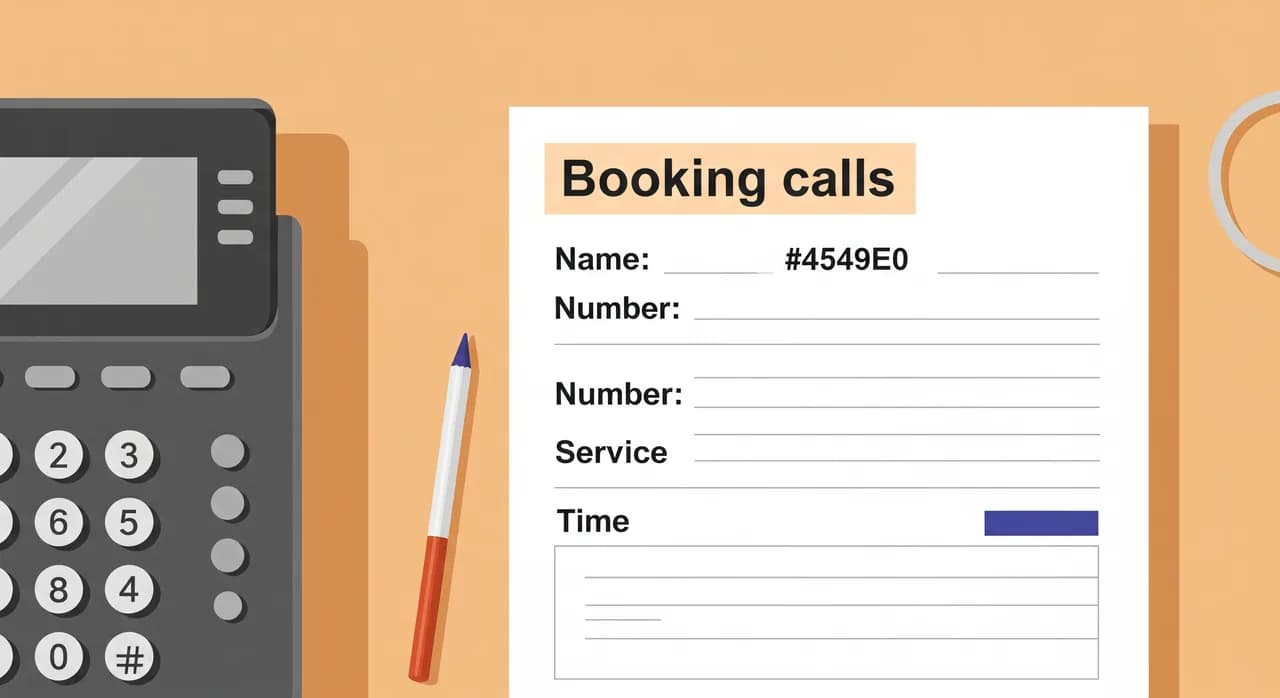
A booking isn't done when you've picked a time. It's done when you have everything you'd need to run the appointment smoothly and reach the person if something changes. Use the same checklist every time so nothing slips — the goal is that no field is optional in your head, even when the call is rushed.
| Field | Why it matters | How to ask |
|---|---|---|
| Full name | You need it for the record and to greet them | "Who am I speaking with?" — at the start |
| Phone number | Your only lifeline if the time changes or they're a no-show | "Best number to reach you on?" — read it back |
| Service needed | Determines slot length and staff | "What can I book you in for?" |
| New or returning | Affects prep, records, and time needed | "Have you been in before?" |
| Preferred time confirmed | The whole point — stated as a full date | "So that's Thursday the 12th at 2" |
| Anything service-specific | Avoids surprises on the day | "Anything I should note before you come in?" |
The phone number is the field people skip most and regret most. If your day shifts and you need to move someone, or a slot opens and you want to fill it, or someone simply doesn't show — the number is what lets you do anything about it. Read it back digit by digit. A transposed number is a booking you can't rescue.
Killing the back-and-forth
"Phone tag" is the silent tax on scheduling. The caller wants a time you don't have, you offer one they can't do, someone says "let me check and call you back," and now the booking is stretched across three calls and a day and a half. Here's how to collapse it back to one exchange.
Anchor with two options, then widen
Always lead with two concrete times. Most callers take one of them because deciding between two options is easy and deciding from a blank calendar is hard. If neither works, then widen: "No problem — mornings or afternoons better for you? Early or late in the week?" You narrow the search fast instead of guessing time after time.
Never hang up to check
"Let me check and call you back" is where bookings go to die. The customer's day moves on, you get busy, and by the time you reconnect they've booked elsewhere. If you truly need to check something, put them on a brief hold and come back — don't end the call. A booking held on the line is a booking. A booking you promised to call back about is a maybe.
Handle the vague caller
Some callers genuinely don't know when they want to come. Don't chase them around the calendar. Ask one narrowing question — "Is this week or next better?" — and offer within it. If they still can't commit, capture their name and number and offer to text them two options. You've turned an open loop into a closed one without spending five minutes exploring their whole schedule.
“A booking held on the line is a booking. A booking you promised to call back about is a maybe.”
Confirm to cut no-shows
The back-and-forth doesn't only happen while booking — it happens as no-shows, which are just bookings that quietly unbooked themselves. A reminder the day before, by text or a quick call, catches the ones who forgot and frees the slot on the ones who can't make it. Mention the reminder on the call so it lands as a courtesy, not a chase: "I'll send you a reminder the day before."
Common mistakes that stretch a booking call
- Reaching for the calendar too early. You can't offer a slot until you know the service. Find out what they need first, then look.
- Asking "when works for you?" It feels polite and costs minutes. Offer two times instead.
- Skipping the name at the start. Ask once, up front. Asking mid-call twice is a small thing that makes the whole exchange feel disorganized.
- Not reading the number back. The one field where an error is unrecoverable, and the one people most often rush.
- No recap. "This Thursday" versus "next Thursday" has cost more no-shows than any other three words in scheduling.
- Over-explaining. The caller wants a time, not your full price list. Answer what they asked, book the slot, move on.
The calls a script can't fix
Here's the honest limit of everything above. A good process makes the calls you answer fast and clean. It does nothing for the calls you can't answer — and for most small businesses, those are the ones quietly costing the most.
You're with a customer and the phone rings. You're on a ladder, driving, mid-treatment, or it's simply after hours. The caller wants to book, hits voicemail — which many people won't leave — and calls the next name on their list instead. That booking never appears in your calendar, so you never feel the loss. It just doesn't show up. Ten missed calls in a week, one booking each, is a real number of appointments that went somewhere else.
No script fixes this, because the problem isn't the call — it's that no one was free to take it. This is the specific, boring gap where automating the routine part of booking earns its place: not replacing the judgment calls, just catching the ones that would otherwise ring out.

Automating the routine part of booking
The booking calls that follow your script are, by design, routine — same greeting, same questions, same fields captured, same recap. Routine is exactly what a phone assistant handles well. Vunoon answers your line when you can't: it greets the caller, works through the same order of operations you would, offers times, captures the name, number, and service into a clean record, and takes the booking or a message. Then it sends you a summary and transcript of the call so you're never guessing what happened.
It runs the process you'd run — service first, offer times, confirm the slot, recap — around the clock and in over 25 languages. When something falls outside the routine, it doesn't bluff: it takes a message or arranges for you to call back, and it won't pretend to be a person if a caller asks. The point isn't to remove you from booking. It's to make sure the call at 7pm on a Tuesday, or the one that rings while you're mid-job, still ends in a booking instead of a missed opportunity you never even hear about.
How long should a phone booking call take?
What information should I always capture when booking by phone?
How do I stop the endless back-and-forth over appointment times?
How do I reduce no-shows from phone bookings?
What happens to bookings I can't answer in person?
Catch the booking calls you can't answer
Vunoon answers your phone when you're busy or closed, takes bookings using the same discipline in this guide, and sends you a summary of every call. Set it up in minutes and test it yourself first.
See how appointment booking works
Vunoon builds an AI phone assistant that answers your business calls 24/7 — it books appointments, answers common questions and sends you a summary of every conversation.