AI Front Desk for Hotels: A Playbook for Guest Calls Around the Clock
How small hotels and guesthouses can put an AI front desk on the phone for rate questions, arrival changes and 2am calls — and where warm hospitality still has to take over.
 Vunoon13 min read
The phone rings at a small hotel far more than the booking sites suggest — a guest whose train is late, a couple asking whether the room has a bath, someone who can't find the parking entrance in the dark. An AI front desk for hotels won't replace the smile at check-in, but it can pick up every one of those calls the moment your one receptionist is already helping someone else, or asleep.
Let's be specific about who this is for. Not a 400-room resort with a switchboard team. This is for the fourteen-room townhouse hotel, the family guesthouse, the boutique inn where the same person checks guests in, carries luggage, answers the phone and does the breakfast eggs. On paper the calls look small. In practice they leak revenue and goodwill all day.
What an AI front desk actually does on a hotel phone
An AI front desk is a voice assistant that answers your hotel's phone number. It greets the caller in your hotel's name, understands what they're asking, and responds from a profile you've filled in — your room types, what's included, check-in and check-out times, parking, pet policy, breakfast hours, directions. When a caller wants something it can't decide on its own, it takes a message or a callback request and sends you a written summary with a transcript. That's the whole job, and the honesty is in the boundaries.
It is not a channel manager, it doesn't touch your rate parity, and it isn't pretending to be a person. If a guest says "am I talking to a human?", it says no. What it does very well is the high-volume, low-drama slice of front-desk calls: the questions you've answered a thousand times, at the exact moment you're not free to answer them again.
The four calls that quietly eat a small hotel's day
If you run the front desk yourself, you already know these by heart. Naming them helps, because each one has a different failure mode when the phone goes unanswered.
1. Availability and rate questions
"Do you have a double for the two nights over the long weekend, and what does it cost?" This is the call that turns into money — or doesn't, because it rang out while you were carrying suitcases. An AI front desk can quote the room types and price ranges you've configured, describe what's included, and either take the caller's details for you to confirm or point them to book directly. It's the difference between a warm lead captured and a caller who has already dialled the place down the road.
2. Arrival-time changes
"Our flight got moved, we'll now arrive around eleven at night — is that a problem?" These calls are small but they matter enormously to the guest, who is anxious about turning up to a locked door. This is where an assistant that answers instantly at any hour earns its place: it can note the new arrival time, reassure the guest about your late-arrival process, and drop the message straight into your inbox so you actually know before they knock.
3. Directions, parking and the practical FAQ
"I'm at the corner by the church, where do I actually park?" A surprising share of hotel calls are logistics: the one-way system, where the car park entrance really is, which bell to press, whether the lift reaches the top floor, whether the restaurant is open on a Monday. None of these needs you personally. All of them frustrate a guest who can't get through. An AI front desk answers them the same way every time, in whatever language the caller speaks.
4. Night calls with no night porter
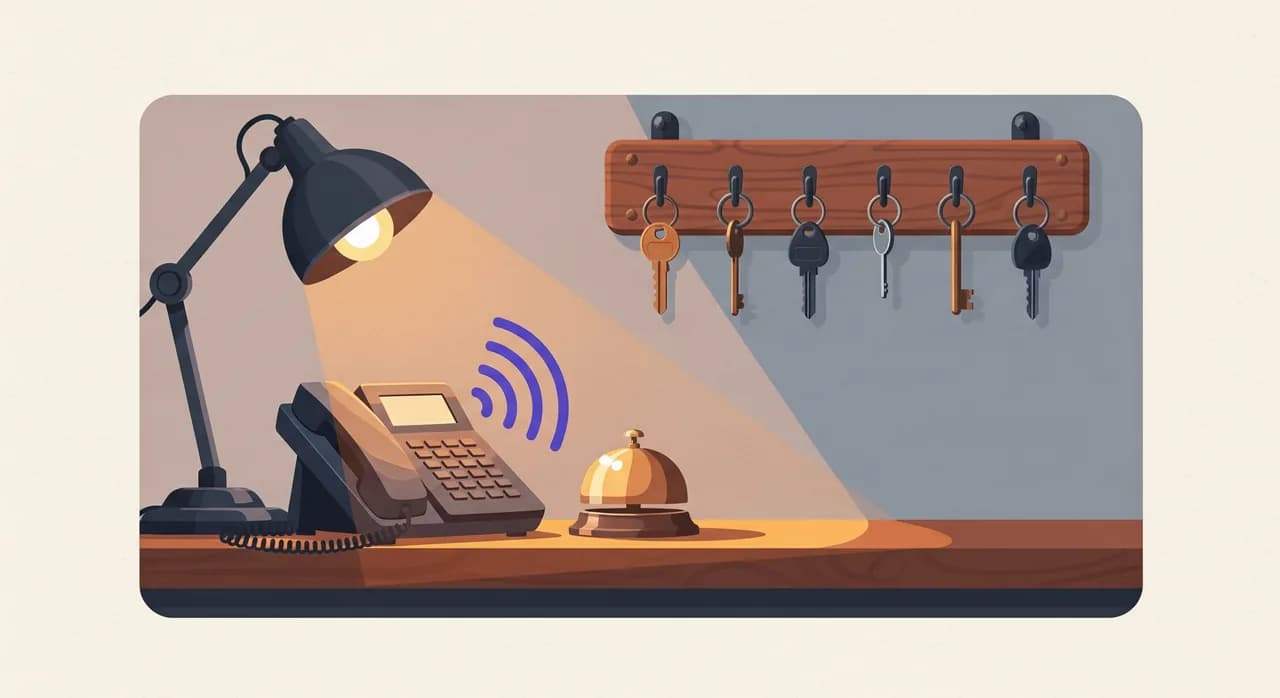
This is the big one for small hotels, because you almost certainly don't staff the desk overnight. The 1am guest locked out of the building, the traveller whose car has broken down two hours away and wants to hold the room, the person calling to ask if you have any availability tonight because their other plan fell through. When those calls hit an answering machine, you lose the booking and, worse, you lose the guest's confidence that anyone is home. An always-on assistant at least answers, gathers the essentials, and flags anything urgent to you immediately.
“A missed 2am call isn't just a lost booking. It's a guest who now quietly wonders whether anyone would come if something went wrong.”
Where the AI ends and warm hospitality begins
This is the part most write-ups skip, so let's put it front and centre. Hotels are a hospitality business, and there are calls where the whole point is that a human cares. Drawing that line clearly is what makes an AI front desk an asset rather than an insult.
Keep the assistant on the routine and the reachable-anytime tasks. Hand the emotionally loaded moments to a person: a complaint about a bad night's sleep, a bereaved guest changing plans, a wedding party wanting to talk through a whole floor, an angry booking dispute. The assistant's job in those moments is to recognise it's out of its depth, take a good message with a callback number, and get it to you fast — not to grind the guest through a script.
- Let the AI own: hours, prices, availability enquiries, parking and directions, arrival-time changes, pet and breakfast policy, taking a message or callback.
- Route to a human quickly: complaints, special-occasion requests, group and event bookings, anything the caller is clearly upset about, and anyone who asks to speak to a person.
- Never fake: if asked, the assistant says it's an automated assistant. Guests forgive a machine that's honest; they don't forgive one that pretends.
The arithmetic that makes it worth doing
You don't need invented statistics to see the shape of this. Do your own back-of-the-envelope. Suppose your hotel misses even three or four calls on a busy afternoon while you're mid check-in, plus a couple of night calls a week. Some of those were just directions. But some were an availability question — a two-night booking that went to the next hotel on the caller's list because you rang out and they didn't leave a message.
One recovered two-night booking a week is not a rounding error for a fourteen-room property. Against that, an assistant that answers everything, captures the lead and messages you the details is doing the arithmetic in the right direction. And that's before you count the goodwill of the guest whose late-arrival call was actually answered — the one who leaves the review that says "they even picked up at midnight when our flight was delayed."
| Call type | Unanswered / voicemail | AI front desk |
|---|---|---|
| Rate & availability | Caller books elsewhere | Lead captured, details sent to you |
| Arrival change | You don't know they're late | Note logged, you're informed before arrival |
| Parking & directions | Frustrated, lost guest | Answered instantly, any language |
| Night call | Rings out, guest worries | Answered, urgent items flagged to you |
Multilingual reception without a multilingual team
Small hotels punch above their weight on international guests, and a phone call in a language your one receptionist doesn't speak is genuinely stressful for both sides. An AI front desk that handles many languages quietly removes that friction. The German family asking about the crib, the French couple checking the breakfast time, the visitor whose English runs out exactly when they most need directions — each hears a confident answer in their own language, and you get the message in yours.
This isn't a gimmick for a border town; it's an everyday advantage anywhere tourists travel. It also protects the guest's first impression, which on the phone is formed in the first ten seconds by whether they were understood.

Setting it up for a small hotel, step by step
The setup is deliberately mundane, which is the point — you shouldn't need an IT project to answer your own phone. Here's the sequence that works for a hotel or guesthouse.
- 1Write your profile like a good handover noteRoom types and what's included, check-in and check-out times, your late-arrival process, parking specifics (the entrance, not just the postcode), breakfast hours, pet and children policy, and the exact directions you find yourself repeating. Detail here is what makes the answers sound like your hotel, not a call centre.
- 2Decide your handoff rulesBe explicit about which calls get taken as a message for you and which the assistant answers outright. Complaints, groups and anyone upset go to you. Rates, directions and arrival changes it handles.
- 3Test it as a guestBefore it touches a real caller, phone it yourself. Ask the awkward questions: 'do you have a family room for Saturday?', 'where do I park?', 'we'll be late, is that ok?'. Listen for anything that sounds wrong and fix the profile until it sounds like you.
- 4Choose how you use itSome hotels forward every call. Many start smaller — after-hours and overflow only — so it answers when the desk is closed or already busy, and you keep taking the daytime calls yourself. You can widen its role once you trust it.
- 5Read the summaries for a weekEvery call arrives as a written summary with a transcript. In the first week you'll spot gaps — a policy you forgot to add, a question guests ask that you never anticipated. Feed those back in. After that it mostly runs itself.
Getting the hotel voice right
A brusque assistant undoes the atmosphere you work hard to create. The fix is in the profile. Write your greeting the way you'd actually answer — "Good evening, the Rosewood House" beats a generic "how can I help you". Give it the warm phrasings you use: how you reassure a late arrival, how you describe the view from the top rooms, the little practical kindness of telling someone the last train times. The assistant will use the tone you give it.
It also helps to tell it what not to do: don't guess at availability you haven't confirmed, don't quote prices for anything special, don't promise an upgrade. A hotel assistant that knows the edges of its own knowledge sounds more trustworthy, not less.
“The best hotel assistant sounds like your calmest receptionist on their best day — and knows exactly when to say, 'let me have the owner call you back.'”
Honest limitations to plan around
No tool is magic, and pretending otherwise gets you burned. A few limits to design around from the start.
- Live availability is only as good as your source. If you don't keep it updated, the assistant can capture the enquiry and pass it to you rather than confirm a room outright. Decide which you want.
- It won't resolve conflict. A furious guest needs a person. The assistant's value there is a fast, complete message — not a resolution.
- Edge cases surprise everyone. Someone will ask something no one anticipated. The transcript shows you exactly what, so you can add it. Expect a fortnight of tuning, then calm.
- It's a front desk, not a concierge team. Booking a specific restaurant table across town, arranging a taxi at a precise minute — that's still a human touch you may want to keep.
A realistic week in the life
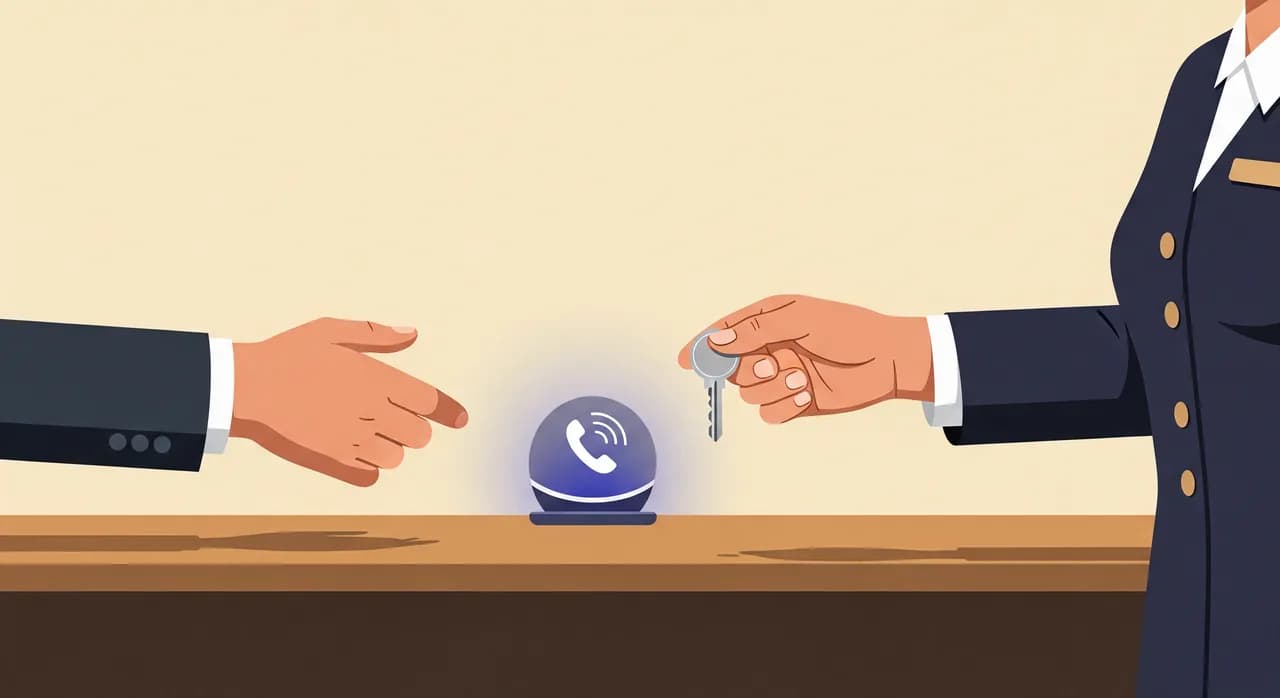
Picture a twelve-room guesthouse run by a couple. Monday morning, the assistant fields two directions calls and an availability enquiry for the following month while they're doing changeover cleaning; the enquiry lands as a message they answer over coffee. Wednesday night, a guest calls at 11:40pm to say their delayed train means a 1am arrival — the assistant reassures them about the key box and sends the note, so no one lies awake wondering if a car will pull up. Friday, a French visitor asks in French about parking and the breakfast time and hears both answered cleanly.
None of these is dramatic. Add them up over a season and you get bookings that would have leaked away, guests who felt looked after, and two owners who stopped flinching every time the phone rang mid-task. That's the whole promise, kept modestly.
Will guests be annoyed that a hotel uses an AI to answer the phone?
Can an AI front desk take an actual booking?
What happens with a call it can't handle, like a complaint?
Do I have to replace my whole phone system?
How long does it take to set up for a small hotel?
Put a front desk on your phone that never sleeps
See how Vunoon answers your hotel's calls day and night, in your guests' languages, and sends you a summary of every one. Set it up for your property in minutes and test it before a single guest calls.
See it for hotels
Vunoon builds an AI phone assistant that answers your business calls 24/7 — it books appointments, answers common questions and sends you a summary of every conversation.