AI Voice Agent, Explained for Business Owners Who Just Want the Phone Answered
"Voice agent" is a piece of tech jargon that hides a simple idea: software that talks to callers like a person would. Here's what it actually means, in plain English.
 Vunoon16 min read
Somewhere in the last two years, the phrase "AI voice agent" escaped from engineering blogs and landed on your radar — probably in an ad, or from a competitor who suddenly answers the phone at 9pm. It sounds like something you'd need an IT department to understand. You don't. Strip away the jargon and it's one plain idea: software that talks to your callers the way a decent receptionist would.
This guide is for the owner who doesn't care what a large language model is and never will. You want to know: what is this thing, how is it different from the robot voice you already hate, can it actually hold a conversation, and what happens when someone asks it something weird. Fair questions. Let's answer them without a single diagram.
What an AI voice agent actually is
An AI voice agent is a program that answers a phone call, listens to what the caller says, understands it, and speaks back — in real time, out loud, in a natural voice. No menu tree. No "press 1 for reservations." The caller just talks, and it talks back. If a person walked past your reception desk and heard one side of the conversation, they'd assume someone was there.
That's the whole thing. Everything else — the models, the training, the integrations — is plumbing that makes that one experience possible. The industry calls it an "agent" because it doesn't just play a message; it acts. It can answer a question, take down a name and number, book a slot, decide the caller needs a human and offer a callback. It does jobs, in the moment, on your behalf.
So when someone says "we run an AI voice agent to handle overflow," translate it in your head to: we have software that answers the phone and talks to people. That's it. The rest of this article is just unpacking why that's suddenly possible and what it means for a business your size.

It's not a recording — and that's the whole difference
The mental model most owners start with is the answering machine, or the automated menu from the utility company. Those two things have poisoned the well. They're rigid, they loop, they never understand you, and everyone has screamed "REPRESENTATIVE" into one. If that's your reference point, of course you're skeptical.
But those systems work in a fundamentally different way, and it's worth understanding the difference because it's the difference. A recording plays fixed words. A phone menu plays fixed words and waits for you to press a number that matches one of a few pre-written branches. Neither one listens in any real sense. They can't. They were built before software could reliably understand open-ended speech.
- A recording says the same sentence to everyone and can't respond to anything.
- A phone menu (IVR) reads a script and routes you based on button presses or a handful of keywords. Say something it didn't expect and it stalls.
- A voice agent understands the actual meaning of what you say, in your own words, and forms a relevant reply on the spot — even for a question no one wrote a script for.
Here's the test that separates them. Call a menu system and say, "Hi, I'm trying to figure out if you're open on the Monday holiday and whether I can bring my dog." The menu is lost — that's two questions, phrased casually, matching no button. A voice agent hears both, checks your hours and your pet policy, and answers both in one breath. That flexibility isn't a nicer script. It's a different category of software.
“A recording plays words at people. A voice agent listens, understands, and answers — and once you've heard the difference, you can't unhear it.”
Why it can actually hold a conversation
You don't need the technical explanation, but you deserve an honest one, because it explains both the strengths and the limits. Under the hood, a modern voice agent chains three abilities together, fast enough that it feels like one:
- 1It turns your speech into textThe moment you talk, the audio is transcribed into words — accurately enough to handle accents, background noise, and someone talking with their mouth full.
- 2It works out what you mean and what to sayThis is the part that got dramatically better recently. The software understands intent — not just keywords — and decides on a relevant, on-topic reply, using the facts you gave it about your business.
- 3It speaks the reply out loudThe text answer is converted back into a natural spoken voice, with pauses and intonation, so it doesn't sound like a robot reading a phone book.
The reason it can "hold a conversation" — remember what you said two sentences ago, handle a follow-up, circle back — is that it keeps track of the whole call as it goes. Ask "and what about the weekend?" and it knows "the weekend" refers to the appointment you were just discussing. That thread of context is what makes it feel like talking to a person rather than restarting a form field.
None of this required you to change anything. The clever part is that the leap in quality happened at the language level — the software genuinely comprehends everyday, messy human speech now, where five years ago it fell over the moment you went off-script. That single improvement is why voice agents crossed from "frustrating gimmick" to "actually useful" almost overnight.
What "trained on your business" really means
"Trained" is the word that makes owners nervous. It sounds like machine learning, months of data, a team of engineers. For a voice agent you set up yourself, it means something much more boring and much more reassuring: you tell it the facts about your business, and it uses only those facts to answer.
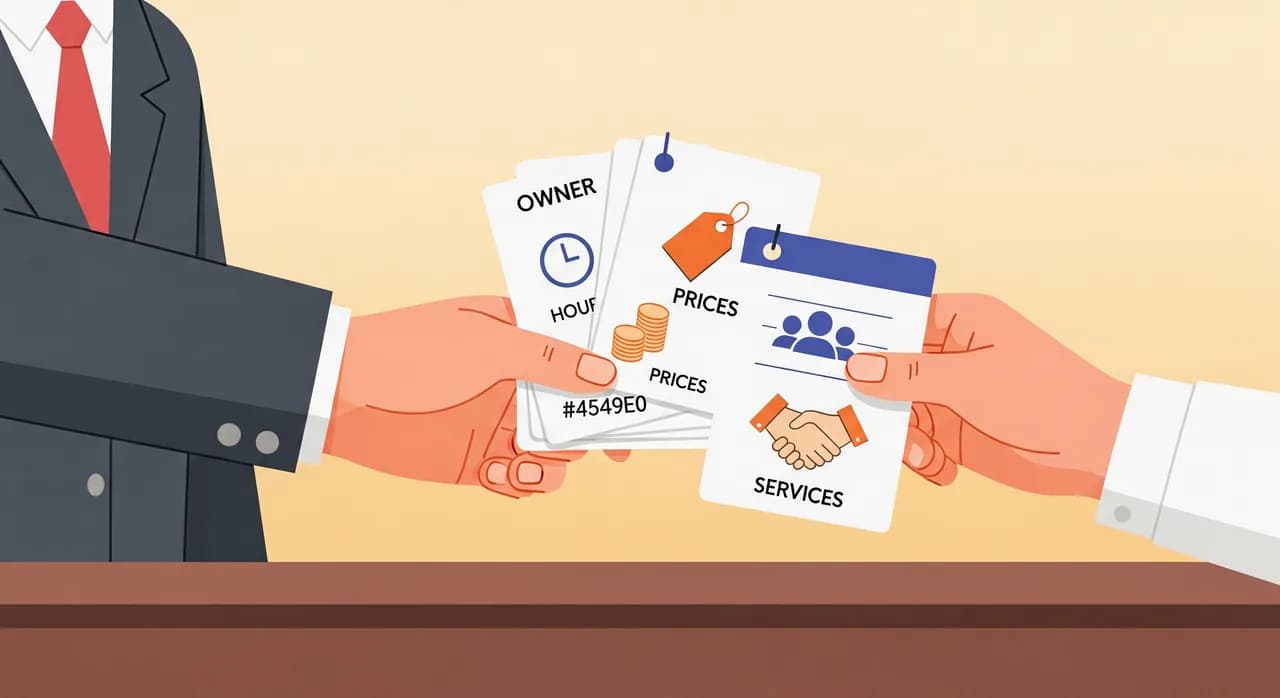
Think of it like the briefing you'd give a new receptionist on their first morning. Here are our hours. Here's what we do and what we don't do. Here's how much a standard service costs. Here's our address and parking situation. If someone asks about X, say this; if they ask about Y, take a message. A voice agent is briefed the same way — you type it in, or answer a few questions in a setup wizard, and that becomes its knowledge.
- Your services — what you offer, described in your words.
- Your hours — including the awkward ones, like a long lunch or Saturdays until noon.
- Your prices or ranges — whatever you're comfortable quoting on the phone.
- Your rules — deposit required, no walk-ins, dogs welcome, whatever matters.
- What to do when it's out of its depth — take a message, offer a callback, or ask the caller to try again during office hours.
The critical point: it isn't inventing answers from the internet, and it isn't guessing. It answers from your profile. If you never told it whether you offer gift vouchers, it won't confidently make one up — it'll take a message so you can follow up. Good agents are built to admit the gap rather than fill it with a plausible lie, because a confident wrong answer on the phone is worse than an honest "let me have someone check that for you."
What it actually does on a real call
Abstract descriptions only get you so far. Let's walk a call end to end. Imagine a two-chair hair salon. The stylist is mid-colour, hands covered, phone ringing on the shelf. Before, that call went to voicemail — and most people who reach a salon's voicemail just call the next salon on the list. With a voice agent, here's the same call:
- 1It picks up on the second ring"Good afternoon, thanks for calling — how can I help?" No hold music, no menu.
- 2It handles the actual question"Do you have anything for a cut and colour this Saturday?" It checks the salon's hours and availability rules and answers naturally.
- 3It takes the booking or the detailsIt collects the caller's name and number, notes what they want, and books the slot or logs the request — depending on how you set it up.
- 4It knows when to step backIf the caller asks for a specific stylist's opinion on a colour correction, it doesn't fake expertise. It takes a message and promises a callback.
- 5It tells you what happenedThe stylist finishes the colour, wipes their hands, and finds a tidy summary and a full transcript of the call waiting for them — name, number, what was asked, what was promised.
Notice what changed and what didn't. The salon didn't hire anyone, didn't install a phone system, didn't answer during a client's appointment. But the caller got answered, the booking got made, and the owner got a record. The math is unglamorous and hard to argue with: if ten calls a week used to hit voicemail and half of those would have booked, that's five appointments a week that quietly stop leaking away.
“Most people who reach a small business's voicemail don't leave a message. They call the next name on the list.”
Voice agent vs. a human vs. an old-school machine
It helps to see the three options side by side, honestly. A voice agent isn't better than a great receptionist at everything — it's better at being there, which for a small business is often the whole game, because the receptionist you can't afford to have on staff at 8pm is worth exactly nothing to the caller at 8pm.
| Voicemail / IVR menu | AI voice agent | A person | |
|---|---|---|---|
| Answers at 9pm and weekends | Plays a message | Yes, fully | Only if you pay for it |
| Understands an off-script question | No | Usually | Yes |
| Books and takes messages | No | Yes | Yes |
| Emotional judgement on a tricky call | No | Limited | Yes |
| Cost of being available 24/7 | Low | Low | High |
The sane way to read that table isn't "machine replaces human." It's "the agent covers the hours and the overflow a human can't, and hands the genuinely human calls to a human." Most owners end up using it as a safety net under a team of one or two — it catches everything that would otherwise fall through, and it never calls in sick.
Does it pretend to be a person?
This is the question owners are almost embarrassed to ask, and it's the most important one. A voice agent sounds natural — that's the point. So callers sometimes can't immediately tell. The honest and correct answer is that it shouldn't pretend, and a responsible one won't. If a caller asks "am I talking to a real person?", it should say no. Deceiving your own customers is a terrible way to start a relationship, and in some places it's not even legal.
There's a practical reason too, beyond ethics. When callers know it's an assistant, they talk to it differently — clearly, one thing at a time — and they're more forgiving when it hands them off. Trying to trick people into thinking it's human only backfires the moment the illusion cracks, which it eventually will. Natural voice, honest identity. That's the combination that actually builds trust.
What it can't do — and why that's fine
Any tool that only tells you its strengths is selling, not explaining. So here's the flip side. A voice agent is not a substitute for judgement on the calls that need it. It won't talk an upset customer down from a genuine complaint the way a calm, experienced person can. It won't make a discretionary call about bending a rule for a loyal regular. It doesn't know your business the way you do — it only knows what you told it.
- It won't improvise beyond its brief. If you didn't cover a topic, it takes a message rather than guessing.
- It won't give professional advice — medical, legal, financial. It shouldn't, and a good one is built not to.
- It won't read the room like a human on a delicate call. Emotional nuance is still a person's job.
- It won't fix a business problem. If your prices confuse people, the agent will faithfully repeat the confusing prices.
None of that is a dealbreaker, because none of it is the job you're hiring it for. You're hiring it to answer every call, capture the routine stuff perfectly, and route the human stuff to a human. Judge it against voicemail — the thing it's actually replacing — and it wins in a walk. Judge it against your best employee on their best day, and of course a person is warmer. That's not the comparison that matters at 9pm on a Sunday when the alternative is nobody answering at all.

How hard is it to set up — really?
This is where the word "agent" scares people off unnecessarily. You might picture a technician, a contract, a training period. For a self-serve voice agent, the reality is closer to setting up a new email account than installing a phone system. You describe your business, you test it by talking to it, and you point your calls at it. No hardware, no engineer.
- 1Describe your businessA short wizard walks you through your hours, services, and the answers to your most common questions. This is the whole of the "training."
- 2Test it yourselfBefore it ever touches a real customer, you call it and try to trip it up. Ask the awkward questions your callers actually ask. Adjust the profile until it answers the way you would.
- 3Point your phone at itYou forward your number — or your after-hours and busy calls — to the agent. Nothing changes for the caller; your existing number just gets answered.
- 4Read the summariesFrom then on, every call arrives as a summary and transcript. You tweak the profile over the first week as you spot anything it got wrong.
Is a voice agent right for your kind of business?
Not every business needs one, and it's worth being clear-eyed. If you're at your desk all day, calls are rare, and you always answer, the upside is small. But most small businesses aren't like that. They're a stylist with their hands full, a mechanic under a car, a two-person office that goes quiet at 5pm while customers keep calling until 9. If missed calls cost you real bookings, the case makes itself.
It tends to earn its keep hardest where the work physically stops you from picking up, or where calls come in outside your hours. Trades and home services on a job site. Salons and clinics mid-appointment. Restaurants slammed during service. Anywhere a missed call is a lost customer rather than a mild inconvenience. If that's you, the phone quietly going unanswered isn't a small leak — it's the front door swinging shut on people who wanted to give you money.
And if you serve callers in more than one language, the case gets stronger still. A single agent can greet and help people in the language they call in — something a solo owner simply can't offer no matter how good they are. That alone converts callers a human front desk would have lost at hello.
What is an AI voice agent in simple terms?
How is a voice agent different from an automated phone menu?
Will my customers know they're talking to an AI?
What does it mean that it's "trained on my business"?
Do I need any technical skill to set one up?
What happens when the agent can't answer a question?
See it answer a call in your own words
The fastest way to understand a voice agent is to hear one. Walk through how Vunoon picks up, understands, and handles a real call for a business like yours.
See how Vunoon answers your calls
Vunoon builds an AI phone assistant that answers your business calls 24/7 — it books appointments, answers common questions and sends you a summary of every conversation.