AI Call Summary for Business: Turning Every Call Into a Next Step
A missed call is a lost opportunity only if nothing happens after it. Here's what a genuinely useful AI call summary contains, where it should land, and a five-minute morning routine that stops leads from slipping through the cracks.
 Vunoon16 min read
The call is answered, the caller is happy, the assistant hangs up. Then what? For a lot of small businesses, that's exactly where the money leaks out — not on the call, but in the twelve hours afterwards when nobody remembered to phone the plumber back. A good AI call summary for business isn't a nice-to-have log. It's the handoff that decides whether a call becomes a booking or a footnote.
Most of the conversation about AI phone assistants stops at the moment the phone gets answered. That's the impressive part — the greeting, the natural voice, the fact that a caller at 9pm on a Sunday gets a real answer instead of a beep. But answering the call is only half the job. The other half is what you, the owner, get afterwards: a clear record of who called, what they wanted, and what you're supposed to do about it.
This article is about that second half. Not the voice on the line, but the note that lands in your inbox — and, more importantly, the small daily habit that turns a stack of those notes into actual revenue. Because a summary you never read is just a tidier way of missing a call.
Why the summary, not the call, is the real deliverable
Think about what actually happens when you miss a call today. Best case, you get a voicemail. You listen to ninety seconds of someone rambling, half of which is "uh, hi, so, um," you scribble a number on the back of an invoice, and you promise yourself you'll call back after lunch. You don't. Worst case, there's no voicemail at all — just a missed-call notification with a number you don't recognise, which you'll never dial because you have no idea whether it's a customer or a courier.
A voicemail is raw material. A summary is a finished part. The difference matters because your time to act on a lead is measured in hours, not days. Someone who calls three roofers on a rainy Tuesday hires the first one who calls back sounding like they were paying attention. If your record of that call is a garbled voicemail you'll parse later, you've already lost to the roofer whose assistant emailed him a two-line summary he read at a traffic light.
So the summary isn't paperwork. It's the thing that makes follow-up cheap enough that you'll actually do it. And follow-up you'll actually do is worth more than a perfect call you never act on.
What a genuinely useful call summary contains
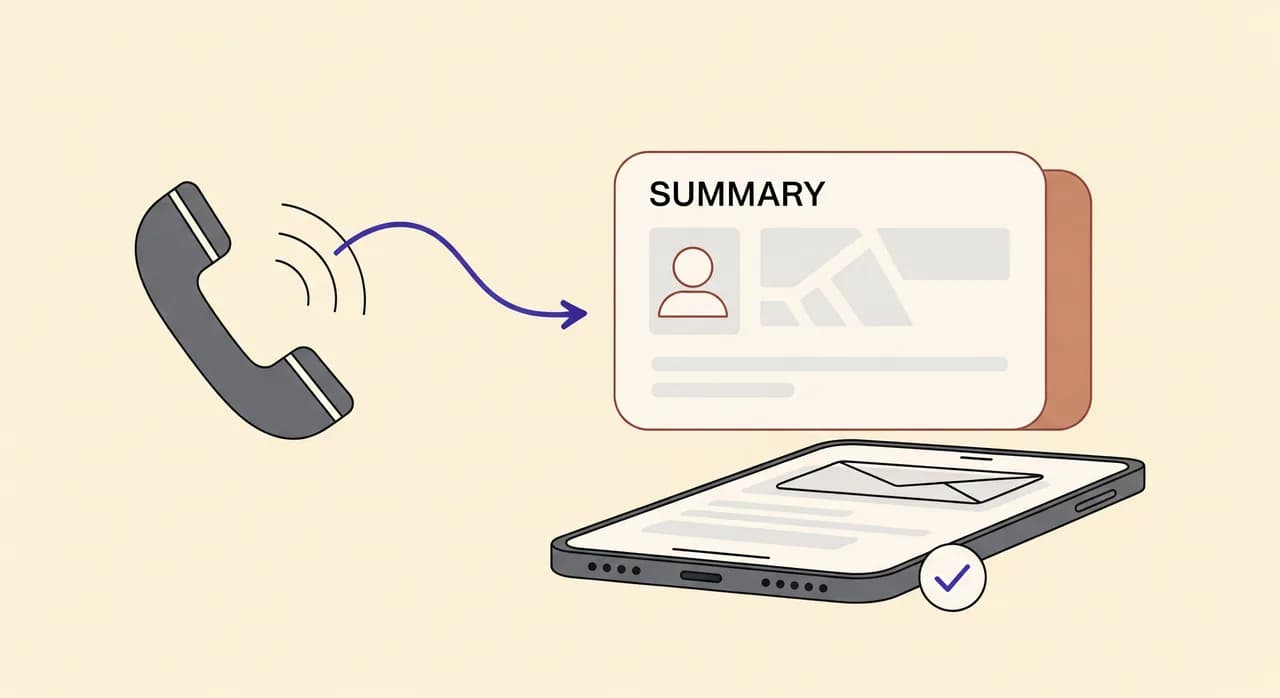
Not all call notes are equal. A summary that just says "caller asked about services" is barely better than a missed-call alert. A useful one answers four questions before you've finished your coffee: who called, why, what specifics came up, and what you're supposed to do next. Miss any of those four and you're back to guessing.
Here's the anatomy of a summary that earns its place in your inbox.
- The caller. A name if they gave one, and always the number to call back. If they mentioned they're an existing customer, or that they were referred by someone, that belongs here too.
- The intent, in one line. "Wants a quote for a bathroom re-tile" or "Rescheduling Thursday's appointment." Not "general enquiry." The whole point is that you know what the call was about without listening to it.
- The specifics that matter. The details that change how you respond — the address, the make of car, the date they're hoping for, the size of the job, the fact that it's urgent because of a burst pipe. These are what let you call back prepared instead of asking everything again.
- The action. The single most important field. "Call back to confirm price" or "Booked for Tuesday 2pm — no action needed" or "Wants you to email the brochure." A summary without an action is a story with no ending.
- The mood, when it's obvious. Not psychoanalysis — just a flag when someone sounded frustrated, in a hurry, or ready to buy today. That's what tells you which of this morning's twelve notes to phone back first.
Vunoon sends you this after every call: a short summary built around the caller, their intent, the details they gave, and the suggested next step — plus the full transcript underneath if you want to read the whole thing. The summary is for skimming at a glance. The transcript is there for the times you need the exact words.
Summary versus transcript: you need both, for different jobs
People sometimes ask whether they want a summary or a transcript. The honest answer is that they do different jobs, and a good setup gives you both, layered.
The summary is what you read ninety-five percent of the time. It's the triage layer: enough to decide whether to act now, act later, or ignore. You should be able to clear ten of them in the time it takes to drink half a coffee.
The transcript is the safety net. You reach for it when the summary raises a question — did they actually say Thursday or Tuesday? What was the exact address? Did they mention a budget? — or when the call was tense and you want the precise words before you call back. It's also what you forward to a colleague when the job isn't yours to handle.
| Summary | Transcript | |
|---|---|---|
| What it's for | Deciding what to do | Checking exactly what was said |
| How often you read it | Every call | When something's unclear or contested |
| Length | A few lines | The whole conversation |
| Best moment to use it | Morning triage, on your phone | Before a careful callback, or to hand off |
“A summary you never read is just a tidier way of missing a call.”
Where the summary should land — and why that's half the battle
The best-written summary in the world is useless if it arrives somewhere you never look. This is the mistake that quietly kills a lot of otherwise-good systems: the notes go into a dashboard the owner logs into twice a month, and the whole thing might as well not exist.
The rule is simple: the summary should land where you already spend your day. For most small-business owners, that's email and their phone. Not a special app you have to remember to open. Not a portal behind a login you'll forget. The follow-up habit only survives if it fits into a place you're already looking twenty times a day.
- Email is the workhorse. Every call becomes a message you can read, search, forward, and — crucially — mark as done. Your inbox is already a to-do list; a call summary that lands there slots straight into a workflow you have.
- A phone notification is for the ones that can't wait. When someone sounded urgent or wanted a callback today, you want to know before you finish the job you're on, not at 6pm.
- A single running log is for the weekly view: how many calls came in, how many turned into bookings, what people keep asking for. That's where patterns live.
Vunoon leans on email for exactly this reason. After each call, the summary and transcript arrive as a message. You can read them on your phone between jobs, forward the relevant ones to whoever handles them, and treat your inbox as the follow-up queue it already is. No new habit to build — just a better class of email arriving in a place you already trust.
The five-minute morning routine that catches every lead
Tools don't follow up. People do — or rather, habits do. Here's a routine that takes about five minutes and stops the overnight calls from turning into missed opportunities. It works because it's boring, repeatable, and short enough that you'll actually keep doing it.
- 1Open the overnight summaries once, first thingCoffee in hand, before the day swallows you, open the folder or thread where your call summaries land. All of them at once. This is the only "log in" step, and you're doing it in your inbox, so it's free.
- 2Triage in one pass: now, today, later, doneRead each summary's action line and sort it into four buckets. "Now" is the burst pipe and the ready-to-buy caller. "Today" is the quote request and the reschedule. "Later" is the vague enquiry worth a nudge this week. "Done" is anything the assistant already handled — a confirmed booking needs no action from you. Don't act yet. Just sort.
- 3Clear the 'now' pile immediatelyCall back the urgent ones before you touch anything else. These are the leads with the shortest fuse. Two minutes each, done before the day starts, is the difference between winning and losing them.
- 4Batch the 'today' pile into one blockDon't scatter callbacks across the day — you'll forget half. Pick one window, phone or email them in a run, and use the summary so you open each call knowing the address, the job, the date they wanted. Prepared callbacks are shorter and land better.
- 5Park 'later' where you'll see itFlag or star the soft leads so they surface again in a couple of days. A friendly follow-up on a lukewarm enquiry converts more often than you'd think — because most of your competitors never send one.
- 6Mark everything doneArchive or tick off each summary as you handle it. The satisfying part: by the end of five minutes, the overnight pile is empty and nothing is quietly rotting in a voicemail box. An empty queue is the whole point.
That's it. No project-management software, no CRM migration, no new discipline to invent. The summaries do the note-taking; the routine does the deciding; your inbox holds the queue. The reason it works is that each step is small enough to survive a busy week — and a system that survives a busy week is the only kind worth having.
From a pile of notes to an actual system
The morning routine handles the day-to-day. But summaries also give you something you never had before: a written record of every call, which quietly becomes a management tool if you let it.
Once a week, skim the log — not to act, but to notice. Three callers this week asked whether you do emergency weekend work; maybe that answer belongs on your website, or in the assistant's profile so it's handled without a callback. Half your missed calls come in during the same two-hour lunch window; that's a scheduling insight, not a mystery. People keep asking for a service you stopped offering; time to update the greeting. The summaries turn your phone from a black box into a source of information about what your customers actually want.
This is also where a small tightening pays off. If your call notes consistently show people asking the same three questions, feed those answers back into how the assistant is set up. The next caller gets the answer on the spot, no summary needed, no callback required. Good summaries don't just help you follow up — over time, they help you need fewer follow-ups.
“The summaries turn your phone from a black box into a source of information about what your customers actually want.”
Where this honestly falls short
No summary system replaces judgement, and it's worth being clear about the edges so you're not surprised by them.
A summary is a compression of a conversation, and compression loses things. If a caller was vague, the summary will be vague too — it can only be as clear as what was said. That's exactly why the full transcript sits underneath: for the genuinely important or ambiguous calls, read it. Don't treat the summary as gospel on the ones that matter most.
It also doesn't do the follow-up for you. The assistant can take a message and tell the caller you'll ring back; it can't ring them back with your voice and your judgement about the price. The action line tells you what to do — you still have to do it. Any tool that promises to "handle everything" while you sleep is overselling. The realistic, honest promise is smaller and more useful: you'll never again wonder what a call was about, and you'll always know what to do next.
And it won't make a bad follow-up habit good on its own. If you let the summaries pile up unread for a week, they're just a neater version of the mess you had before. The five minutes in the morning is the part that isn't optional. The tool makes that five minutes possible; it can't make you spend it.
Setting it up so the summaries actually arrive
The whole workflow depends on the summaries being good and landing somewhere you look. With Vunoon, both come from the same short setup — and it's worth doing thoughtfully, because a five-minute investment here is what makes the five-minute morning routine possible for the next year.
- 1Describe your business wellThe wizard asks about your services, hours, and the things people call to ask. The more precise this is, the sharper the summaries: an assistant that knows you don't do weekend jobs will capture that in the note instead of leaving you to sort it out later.
- 2Point the summaries at your inboxSet the email where you actually read messages on your phone. This is where your follow-up queue will live, so make it the address you check between jobs, not one you ignore.
- 3Test it by talking to itBefore you forward a single real call, phone the assistant yourself. Play the awkward customer. Then read the summary it sends — is the action line clear? Are the details right? Tweak the setup until the note is something you'd happily act on.
- 4Forward your number and start triagingOnce the summaries read the way you want, forward your line. From tomorrow morning, the overnight calls arrive as a tidy pile of notes, and your five-minute routine has something to work on.
There's a free trial, so you can run the whole loop — set up, test, read a real summary — before committing to anything. The best test is boring on purpose: forward your number for a week, do the morning routine, and count how many callbacks you made that you'd otherwise have missed.
What does an AI call summary for business actually include?
Do I get a full transcript as well as the summary?
Where do the call summaries get sent?
How do I make sure I actually follow up on the summaries?
Can the assistant do the follow-up call for me?
Will the summaries help me beyond just following up?
Turn every call into a clear next step
Set up Vunoon in minutes, test it by talking to it, and see the summaries it sends after each call. Free trial — forward your number for a week and count the callbacks you'd otherwise have missed.
Start your free trial
Vunoon builds an AI phone assistant that answers your business calls 24/7 — it books appointments, answers common questions and sends you a summary of every conversation.