Handling Repetitive FAQ Calls: The Ops Fixes Before You Buy Any Tech
Most repetitive customer calls are demand for information you could have published, standardized, or deflected long before anyone answers. Here's how to reduce repetitive customer calls in the right order.
 Vunoon16 min read
Somewhere in your day there is a version of the same phone call, on repeat: what time do you close, how much is the thing, and where exactly are you. It feels like customer service. It is mostly friction. Before you buy a single piece of software to handle it, there is a cheaper, faster set of moves most businesses skip — publish the answers where callers actually look, make sure your team gives the same answer every time, and only then hand the leftovers to an assistant. This is a guide about doing those in the right order.
The question behind the repetitive call
Start with an uncomfortable reframe. A repetitive FAQ call is not really a customer wanting to talk to you. It is a customer who could not find something and had to interrupt a human to get it. "What time do you close on Sunday" is not a conversation anyone enjoys. It is a lookup that failed. The person would have preferred to never dial at all — they wanted the answer, not the chat.
That reframe matters because it tells you where the fix lives. If the goal were more human warmth, you'd hire. But the goal is usually the opposite: remove the need to ask. Every repetitive call is a small signal that a piece of information is either missing, hard to find, or contradicted somewhere else. Chase those signals and the call volume drops on its own, before any tech gets involved.
So the sequence throughout this piece is deliberate. First, publish — put the answer where people are already looking. Second, standardize — make sure the humans who do pick up say the same thing. Third, deflect — route the residue that survives both steps to an assistant so your team stops absorbing it. Do them out of order and you'll pay for automation to answer questions you could have prevented for free.
First, audit what people actually ask
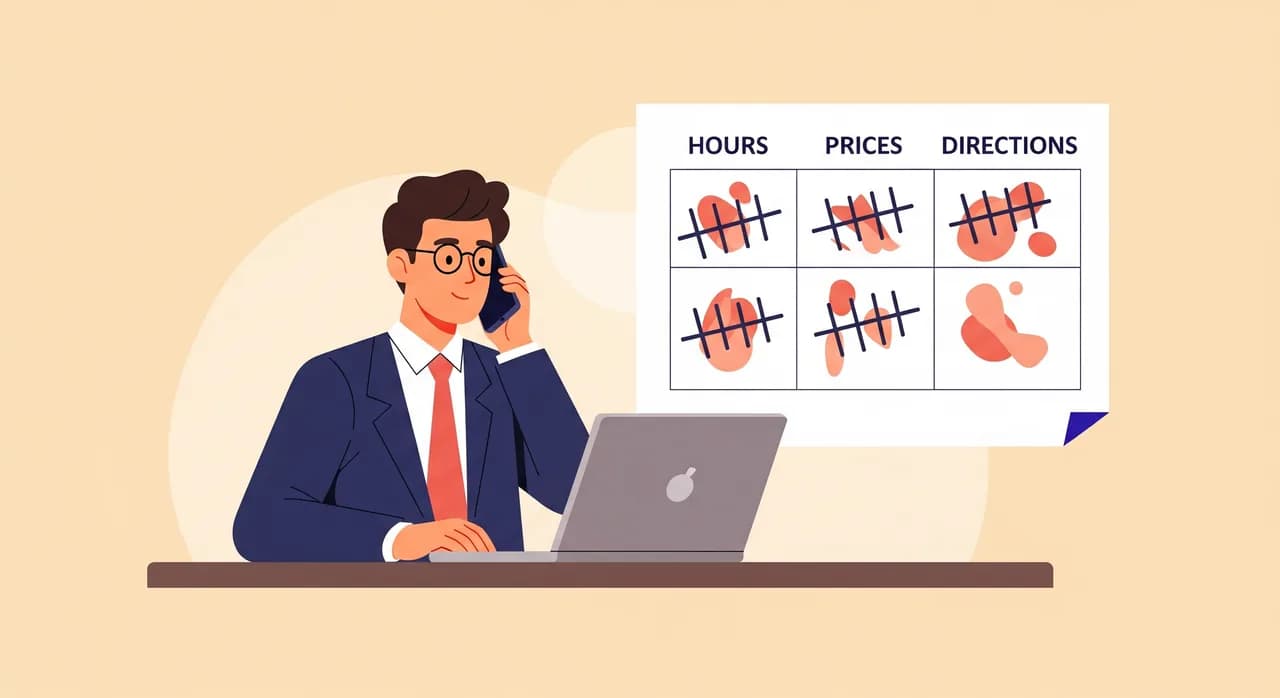
You cannot reduce what you haven't measured, and almost nobody measures their phone questions. Owners have a gut sense — "people always ask about parking" — but the gut is a bad instrument. It over-weights the memorable call and forgets the twenty forgettable ones. Spend one week counting.
The instrument can be a sticky note by the phone or a shared note on a phone. Every time someone answers, they tally a category with one keystroke: hours, price, location, availability, booking, or other. No essays. Just marks. At the end of the week you'll have something you've probably never had: a ranked list of the questions eating your day.
- Hours & closures. Regular hours, holidays, "are you open right now," lunch breaks.
- Prices & estimates. "How much is X," "do you charge for the first visit," "is that per person."
- Location & access. Directions, parking, which entrance, is it wheelchair accessible.
- Availability. "Can you fit me in today," "do you have the blue one in stock."
- Booking & policies. How to reserve, cancellation rules, deposits, what to bring.
- Genuine sales & complex questions. The calls only a human should take — the ones worth protecting.
Almost every business is shocked by the top of that list. It is rarely the interesting question. It's usually hours and price — two things that are stable, public, and completely answerable without a person. That's the good news: the biggest chunk of your interruptions is also the easiest to prevent.
Publish the answers where callers actually look
Here is the mistake almost everyone makes: they know the answers are "on the website," so they assume the job is done. But callers don't dial because the answer doesn't exist. They dial because they couldn't find it in the three seconds they were willing to spend looking. Publishing isn't about existing. It's about being findable at the exact moment of the question.
Think about the actual path. Someone types your name into a maps app or a search bar. They see a listing. They want a fact. If that fact isn't right there — in the listing, not two taps deep on a page that takes four seconds to load on a phone in a car park — they call. So the highest-leverage place to publish is almost never your website's contact page. It's the profile that shows up first.
The map and search listing comes first
Your business listing on the dominant map and search platform is the single most-viewed surface you own, and most small businesses treat it as a formality. Fill it in completely. Hours, including special holiday hours, entered as actual holiday hours so the listing shows "closed for the holiday" instead of your normal Tuesday times. A pinned note or attributes covering parking, entrance, and accessibility. Photos of the front door so people recognize it. This one surface can quietly delete a third of your "are you open" and "where are you" calls.
A website that answers in one glance
For the callers who do reach your site, the test is brutal and simple: can they get hours, price range, and directions without scrolling, tapping, or thinking? Put hours in the header or a persistent footer. Give prices a real page — not "contact us for a quote" if a quote isn't genuinely required, because "contact us" is just a repetitive call you invited. If you can't post exact prices, post a range or a starting-from figure. A range prevents ten calls; secrecy invites them.
Directions deserve more than a pin. Add the specifics people phone about: which floor, which door, where to park, what the building looks like. A single line — "blue door beside the pharmacy, free parking on Mill Street" — is worth more than a perfectly styled map you have to zoom into.
“Every "contact us for details" is a repetitive phone call you personally scheduled.”
The surfaces everyone forgets
- Your social profiles. Hours and price info in the bio and pinned post — a big share of people check a social page before a website.
- Your voicemail greeting. If you must have one, front-load the answers: hours and website in the first eight seconds, before "please leave a message."
- On-hold message. The captive moment. "We're open until six today; you can book anytime at our website" answers the question while they wait.
- Booking confirmations and receipts. Put your policies, parking, and what-to-bring in the confirmation, and the pre-visit call vanishes.
- An SMS auto-reply. A missed call can trigger a text with your hours and a link — deflecting the redial before it happens.
None of these cost money. All of them chip away at the same pile. The discipline is to think like a caller and put the answer one step earlier than the phone at every point in their path.
Standardize the answers your team gives
Publishing handles the callers who look. But some people will always call anyway — habit, laziness, or a genuinely fuzzy question — and when they reach a human, a new problem appears: inconsistency. Two staff members give two different prices. One says the deposit is refundable, the other says it isn't. Now you don't just have repetitive calls; you have repetitive calls with wrong answers, which breed follow-up calls and disputes.
Standardizing isn't about scripting your people into robots. It's about agreeing, once, on the answer to the ten questions you get most — so the fact is the same no matter who picks up. This is boring, unglamorous ops work. It also happens to be free and unusually effective.
- 1Take your top ten from the auditUse the ranked list from your tally week. Don't guess; use the count. The top ten questions cover the vast majority of your call volume.
- 2Write one canonical answer for eachShort, plain, correct. "We're open nine to six weekdays, ten to two Saturday, closed Sunday." Agree the exact wording, including the awkward edge cases like holidays and deposits.
- 3Put it where the phone isOne laminated card by the phone, or a shared note everyone can open. Not a policy document nobody reads — a cheat sheet at arm's length during the call.
- 4Handle the price question honestlyDecide as a team how you talk about price: the range you'll quote, when you say "it depends," and what triggers a proper estimate. Vague, improvised pricing is the number-one source of follow-up calls.
- 5Review it monthlyPrices change, hours change, policies change. A cheat sheet that goes stale creates the exact wrong-answer calls you were trying to kill. Ten minutes a month keeps it true.
The compounding benefit is that a standardized answer is also a faster answer. A person reading a canonical line handles the call in twenty seconds instead of ninety seconds of "um, let me check." You've shortened every call that survives, not just prevented the ones that didn't need to happen.

Then, and only then, deflect the residue
Now the interesting part. You've published aggressively and standardized your humans. Call volume is down and the surviving calls are handled better. But a residue remains — and it's stubborn. People call outside hours. People call while your one person is with a customer. People call because they'd rather ask than look, and no amount of publishing changes that habit. This leftover is where an assistant earns its place.
The reason to reach for automation last, not first, is economic. If you'd led with an assistant, you'd be paying it to answer "what time do you close" for callers who would happily have read a listing. Do the free work first and the assistant handles a smaller, more sensible volume — the genuinely unavoidable overflow. Same tool, far better value, because it's catching residue instead of substituting for basic housekeeping you skipped.
What an assistant is genuinely good at here
For the repetitive-FAQ residue, an AI phone assistant like Vunoon is a strong fit precisely because the questions are answerable from a fixed profile. You describe your business once — hours, services, prices you choose to share, directions — and it answers callers from that. It picks up on the first ring, at 2pm and 2am, in the caller's language, without your team dropping what they're doing. For a stable factual question, it's not a downgrade from a human; for the tenth identical call of the day, it's arguably an upgrade, because it never gets short with anyone.
- Answers the stable facts instantly — hours, location, the prices you've configured — from your profile, on every call, day or night.
- Takes a message or a booking when the question goes past the FAQ, and sends you a summary and transcript so nothing is lost.
- Absorbs the overflow when your line is busy, so the eleventh caller isn't sent to voicemail while you're mid-conversation.
- Hands off honestly. It doesn't pretend to be a person when asked, and it routes anything real to you — a callback or a message — instead of faking an answer.
What it should not be asked to do
Honesty matters here, because over-deflection backfires. Don't route the calls that should reach a human into a bot — the anxious first-time customer, the complaint, the high-value inquiry that wants reassurance. Those aren't repetitive FAQs; they're relationships, and sending them to automation costs you more than the call ever did. The point of the assistant is to protect those calls by clearing the noise around them, not to replace them.
It also can't fix bad inputs. An assistant answering from a profile with the wrong hours will confidently tell callers the wrong hours. Everything in the publish-and-standardize steps still matters — the assistant is a mouthpiece for the facts you maintain, not a substitute for maintaining them. Garbage profile, garbage answers.
“Automation catches the residue. It was never meant to catch questions you could have prevented for free.”
Putting the whole order together
It helps to see the three layers side by side, because each one shrinks the pile before it reaches the next. Publishing removes the questions people can self-serve. Standardizing makes the surviving human calls fast and consistent. Deflection catches what's left when no human is free. Skip a layer and the layers after it work harder than they should.
| Layer | What it fixes | Cost | What it can't do |
|---|---|---|---|
| Publish | Callers who'd self-serve if they could find the answer | Free — your time | Reach people who refuse to look before dialing |
| Standardize | Wrong and inconsistent answers from your team | Free — a cheat sheet | Cover calls when no one is available to pick up |
| Deflect | Overflow, after-hours, and the tenth identical call | A tool like Vunoon | Handle calls that genuinely need a human relationship |
Notice the pattern: each layer's blind spot is exactly the next layer's job. That's why the order isn't arbitrary. It's also why leading with the paid layer is a false economy — you'd be spending money to cover ground the free layers handle better and cheaper.

A worked example: the two-chair salon
Imagine a small hair salon with two stylists and no receptionist. On a busy Saturday the phone rings while both chairs are full. The tally week revealed the truth: of forty calls, twenty-two were "are you open," "how much for a cut," and "where do I park." Six were bookings. The rest were a mix. So more than half the interruptions during their busiest, most profitable hours were pure information the caller could have gotten elsewhere.
The publish layer went first. They corrected their map listing, added Saturday hours and a parking note, put a price range on the website, and set an SMS auto-reply on missed calls. Within a fortnight the "are you open" and "where" calls roughly halved — those callers were now getting the answer before dialing. The standardize layer came next: one card by the mirror with agreed prices and the cancellation policy, so whichever stylist grabbed the phone gave the same figure. The improvised "um, I think it's around..." calls, and the disputes they caused, stopped.
What remained was the genuinely hard part — the calls that came while both stylists had scissors in hand. No cheat sheet helps when nobody can pick up. That residue went to an assistant: it answered the price and hours questions instantly, took bookings straight into the day, and texted the stylists a summary of anything that needed them. The salon didn't replace a receptionist they never had. They removed most of the calls, sped up the ones that survived, and stopped losing the overflow to voicemail — in that order, spending money only on the last, smallest slice.
How to know it's actually working
Run the tally week again a month later. It's the only honest measure — the same one-keystroke count that started everything. If "hours" and "location" have collapsed, your publishing worked. If the surviving human calls are quicker and nobody's disputing a price, your cheat sheet worked. If the after-hours and overflow calls are being answered instead of dropped, your deflection worked. You don't need a dashboard; you need the same sticky note, a month apart.
Then keep the loop turning. Whatever category is still stubbornly high is telling you where a fact is missing or hard to find. Maybe your holiday hours slipped out of date. Maybe a new service has no published price. Repetitive calls are a permanent, free diagnostic of the gaps in your public information — treat every recurring question as a bug report against your own listings.
How do I reduce repetitive customer calls without ignoring people?
What's the single highest-impact thing I can do today?
Should I put prices on my website or keep them for the phone?
When does an AI phone assistant make sense for FAQ calls?
Won't automating FAQs make my business feel impersonal?
Ready to deflect the residue?
Once you've published and standardized, let Vunoon catch the calls that are left — answering hours, prices, and directions 24/7 from your business profile, taking messages and bookings, and handing off to you when a caller needs a person.
See how Vunoon handles your FAQ calls
Vunoon builds an AI phone assistant that answers your business calls 24/7 — it books appointments, answers common questions and sends you a summary of every conversation.