AI Answering Customer Questions: Ending the Same Ten Calls a Day
Most of your inbound calls ask the same handful of things — hours, prices, directions, parking, 'do you do X'. Here's how an AI receptionist answers them from your own knowledge base, and how to make sure it takes a message instead of guessing.
 Vunoon14 min read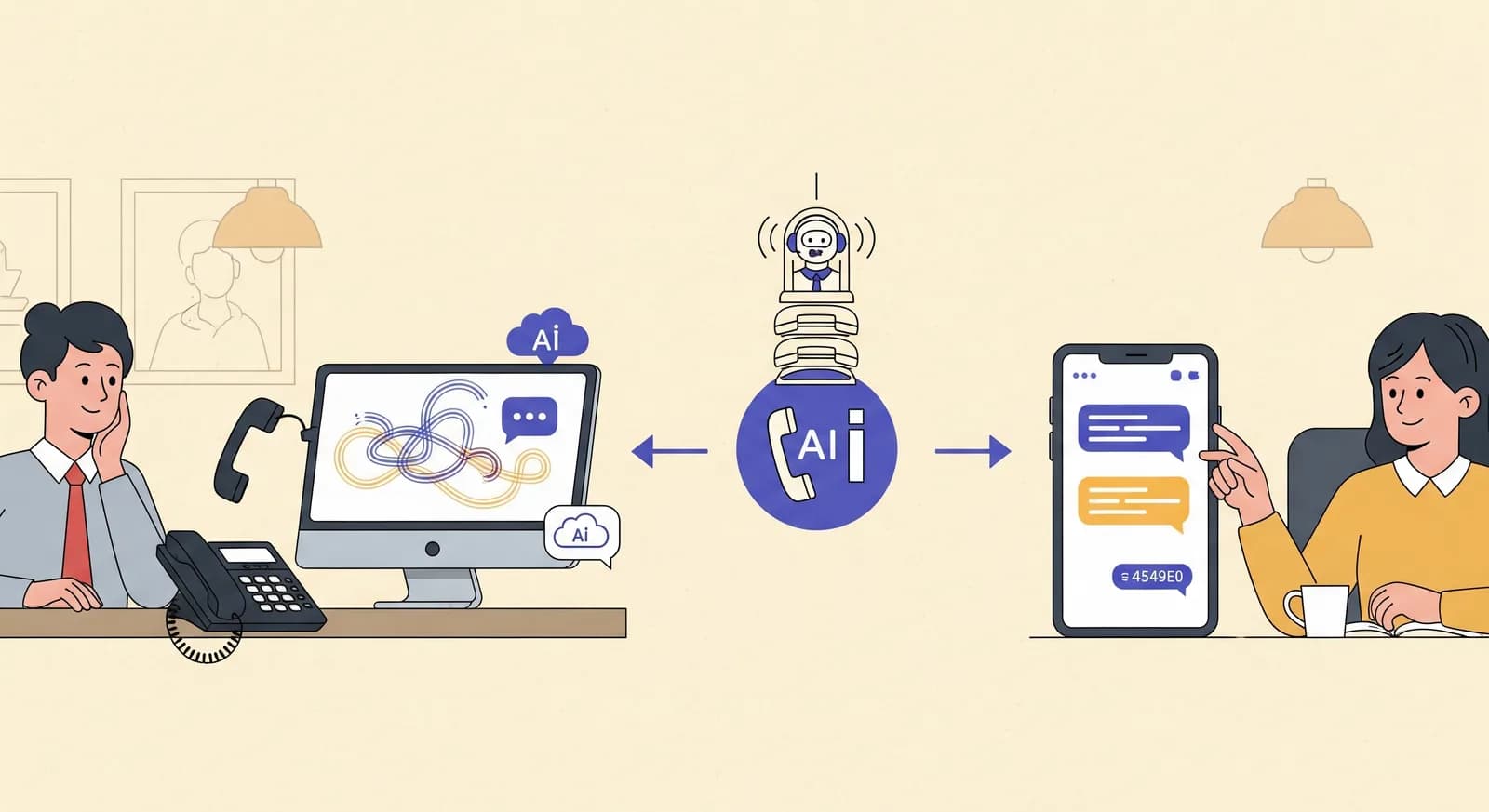
Pull the call log for any small business and a pattern jumps out fast: the same ten questions, over and over, all day. What time do you close? How much is a checkup? Where do I park? Do you take walk-ins? The answers never change, but each one still costs someone a stopped task and a repeated sentence. This is exactly the work an AI receptionist answering customer questions is built to absorb — and the part worth understanding is how it knows the answers, and what it's told to do when it doesn't.
There's a comfortable myth that the valuable calls and the boring calls are different phone calls. They aren't. The person asking whether you're open on Saturday is often the same person who books an appointment thirty seconds later. The repetitive question is the front door. The problem isn't that these questions exist — it's that answering them competes with everything else you're paid to do, and when it loses that competition the call goes to voicemail, or nowhere.
The repetitive 80% is more of your calls than you think
If you actually tally a week of inbound calls, most businesses land somewhere around the same shape: a large majority are informational or transactional in a completely predictable way, and a small minority are genuinely novel. The novel ones — the complaint, the unusual request, the supplier with a problem — deserve a human. The rest are just facts you already know, delivered by voice.
Consider the categories that show up in nearly every trade. Hours: are you open now, what about the holiday Monday, when's your lunch break. Prices: what does the basic service cost, is there a call-out fee, do you charge for a consultation. Location and access: what's the address, is there parking, which entrance, are you near the station. Availability: can I come in today, do you take walk-ins, how far out are you booked. 'Do you do X': do you treat cats, do you do gel nails, do you work on diesel engines, do you cater. None of these require judgment. They require someone to be there with the answer.
What answering the same question really costs
The individual call feels cheap. Ninety seconds, a friendly answer, done. But the cost isn't in the call — it's in the interruption tax around it. A dentist mid-procedure can't answer. A hairdresser with a client in the chair either ignores the ring or apologises to the person in front of them. A one-van plumber on a roof lets it go to voicemail, and the caller — who had a simple question — dials the next name on the list instead of waiting for a call back.
That's the quiet damage of the repetitive call: not that answering it is hard, but that not being able to answer it right now loses you the transaction hiding behind it. The 'what time do you close' caller was going to come in. The 'how much for a filling' caller was ready to book. Miss the trivial question and you often miss the customer, and you never even know it happened because there's no record of a call that went to a dead voicemail box no one filled out.
“The trivial question is rarely just a question. It's usually a booking wearing a disguise.”
How the assistant actually knows your answers
This is the part that separates a useful AI receptionist from a gimmick. It doesn't invent answers, and it isn't drawing on some generic idea of what a business 'usually' does. It answers from your business profile — the specific facts you enter when you set it up: your hours, your services, the prices you choose to publish, your address and parking notes, whether you take walk-ins, which things you do and don't do.
Think of it as a knowledge base you fill in once and can edit any time. With Vunoon, that profile is built in a short setup wizard — you describe your business in plain language, list what you offer, and add the details customers ask about most. From then on, when a caller asks 'do you do teeth whitening', the assistant checks what's in your profile and answers accordingly. If whitening is listed, it says yes and can offer to book. If it isn't, it doesn't bluff — and that boundary is the whole point of the next section.
- Hours — including exceptions you add, like a closed Wednesday afternoon or a holiday, so it doesn't tell someone you're open when you aren't.
- Services and 'do you do X' — the list of what you actually offer, so it answers yes or no honestly rather than guessing.
- Prices you choose to share — you decide what's public. If you'd rather quote in person, it can say so and take a message instead.
- Location and access — address, parking, the entrance to use, nearby landmarks.
- Policies — walk-ins, deposits, cancellation notice, which payment methods you take.
The rule that matters: when it takes a message instead of guessing
A confident wrong answer is worse than no answer. If a caller asks something outside your profile — an unusual medical question, a bespoke quote, a policy you never wrote down — the right behaviour is not to improvise something plausible. It's to say, honestly, that it'll take a message and have the owner get back to them. That's the design principle underneath the whole product: answer what it knows, hand off what it doesn't.
This is where a lot of nervousness about AI on the phone lives, and it's a fair worry. Nobody wants their assistant inventing a price, promising a service they don't offer, or guessing at a clinical question. Vunoon is built so the boundary is explicit: it answers from your profile, and when it hits the edge of what you've told it, it takes a clear message with the caller's name, number and question, and sends you a summary and transcript so you can call back. It also won't pretend to be a person if a caller asks — it's upfront about being an assistant.
- 1It checks your profile firstThe caller asks a question. The assistant looks for the answer in the facts you configured — hours, services, prices, policies, location.
- 2If it's there, it answers plainlyIt gives the specific answer in your caller's language, and where it makes sense offers the next step — booking a slot, or noting a callback.
- 3If it's not there, it doesn't inventInstead of guessing, it tells the caller it'll pass the question to you and takes their details and the question itself.
- 4You get the message and transcriptAfter the call you receive a summary and a full transcript, so you can pick up exactly where the caller left off — no lost context, no 'sorry, remind me what you asked'.
“A confident wrong answer costs you more than an honest 'let me have the owner call you back.'”
What this looks like across different trades
The mechanics are the same everywhere, but the questions differ. A few illustrative scenarios make it concrete — these are examples, not real customers.
A two-chair dental practice. The phone rings during a filling. Caller: 'Do you take new NHS patients and how much is a checkup?' The assistant answers the fee from the profile, notes the practice isn't taking new NHS patients this quarter — because that fact was added — and offers a private new-patient slot. If the caller then asks something clinical, like whether a symptom is serious, it doesn't diagnose. It takes a message for the dentist. Nothing about the call interrupted the procedure.
A hair salon on a Saturday. Every stylist is with a client, and the phone is relentless. 'Do you do balayage, how long does it take, and can I get in today?' The assistant answers the service and rough duration from the profile, checks openness, and either offers a slot or, if the day's full, takes a callback request for a cancellation. The stylists never look up from their work.
A car repair garage. 'Do you do MOTs, do you work on hybrids, and is there parking while I wait?' Three flat facts, three clean answers from the profile — and if the caller wants an unusual quote the mechanic hasn't priced generically, the assistant takes the details rather than pulling a number out of the air. That's the difference between helpful and harmful automation.
It doesn't clock off, and it doesn't only speak one language
Two things quietly widen the pool of questions you can answer. First, hours: a large share of repetitive calls arrive when you're closed — evenings, weekends, lunch. Someone deciding tonight whether to call you tomorrow wants to know your hours now. An assistant that answers at 9pm captures the booking that a morning voicemail callback would have lost. Second, language: Vunoon works in 25+ languages, so the 'do you speak my language' barrier doesn't quietly cost you the caller who'd rather ask in their own words.
Neither of these replaces you. They just mean the boring, answerable question gets answered whenever and however it arrives, instead of only during the narrow window when a human happens to be free and the caller happens to speak the default language.
Being honest about the limits
An assistant is only as good as the profile behind it. If your hours are wrong in the setup, it'll confidently tell people the wrong hours — the fault is in the data, not the AI, but the caller doesn't care about that distinction. Keep the profile current the way you'd keep your opening times current on a shop door. When something changes — a new service, a price rise, a temporary closure — update it, and the answers update with it.
It also isn't a substitute for judgment, and shouldn't try to be. It won't give medical or legal advice, it won't negotiate a bespoke deal, and it won't handle the genuinely emotional call better than a person would. Those aren't the calls you're automating. You're automating the ten flat questions a day so that when a call does need you, you have the attention to give it — because you weren't just interrupted for the fifth 'what time do you close' of the afternoon.
Setting it up so the answers are actually good
The whole thing hinges on the profile, and the good news is that building it is fast and something you do once, then tune. Setup is self-serve: sign up, describe your business in the wizard, and — this is the step people skip — test it by talking to it before you forward your number. Call it, ask it your ten most common questions, and listen for the two failure modes: an answer that's wrong (fix the data) and a guess where it should have taken a message (add the fact, or leave it to hand off deliberately).
- Front-load your top ten questions. Add the facts behind the calls you hear most before anything else — that's where the payoff concentrates.
- Be explicit about what you don't do. A clear 'we don't offer X' is as valuable as listing what you do; it stops the assistant from wishful guessing.
- Decide your price policy on purpose. Publish the prices you're happy to quote by phone; for anything bespoke, let it take a message.
- Add the awkward access details. Parking, entrances, lifts, stairs — the small stuff that turns a good answer into a great one.
- Test, then forward. Only point your number at it once you've heard it handle your real questions well.
| Type of question | Best handling |
|---|---|
| Hours, address, parking, walk-in policy | Answer directly from profile |
| Standard service prices you're happy to quote | Answer directly from profile |
| 'Do you do X' where X is on your list | Answer, then offer to book |
| Bespoke quote or unusual custom job | Take a message, owner calls back |
| Clinical, legal or sensitive judgment | Take a message, never advise |
| Complaint or upset caller | Take a message and flag for a person |
Do that, and the repetitive 80% of your calls stop being a tax on your day. The clock, price, parking and 'do you do X' questions get answered instantly, in the caller's language, whether or not you're free — and the calls that genuinely need you arrive as a clean message with a transcript, not a missed ring you'll never know about.
How does an AI receptionist know the answers to customer questions?
What happens when a caller asks something the assistant doesn't know?
Can it handle prices, or should those stay with a human?
Will it pretend to be a real person?
Does it work outside business hours and in other languages?
Try it on your own ten questions
Sign up, describe your business in a short wizard, and call the assistant with the questions you hear every day. If it answers them the way you would — and takes a clean message when it shouldn't guess — forward your number.
Set up your assistant and test it
Vunoon builds an AI phone assistant that answers your business calls 24/7 — it books appointments, answers common questions and sends you a summary of every conversation.