AI Receptionist and Angry Customers: What Good De-Escalation on the Line Looks Like
A caller is furious about a late job. Can an AI receptionist handle angry customers without making it worse? Here's what good handling looks like — and exactly where a human has to take over.
 Vunoon14 min read
It's 6:40pm. Your best installer is stuck across town, the 2pm job never got done, and the customer who waited all afternoon is now calling — not to ask a question, but to shout. In the old world, that call rings out to voicemail and the customer spends the evening writing a one-star review. So here's the uncomfortable question: can an AI receptionist handle angry customers at all, or does it just pour petrol on the fire?
The honest answer is that an AI phone assistant will never calm someone down the way a genuinely apologetic human can. It has no skin in the game and everyone knows it. But that's not actually the job. The job, in the first ninety seconds of an angry call, is much narrower: make the person feel heard, get their problem written down accurately, and get it to someone who can fix it — fast. Done well, that's often better than what a stretched small business delivers today, which is a busy tone.
This piece walks through a single frustrated call in slow motion — the delayed-job scenario every trades, service, and clinic business knows too well. We'll look at what good handling sounds like line by line, where it goes wrong, and the one thing that matters most: knowing the exact moment the machine should stop talking and put a human in the loop.
The scenario: a late job and a caller who has had enough
Imagine a small plumbing outfit — an owner, three vans, no office staff. A customer booked a boiler repair for early afternoon. Something upstream ran long, nobody called ahead, and now it's evening. The customer took a half-day off work for nothing. They dial the business number expecting to leave yet another unanswered message, and instead the phone is answered on the second ring.
That last detail matters more than any clever phrasing. For a frustrated caller, the wait is half the insult. Ringing out to voicemail after being stood up confirms their worst suspicion: that this business doesn't care. Simply being answered — promptly, by something that listens — takes the temperature down a notch before a single word of apology is spoken.
The first ninety seconds: acknowledge before anything else
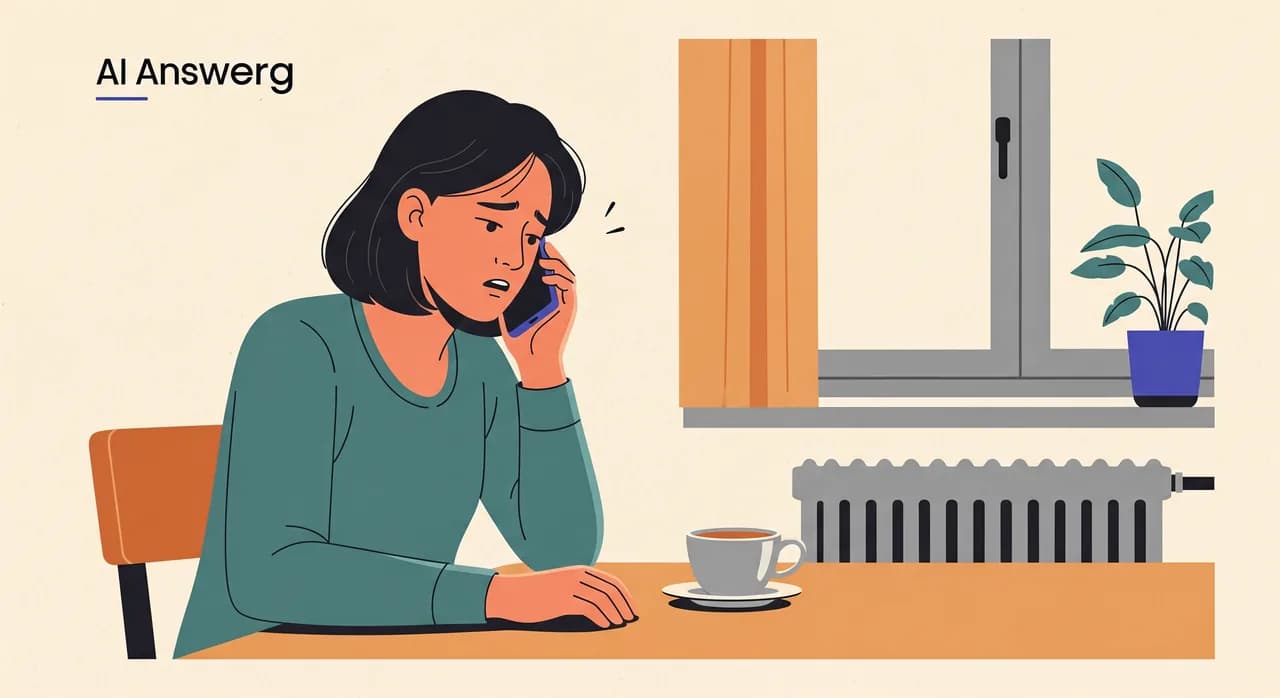
The single biggest mistake any receptionist — human or AI — makes with an angry caller is rushing to the solution. The caller says "I waited all afternoon and nobody showed," and the well-meaning but tin-eared response is "Can I take your booking reference?" That's logistically sensible and emotionally disastrous. You've just told a furious person that their feelings are an obstacle to your paperwork.
A well-configured assistant does the opposite. It acknowledges first, in plain, non-corporate language: "I'm really sorry — that shouldn't have happened, and I completely understand why you're frustrated. Let me get this sorted for you straight away." No excuses, no "unfortunately due to high demand." Just an admission that the caller has a legitimate grievance and a clear signal that action is coming.
“For a frustrated caller, the wait is half the insult — being answered at all takes the temperature down before a word of apology is spoken.”
There's a real limit here worth naming out loud. An AI can be trained to acknowledge; it cannot feel remorse. Some callers will sense that and it'll annoy them further. That's fine — you're not trying to win them over with sincerity you don't have. You're trying to be useful, honest, and quick. Which is why the next move is capture, not more soothing.
Capture the facts — cleanly, without an interrogation
Once the caller feels acknowledged, they usually want to know one thing: is this going to get fixed, and when? The assistant's job is to gather exactly enough to make that possible for the owner, and not one question more. An angry caller made to recite their life story is an angrier caller.
Good capture is short and confirms as it goes. The assistant already knows the booking was for a boiler repair this afternoon (it's in the profile), so it doesn't ask the customer to re-explain their own appointment. It confirms the name and number, asks whether the boiler is still down and whether there's any immediate safety concern, and — crucially — it reads it back. "So that's a boiler repair booked for today that didn't go ahead, you'd like a call first thing tomorrow, and there's no gas smell or leak right now. Have I got that right?"
- Confirm identity and callback number — so the owner can act without playing phone tag.
- Establish urgency and safety — is this an inconvenience or a genuine emergency? The two get routed very differently.
- Capture the ask in the caller's own words — "I want someone here before noon tomorrow," not a paraphrase that loses the point.
- Read it back — nothing reassures a frustrated person like hearing their complaint repeated accurately.
What good handling actually sounds like, line by line
It's easy to talk about de-escalation in the abstract. Here's the same call rendered as it might genuinely play out — imperfect, but far better than a busy tone.
- 1Caller opens hot"Your guy never turned up. I took the whole afternoon off. This is a joke."
- 2Assistant acknowledges, no defensiveness"I'm sorry — that's not okay, and I understand why you're upset. Let me make sure this gets straight to the owner tonight."
- 3Assistant checks for urgency"First, is the heating and hot water off right now, and is there anything that feels unsafe — any gas smell or water leak?"
- 4Assistant captures the ask"Understood. So you'd like a firm time for tomorrow morning and a call to confirm it. What's the best number to reach you on?"
- 5Assistant reads it back and sets a real expectation"I've got all of that. I'm sending this to the owner now marked urgent, and I'll make sure you get a call before 9am tomorrow. Again, I'm sorry about today."
Notice what the assistant did not do. It didn't promise a specific engineer or a discount it has no authority to offer. It didn't blame the last customer's job or the traffic. It didn't argue. It set an expectation it can actually keep — a callback by a stated time — and then made sure that callback would happen by flagging the call as urgent to a human.
The line: where a human absolutely has to take over
This is the most important section, and the one most vendors gloss over. An AI receptionist that tries to resolve every angry call is dangerous. There is a hard boundary between capturing a complaint and settling it, and a good assistant knows it's on the wrong side of that line.
The rule of thumb is simple: the assistant handles the intake; the human handles the decision. Anything that involves money, blame, a promise the business will be held to, or a caller in genuine distress is not the machine's call to make. When any of those show up, the right behaviour isn't to improvise — it's to stop, be honest about what it can do, and route the call to a person.
- The caller demands a refund, discount, or compensation. The assistant has no authority to grant it and should never pretend to. It captures the demand and escalates — it does not negotiate.
- Safety or emergency is involved. A gas smell, a flood, a vulnerable person without heat — these get flagged as urgent and, where you've set it up, connected to a human or emergency line immediately.
- The caller explicitly asks for a human. "I want to speak to a real person" is a full stop. The assistant should say plainly that it's an automated assistant, take a message or offer a callback, and never stonewall.
- The caller is escalating beyond reason. When someone is abusive or spiralling, more AI back-and-forth just prolongs it. The assistant should calmly take the essentials and end the loop by promising a human callback.
- The complaint is legal, medical, or reputational. Threats of legal action, injury claims, or anything a wrong word could make worse belong with the owner, verbatim, not paraphrased or answered.
“The assistant handles the intake; the human handles the decision. Money, blame, and promises are never the machine's call to make.”
The handoff: what "escalate fast" means in practice
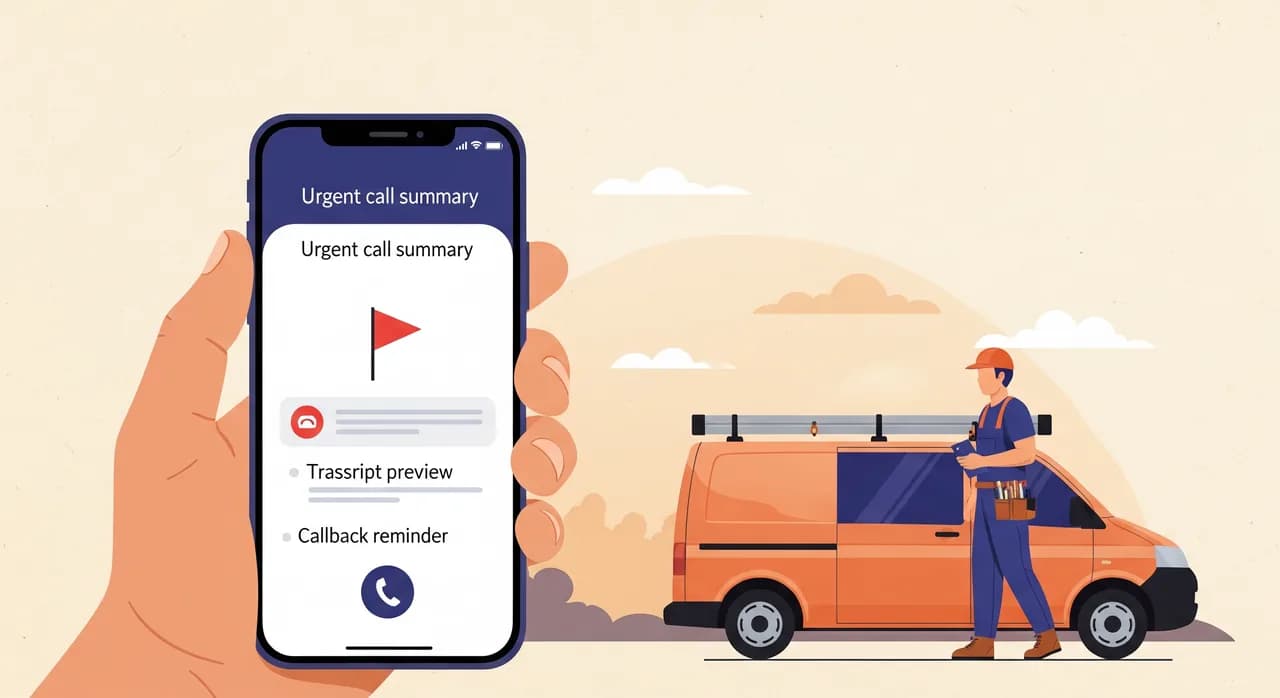
"We'll pass it on" is where most answering services quietly fail. A message that sits in an inbox until Monday isn't an escalation; it's a delay with extra steps. For an angry caller, a fumbled handoff is worse than no handoff, because now you've promised action and not delivered it.
A useful assistant treats a complaint call differently from a routine one. The moment it detects frustration or an urgent flag, it doesn't just log a summary — it pushes it. The owner gets a notification within seconds, not a digest at midnight, and the summary leads with the emotional and factual headline: "Upset customer — missed boiler job today — wants callback before 9am, no safety issue." Attached is the full transcript, so the owner walks into the callback already knowing the story and doesn't make the customer repeat it.
| Element | Routine call | Frustrated / urgent call |
|---|---|---|
| Opening | Greet and help | Acknowledge the problem first |
| Questions asked | As needed to book | Minimum viable — identity, urgency, the ask |
| Promises made | Standard booking | Only a callback by a stated time |
| Notification to owner | In the call summary | Immediate, flagged urgent, with transcript |
| Resolution | Handled end to end | Human decides; AI only captures |
Get this right and something counterintuitive happens: the angry call becomes a save. The customer who was ready to leave a scathing review instead gets a call before breakfast from an owner who already knows exactly what went wrong. That's a recoverable relationship. The version where the phone rang out is not.
The unglamorous math of a saved call
It's tempting to think of angry calls as a problem to minimise. Flip it. Every complaint that reaches a person is a complaint you can fix; every one that hits voicemail is a customer you're likely losing plus a review you'll be apologising for in public for years.
Consider a business that gets a handful of after-hours complaint calls a week. If even half of them currently go to voicemail and half of those churn or leave a bad review, that's a steady leak — not of leads, but of customers you already earned and paid to acquire. Catching those calls, capturing them cleanly, and getting an owner on the phone the next morning turns a churn event into a loyalty moment. The arithmetic isn't dramatic; it's just relentlessly positive.
How to configure your assistant for the hard calls
None of this happens by accident. When you set up an assistant like Vunoon, a few deliberate choices make the difference between one that helps on a tough call and one that grates.
- 1Write an honest, human greetingSkip the corporate script. A plain, warm greeting sets a calmer tone and makes acknowledgement feel natural rather than robotic.
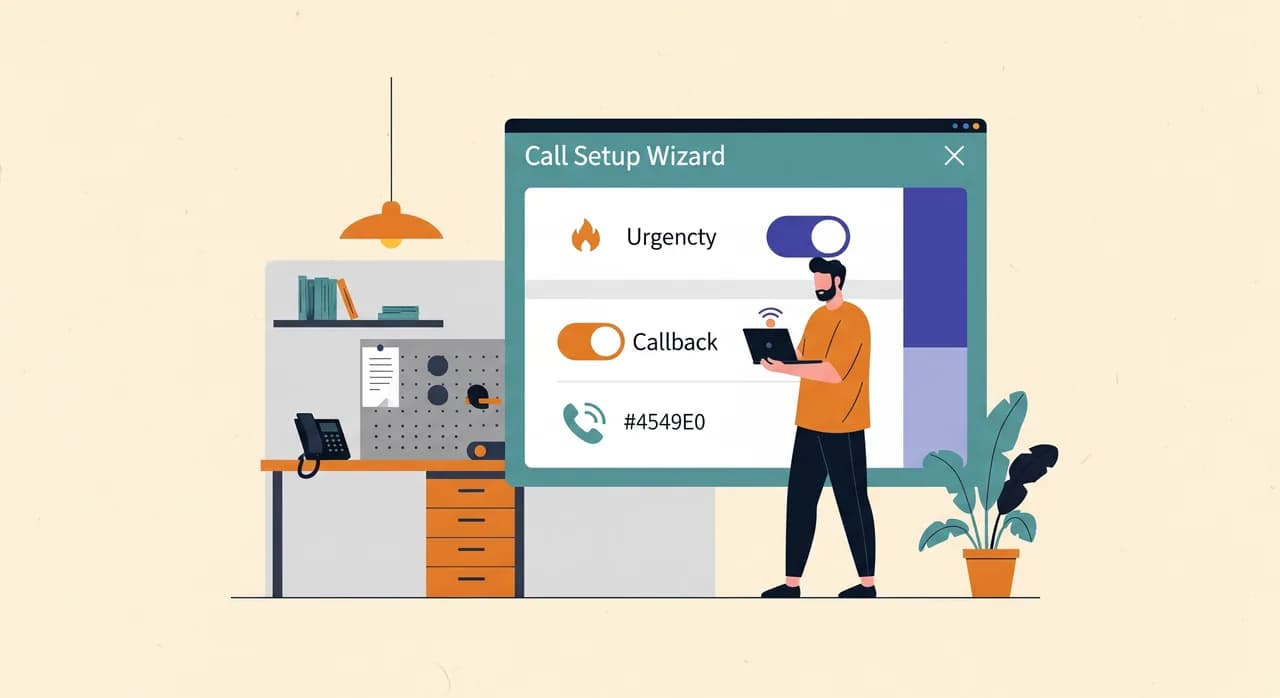
- 2Set clear escalation triggersDecide in advance what an urgent call looks like for you — safety words, refund demands, 'speak to a human' — and make sure those route to an immediate notification or a live number.
- 3Cap what it can promiseGive it exactly one thing to offer on a complaint: a callback by a stated time. No prices, no discounts, no blame.
- 4Turn on transcripts and instant alertsSo a flagged call reaches you in seconds with the full story, and your callback starts from a position of knowing, not asking.
- 5Test it by being the angry caller yourselfBefore you forward your number, call in and try to break it. Shout, demand a refund, ask for a human. You'll learn exactly where its lane ends — which is precisely what you want to know.
The honest limits — so you set the right expectations
It would be easy to end on a triumphant note, but you'd catch us overclaiming and rightly stop trusting the rest. So, plainly: an AI receptionist is not a customer-service department. It won't out-empathise a good human on a call that's really about a broken relationship. A caller determined to vent at a person will find its calm frustrating. And it can only route to a human as fast as your setup allows — if nobody's picking up the escalation, the AI can't save you from yourself.
What it does do is reliable and, for most small businesses, transformative in the narrow slot it occupies: it answers, it listens, it captures accurately, and it escalates fast — every time, at any hour, without getting tired or defensive. On an angry call, that's not the whole job. But it's the part that was going straight to voicemail, and voicemail never de-escalated anyone.
Can an AI receptionist really calm down an angry customer?
What happens when a caller asks to speak to a real person?
Will the AI make promises it can't keep, like refunds or discounts?
How fast does the complaint reach me?
Is there a risk the AI makes an angry situation worse?
See how your assistant handles a tough call
Set up Vunoon in minutes, then call in as your own angriest customer and watch how it acknowledges, captures, and escalates. You decide exactly where it hands off to you.
See how it handles tough calls
Vunoon builds an AI phone assistant that answers your business calls 24/7 — it books appointments, answers common questions and sends you a summary of every conversation.