Missed Calls During Business Hours: A Salon's Lunch Rush, Minute by Minute
Most salons lose bookings not at night but at 12:40 on a Tuesday, when the phone rings and both hands are in someone's hair. Here is where those calls actually happen.
 Vunoon15 min read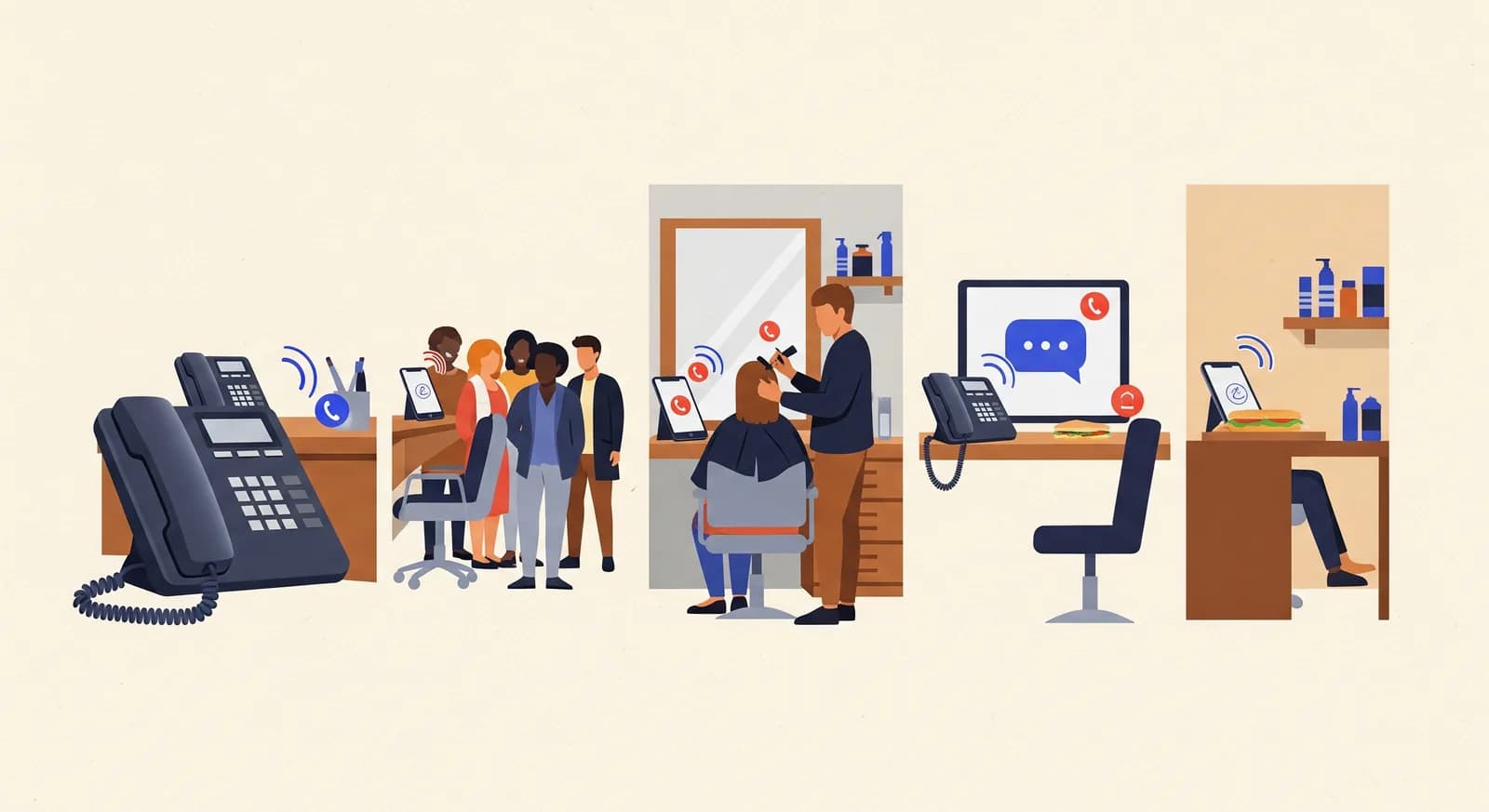
You would forgive yourself for thinking missed calls happen after hours. They mostly do not. The calls you lose are the ones that ring at 12:40 on a Tuesday, while you have a comb in one hand, colour on the other, and a timer counting down on a bowl of bleach. This is a walkthrough of one ordinary day in a single-chair salon, hour by hour, to show you exactly where missed calls during business hours come from — and why willpower has nothing to do with it.
Let's set the scene honestly. You run a small salon on your own, or with one part-timer who is off today. You are good on the phone when you can get to it. You are not lazy, disorganised, or bad at customer service. And yet, if you pulled your call log for last week, you would find a scatter of unanswered numbers — most of them clustered around the exact hours you were most productive. That is not a coincidence. It is the fundamental shape of the work.
The whole point of this article is one uncomfortable idea: the busier you are with paying work, the less able you are to answer the phone — and the phone rings most when you are busiest. Your service hours and your call-volume hours are the same hours. So let's map them.
Why service time and call time are the same time
Before the minute-by-minute, it helps to understand why this collision is structural rather than a personal failing. Your callers are, overwhelmingly, other people living the same daytime rhythm you are. They call on their lunch break, between meetings, while waiting for the kettle, or the second they think of it — which is usually while doing something else. The dead zones in your call log (early morning, late evening) are dead precisely because normal people are asleep or off the clock.
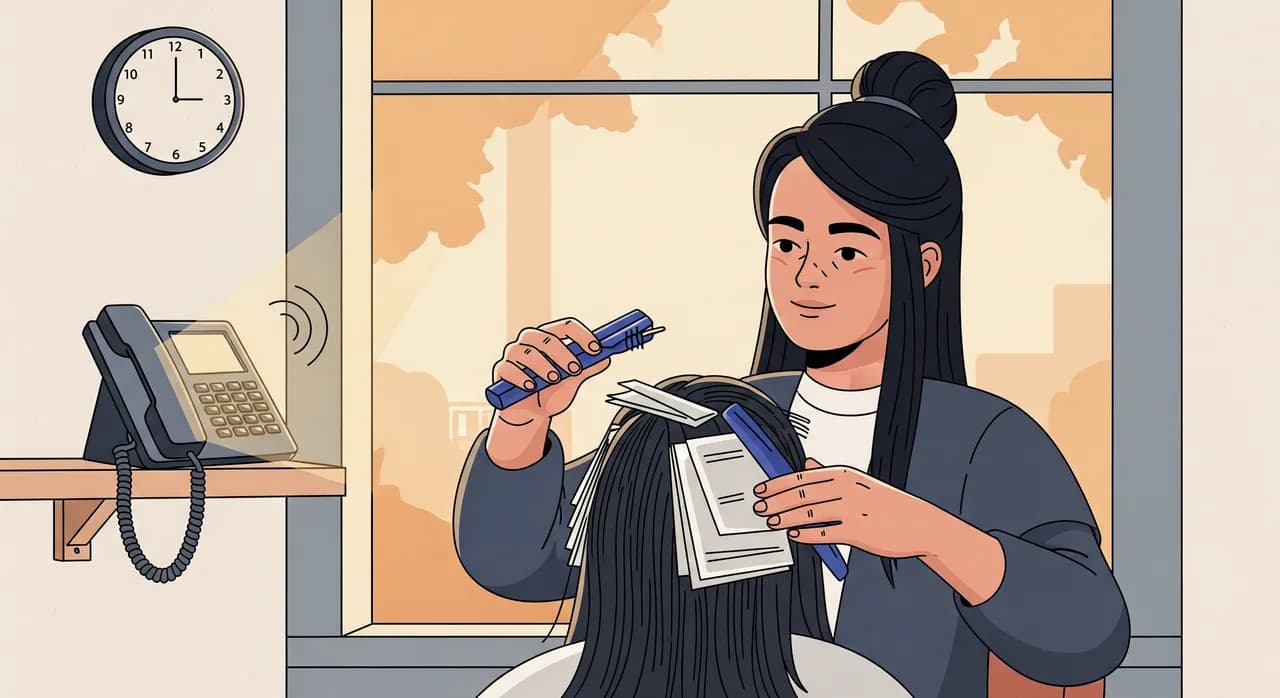
Meanwhile, a haircut or a colour is not a task you can pause. Once your hands are committed, they are committed for twenty, forty, ninety minutes at a stretch. You cannot answer a phone with foils in your fingers and gloves on. Even if you could reach it, you should not — walking a client's freshly-mixed colour to the counter to take a booking is how you end up with an uneven root and an unhappy chair. So the phone rings into an empty reception, three, four, five times, and then it stops.
8:45–10:00 — The warm-up, where you feel in control
You open up, sweep, switch on the water heater, check the book. Your first client is at 9:00 — a regular, a trim, forty-five minutes. The phone barely rings in this window, and when it does, you often catch it. This is the part of the day that fools owners into thinking the phone is manageable. It is manageable, at 9 a.m., because demand is low and your chair is only half-committed.
One call comes in at 9:20: someone asking if you do balayage and roughly how long it takes. You are mid-trim but it's a quick pause, so you answer. Good. That's the mental model you carry into the rest of the day — I answer my phone — and it's about to be tested.
10:00–11:45 — Load climbs, hands lock
By ten your 9 o'clock has become a 10 o'clock colour, and this one's a full head. Mixing, sectioning, applying — that's forty-five minutes where your hands genuinely cannot leave the client. The phone rings at 10:35. You hear it. You physically cannot go. It rings out. It rings again at 10:52; same story. Two calls, gone, and it's not even lunch.
Here's the part owners underestimate: the person who rang at 10:35 and got nothing did not leave a voicemail (almost nobody does anymore) and did not necessarily try again. They had a job to do — book a haircut — and your competitor two streets over answered on the second ring. The call didn't fail. The booking failed, and you'll never see it in your numbers because it never became a number.
“A missed call doesn't show up as a loss. It shows up as nothing — which is exactly why it's so easy to ignore.”
12:00–13:30 — The lunch rush, where the day is won or lost
This is the crunch. Not for your chair — for your phone. Everyone else's lunch break is your peak inbound window. Office workers, shift workers, parents on a school run gap: this is when they finally have a free hand to call and book a haircut. It is also, reliably, when you have a back-to-back double booked in to make the most of the midday demand, because that's what a smart owner does with a busy lunch slot.
So picture 12:40. You have one client under the dryer and another in the chair mid-cut. The phone rings. You glance at reception — nine feet away, might as well be nine miles. You keep cutting, because the client in front of you is real and paying and watching, and the caller is a maybe. The phone rings out. Ninety seconds later it rings again — a different number. Out again. Between noon and half-one you might take four, five, six calls into an empty room.
- 12:12 — new client wants a cut-and-blow for Saturday. Rings out. Books elsewhere.
- 12:40 — existing client needs to move her appointment. Rings out. She'll try later, maybe forget, maybe just not show.
- 12:55 — someone asking your prices for highlights. Rings out. Never rings back; price shoppers rarely do.
- 13:15 — a supplier, actually, which you'd have wanted to skip anyway — but you couldn't have known that without answering.
Notice the last one. Part of what makes the ringing phone so corrosive is that you can't triage it. Every ring might be a Saturday booking or it might be a robocall. The uncertainty taxes your attention even when you don't pick up. You're cutting hair and half-listening for the phone and slightly resenting both — which is a miserable way to spend the most valuable hour of your day.
13:30–15:00 — The false calm
The phone quietens after lunch. You take a breath, maybe eat something over the sink, catch two calls that come in and feel, again, like you've got this handled. This afternoon lull is deceptive. It's when you convince yourself the morning wasn't so bad — you did answer some calls, didn't you? — and it's why the pattern survives year after year. The good hour papers over the four bad ones.
If you want to feel the real shape of it, don't rely on memory. Memory keeps the calls you answered and quietly deletes the ones you didn't, because you were doing something else and never registered them. Pull the actual log.
The five-minute exercise: read your own call log
This is the most useful thing in this article, and it costs nothing. Open your phone's recent-calls list, or your business line's log, and do this for last week:
- 1Filter to incoming onlyIgnore your outbound calls. You're looking at demand, not your own effort.
- 2Mark every call you did not answerMissed, declined, or rang-out — count them all. Don't excuse any.
- 3Write the time next to eachJust the hour is enough. You're building a heat map, not an audit.
- 4Count how many landed between 11:30 and 14:00For most single-operator salons, this window alone holds a startling share of the week's missed calls.
- 5Ask what one booking is worthTake your average ticket. A full colour, a cut, a set of highlights. Now multiply by the misses you can't dismiss as spam.
You don't need fabricated industry statistics for this to land — your own log is the only evidence that matters. If you find, say, ten genuine missed customer calls in a week and even a third of them would have booked, that's three lost appointments. Do your own arithmetic on what three appointments a week is over a year. It is not a rounding error.
15:00–17:30 — The second peak nobody plans for
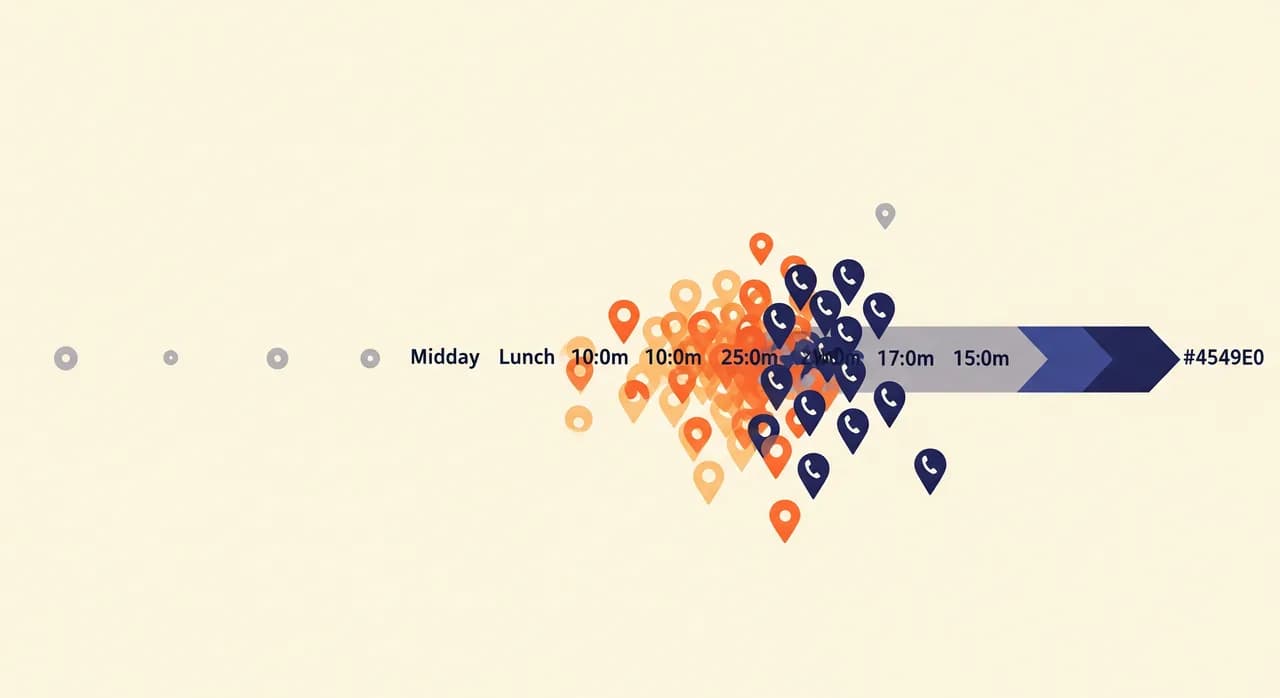
There's a second bump most owners never map: the school-run and end-of-workday window. Parents freed up at three, office workers calling on their way out at five, people booking the weekend now that they've survived the week. Your chair, meanwhile, is still full — you back-loaded the day to catch after-work clients, so your hands are busy again exactly as this second wave of callers arrives.
By now you're also tired, which matters. Attention for the phone is a resource, and it's lowest at the end of a full day. The 5 p.m. caller asking whether you can fit them in Friday gets the same empty room the 12:40 caller got — you're just less bothered about it by now, which is its own quiet problem.
17:30 onward — The overrated after-hours problem
Everyone talks about after-hours calls, and yes, they exist — the evening scroll, someone remembering they need a trim before a wedding. But for a daytime salon they're the minority. If you fix only your evenings and leave your lunch rush untouched, you've bailed a teacup while the sink overflows. The bulk of the money is leaking during the hours you're standing in the shop, working, unable to reach the phone. That's the counter-intuitive heart of it.
The fixes owners try — and why they only half-work
You've probably reached for one of these already. None are wrong, exactly. They just don't survive contact with the lunch rush.
- Voicemail. Honest but nearly useless — a modern caller who reaches voicemail hangs up and dials the next salon. You're not capturing them; you're politely waving them out the door.
- Online booking only. Great for the tech-comfortable, but a large slice of salon clients still want to talk to a person, ask a question, negotiate a time. And it does nothing for the caller who wants to move an existing appointment.
- A part-timer on reception. This genuinely works — if you can afford a second wage and can keep them busy enough to justify it. For a single-chair salon the maths rarely closes.
- Calling everyone back at day's end. Noble, exhausting, and too late. By 6 p.m. the lunch-rush callers are unreachable and half have booked elsewhere.
The common flaw is that all of them assume the problem is after the miss. But the miss already cost you the booking. What you actually need is something that answers at the moment of the ring, during service, without your hands.
“You don't need a way to call people back faster. You need the phone to stop going unanswered in the first place.”
What answering-during-service actually looks like
This is where an AI phone assistant earns its place — not as a gimmick, but as a way to make the ring-during-service problem simply stop existing. The idea is plain: when you can't pick up, something picks up for you, in a natural voice, and handles the call the way a good receptionist would.
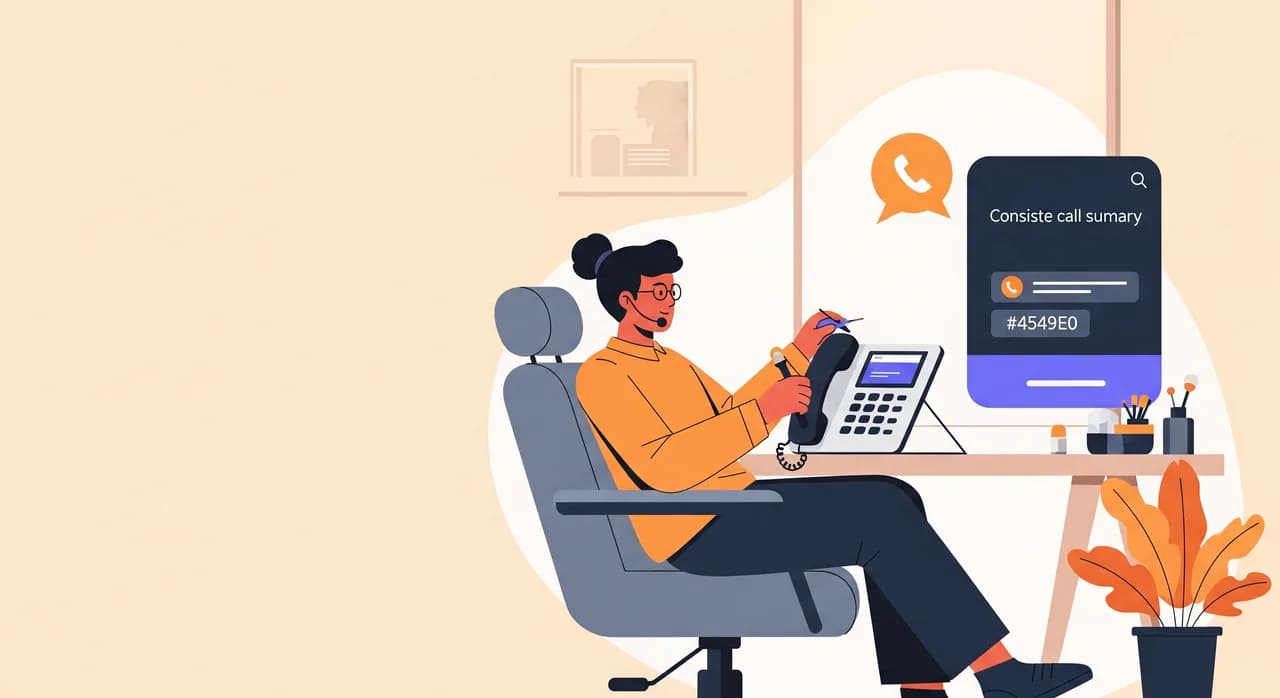
Concretely, for the 12:40 caller who wanted a cut-and-blow for Saturday: instead of ringing into an empty room, they're greeted, asked what they need, told your Saturday availability from the profile you set up, and either booked or taken as a message that lands on your phone with a full summary the second your hands are free. The caller got an answer. The maybe became a booking. And you never broke your parting line.
With Vunoon specifically, you describe your salon once in a short setup wizard — services, hours, rough prices, the questions you get asked twenty times a day — then test it by literally talking to it before it ever touches a real caller. When you're happy, you forward your number so it only answers the calls you'd have missed anyway. Every call it handles arrives as a summary and transcript, so you're never in the dark about who rang and why.
What actually changes on the floor
The point isn't the technology; it's the change in your day. Three things shift, and they're all felt rather than measured.
- The lunch rush stops taxing your attention. You cut hair without half-listening for the phone, because you know it's being answered. That focus is worth something on its own.
- Callbacks stop decaying. The caller got their answer live, so there's nothing rotting on your screen at 6 p.m. — or the summary is sitting there ready, with a real reason and a real number, easy to close.
- You stop losing bookings you never knew you had. The invisible losses — the ones that never became numbers — start becoming numbers again.
None of this requires you to become a 'phone person' or to hire before you can afford to. It just closes the specific gap this whole article is about: the collision between busy hands and a ringing phone during the exact hours you make your living.
Common questions from salon owners
Aren't most of my missed calls after hours anyway?
Why can't I just call people back later?
Won't callers be annoyed to reach an AI instead of me?
I already have online booking. Do I still miss calls?
How much setup does this take when I'm already stretched?
See it handle your lunch rush
Describe your salon in a few minutes, test it by talking to it, and let it answer the calls you're losing between the foils and the dryer. There's a free trial to try it on a real busy day.
Set up your salon assistant
Vunoon builds an AI phone assistant that answers your business calls 24/7 — it books appointments, answers common questions and sends you a summary of every conversation.